.svg&w=384&q=75 "Naijagoal logo")

Inter's Dominance Over Udinese: A 5-3 Showdown
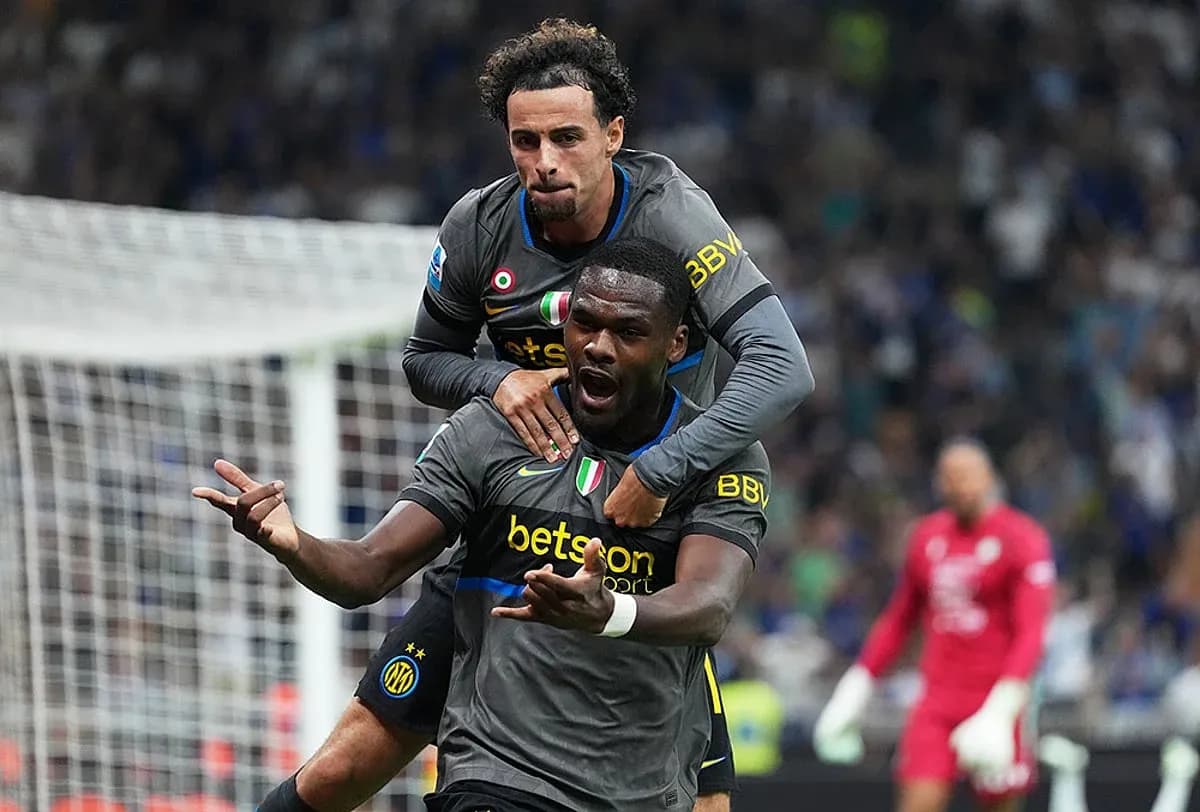
Under the San Siro lights, this was supposed to be a litmus test of early‑season identities. Inter arrived as a ruthless, free‑scoring machine; Udinese as a chaotic, dangerous counter‑puncher. A 5‑3 scoreline in favour of Inter felt less like a surprise and more like an inevitable expression of both teams’ seasonal DNA.
I. The Big Picture – Form, Table and Structural Identities
Following this result, Inter’s perfect start continues to define the narrative. In total this campaign they have 4 wins from 4, and the table snapshot already underlined their authority: 2nd place, 12 points, with a goal difference of +7 built from 13 goals for and 6 against. At home they have been ferocious, with 12 goals scored and 6 conceded across 3 matches, an average of 4.0 goals for and 2.0 against per home game. This is a side built to overwhelm rather than simply edge contests.
Udinese, by contrast, came into San Siro in 13th place with 4 points from 4 matches, their overall goal difference at -2 (8 scored, 10 conceded). On their travels they are volatile: 1 win and 1 defeat, with 6 goals scored and 7 conceded away from home, an away average of 3.0 goals for and 3.5 against. They do not keep clean sheets – in total this campaign they have 0 – but they rarely die quietly.
Tactically, the formations told their own story. Cristian Chivu stayed loyal to Inter’s 3‑5‑2, with J. Martinez behind a back three of M. Akanji, J. Stones and A. Bastoni. The wing‑half roles were entrusted to A. Diouf and Carlos Augusto, with N. Barella, P. Zielinski and H. Mkhitaryan forming a technically rich interior triangle. Up front, M. Thuram partnered the emerging F. Esposito.
Kosta Runjaic mirrored the back three with a 3‑4‑2‑1, but with a different intention. M. Okoye marshalled a line of J. Abankwah, C. Kabasele and E. Ebosse. The wide lanes were owned by M. Vojvoda and H. Kamara, with J. Karlstrom and L. Miller central. Ahead of them, U. Gomez and J. Ekkelenkamp floated behind K. Davis, a narrow band designed to spring forward in transition.
II. Tactical Voids – Absences and Discipline
Both coaches had to navigate significant absences that reshaped their midfields. Inter were without H. Calhanoglu, missing with a muscle injury, and D. Spence, also sidelined. The absence of Calhanoglu’s metronomic passing forced Chivu to redistribute creative duties: P. Zielinski became the primary deep playmaker, while H. Mkhitaryan dropped into pockets to link play rather than constantly arrive in the box.
Udinese’s list was longer and more structurally disruptive. J. Arizala (thigh injury), M. Palma (muscle injury), J. Piotrowski (heart problems), O. Solet (injury), N. Zaniolo (thigh injury) and A. Zanoli (knee injury) were all ruled out. The loss of Piotrowski, a midfielder who in total this campaign had combined 1 goal with assertive defensive numbers and 2 yellow cards, stripped Runjaic of a natural enforcer. Without him, Karlstrom and Miller were asked to both screen and build, a dual role that proved too heavy against Inter’s five‑man midfield.
The disciplinary profiles of the teams hinted at the emotional tone. Inter’s yellow cards are spread, with a noticeable 40.00% of their cautions arriving between 46‑60 minutes – a sign of an aggressive restart after half‑time. Udinese’s bookings are more evenly scattered, but they already carry cards in every segment up to 90', including 22.22% in each of the 16‑30 and 31‑45 ranges. This is a side that lives on the edge in the middle of halves, and against Inter’s surges that edge looked like a fault line.
III. Key Matchups – Hunter vs Shield, Engine Room Battles
The “Hunter vs Shield” duel was most vividly embodied by F. Esposito and M. Thuram against Udinese’s back three and M. Okoye. Esposito’s season profile – 2 goals and 1 assist in total, from 9 shots (5 on target) and 4 key passes – already painted him as a modern penalty‑box forward who can both finish and combine. Thuram, with 2 goals, 1 assist and a sparkling 7.57 rating in total, brings verticality and link play, winning 11 of 18 duels and completing all of his dribbles so far.
They attacked a Udinese defence that, on their travels, had already conceded 7 goals in 2 games. C. Kabasele was asked to marshal the line while also stepping out to meet Thuram between the lines; that left channels for Esposito to attack, especially when Diouf or Carlos Augusto overloaded the flanks.
In midfield, the “Engine Room” confrontation was decisive. For Inter, A. Diouf has emerged as one of Serie A’s most influential early‑season creators: in total this campaign he has 3 assists, 13 key passes and a passing accuracy of 91%. His role as the right‑sided hybrid between wing‑back and interior midfielder allowed Inter to tilt the pitch, repeatedly isolating Kamara and Vojvoda.
Udinese’s response came through H. Kamara and J. Ekkelenkamp. Kamara’s all‑action profile – 2 goals, 1 assist, 12 tackles and 1 blocked shot in total – makes him both their most reliable ball‑winner and a dangerous runner. Ekkelenkamp, with 2 goals, 1 assist and 6 shots (4 on target) in total, is the late‑arriving threat. But without Piotrowski’s bite and with Karlstrom pinned deeper, Udinese’s engine room often found itself chasing shadows as Barella and Mkhitaryan rotated into half‑spaces.
IV. Statistical Prognosis – Why the Game Tilted
Even before kick‑off, the numbers pointed towards a high‑event match. In total this campaign Inter average 3.3 goals scored and 1.5 conceded per game; Udinese average 2.0 scored and 2.5 conceded. Overlay those profiles and a multi‑goal affair becomes almost probabilistic.
Inter’s lack of clean sheets at home (0 so far) and Udinese’s total absence of clean sheets, home or away, meant that both J. Martinez and M. Okoye were likely to be worked. The first‑half 2‑2 scoreline reflected that mutual vulnerability, but the deeper squads and more coherent structure told in the second period. Inter’s 3‑5‑2, played in all 4 league matches, is a settled platform; Udinese’s 3‑4‑2‑1 is likewise consistent, but the personnel absences in key central roles made their version brittle.
From a predictive, xG‑style lens – even without explicit xG values – Inter’s volume of shots, creative hubs (Diouf, Zielinski, Mkhitaryan) and dual‑threat forward line justify a heavy expected share of quality chances, especially at home where they already have a biggest win of 4‑1 and a ceiling of 5 goals in a single match. Udinese’s away profile, including a 5‑3 defeat and a 2‑3 win as their biggest away loss and win, underlines that when they open up, they do so completely.
Following this result, the trajectories diverge further. Inter look every inch like a Champions League‑bound powerhouse, their attacking structure resilient even without Calhanoglu. Udinese, for all their bravery and offensive flashes through Kamara, Ekkelenkamp and Davis, remain a side whose attacking promise is constantly undermined by defensive exposure – particularly on their travels, where conceding 7 goals in 2 matches has become a defining, and dangerous, pattern.