.svg&w=384&q=75 "Naijagoal logo")
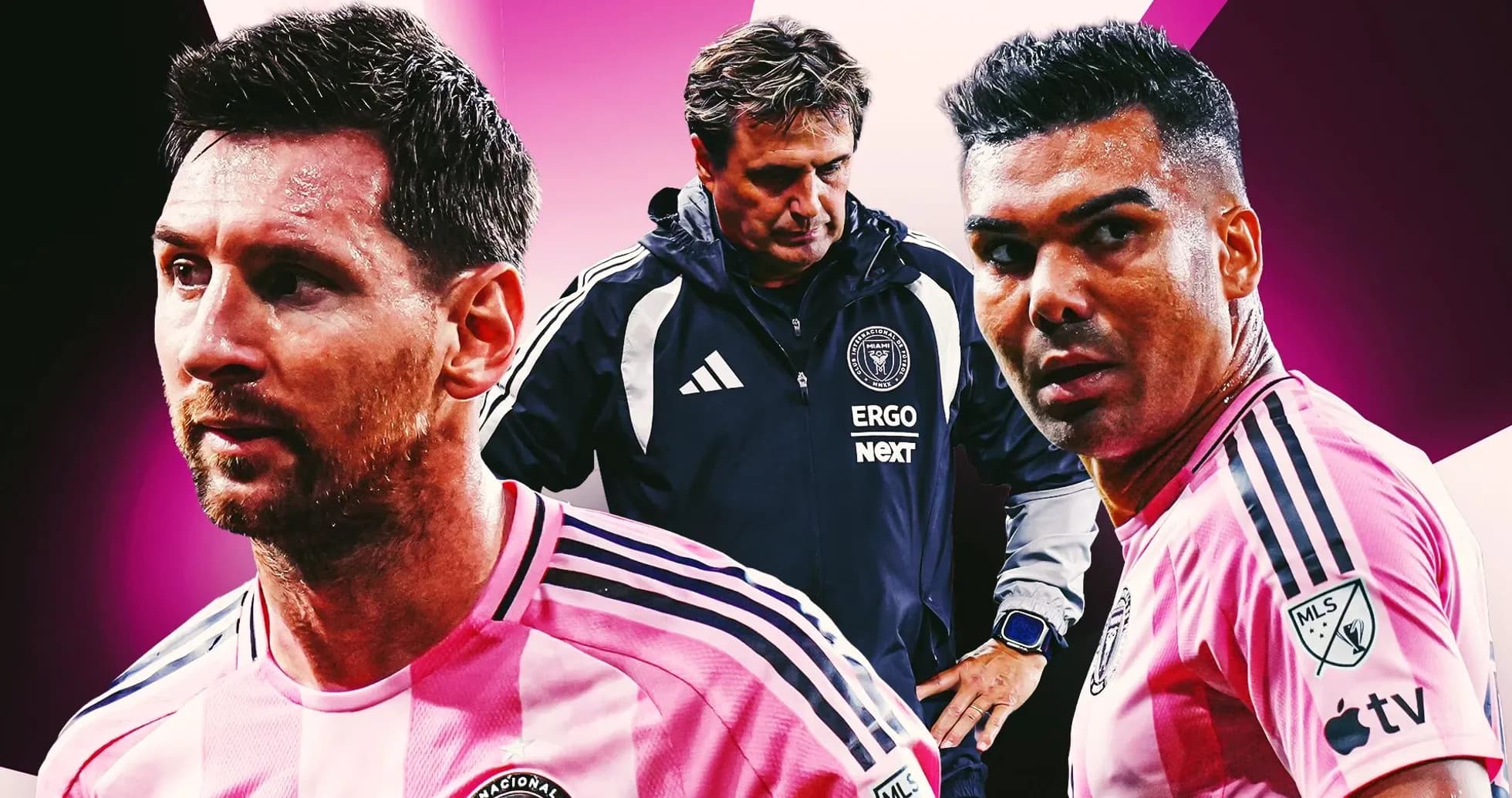

Inter Miami's Struggles Without Messi: A Team in Crisis
Nashville rip them apart, 4-1, and the scoreline still feels kind.
Inter Miami had the ball. They just didn’t have a team. They monopolized possession in Tennessee, yet every time Nashville broke, the Herons split open like a side with no plan, no legs and no protection.
Hany Mukhtar, one of MLS’ sharpest No.10s, didn’t just exploit the gaps. He humiliated them. Two goals, constant menace, the kind of performance that exposes a fragile structure as much as any tactical breakdown ever could. Sam Surridge joined the fun with another, Andy Najar stormed forward from right back to add a fourth, and Miami’s “shape” became more of an abstract concept than an actual defensive unit.
Eddi Tagseth and Matthew Corcoran ran riot in central midfield, repeatedly surging into the acres of space Miami left between the lines. It was a long, painful night for a team that wants to be a global spectacle but currently looks like a mid-table playoff hopeful held together by one man.
A one-man superclub
Strip away the branding, the pink shirts, the celebrity ownership and the Messi mania, and the reality is blunt: Miami are not a particularly good soccer team. They are a Messi team.
Keep Lionel Messi quiet, or at least limit his influence, and the whole thing collapses. Nashville did it. Others are taking notes.
Messi doesn’t defend. He never has, and at 37, he never will. Luis Suárez, 39 and still straining every sinew, simply can’t cover ground anymore. Rodrigo De Paul sprints and snarls on the right of midfield, but he’s trying to plug holes that keep opening behind him. Casemiro, the post-World Cup marquee signing, moves through games as if he’s wading through mud.
Then there’s the drop-off at left back. Jordi Alba’s decline was always going to come, but going from him to Sergio Reguilón, who hasn’t played regular soccer since 2022, has been brutally stark. The back line has no protection, the midfield has no legs, and there is no tactical magic trick that can disguise those flaws.
At best, this looks like an average playoff team. What drags them above that line is Messi. Only Messi.
Built to please, not to last
Could this be fixed? On paper, yes. Any competent sporting department can look at this squad and see where it’s creaking. Miami, under tight salary rules, have already proved they can contort the cap, bend the mechanisms, and pull off big-name deals that infuriate rival fanbases.
The needs are obvious: energy in attack, dynamism in central midfield, players who can run as well as they can play. Elite central midfielders are scarce and rarely choose MLS in their prime, but there was a world where N’Golo Kanté, for example, might have been the one arriving instead of Casemiro.
Instead, Miami spent around $15 million on German Berterame, a forward who doesn’t excel in any one defining area. Benjamin Cremaschi, one of the few obvious young, energetic midfielders in the squad, grew frustrated enough under Javier Mascherano to admit publicly he felt misused. With more care, he might have been the kind of homegrown pillar this team so clearly lacks.
The deeper issue runs through almost every major decision: Messi’s influence. This goes back to 2023, when Sergio Busquets and Alba arrived in moves widely understood as part of the package to lure Messi. De Paul has openly said his move was driven by a desire to play with Messi and stay sharp for Argentina, having reportedly trained extra with him before the World Cup while still at Atletico Madrid.
Even Casemiro, once Messi’s great rival in the Real Madrid-Barcelona wars, framed his Miami switch around the No.10.
“For me, without a doubt, I am coming only to play with the best player of all time,” he said at his introductory press conference. “I want to enjoy, I want to help him to keep winning because he is a winner. Another player is joining who wants to win, who wants to compete.”
Whether Messi personally places the calls or simply nods at the targets is almost irrelevant. The outcome is the same: this is a squad constructed to keep him happy. Not to survive without him.
A looming calendar change, and a bigger question
All of this unfolds at a strange moment for MLS. The league is preparing to flip to a fall-spring calendar in 2027-28, a shift that will drop clubs into the heart of the European transfer market. Owners have already heard proposals for looser salary rules and more spending freedom. This is the phase when teams can decide whether they want to be serious players in the global game or just dabble.
Miami’s timeline is locked to Messi’s contract. Officially, he’s tied down through the end of the 2028 season. That covers next year’s shortened “sprint season” and the first full fall-spring campaign. On paper, they have an abbreviated year, one full season and the remainder of this one with their main man.
But if he walks earlier, say at the end of this year, the outlook darkens fast.
Miami would be left with expensive Designated Players that don’t quite fit any coherent post-Messi model. De Paul is on DP money through 2029. Berterame is, too. Casemiro does not currently occupy a DP slot, but Miami have already shown their willingness to structure deals creatively, as they did with De Paul, starting him on smaller money before bumping up his terms. That kind of flexibility could be used again.
In a Messi-less world, that might be the worst possible scenario: a roster full of costly names, none capable of carrying the sporting and commercial burden he shoulders alone.
The impossible succession
What Miami truly need is not just another elite player. They need a new face of the franchise, someone who can anchor the project on the field and sell it off it.
Julian Alvarez is the dream. He won’t replicate Messi’s box-office gravity — nobody can — but he ticks every other box: age, quality, work rate, Argentine roots, marketability. He is the one name that looks like a genuine succession plan rather than a stopgap.
Reality bites hard, though. Atletico Madrid paid an initial €75 million, plus up to €20m in add-ons, to take him from Manchester City in 2024. This summer, they reportedly turned down a €150m offer from Real Madrid. For Miami, that means a transfer fee far beyond anything MLS has ever seen, before they even start talking about wages.
Beyond Alvarez, the options thin out quickly. If that level of spending is simply impossible, the logical pivot would be an American star.
Christian Pulisic and Weston McKennie are the only two that truly make sense. Pulisic is the most recognizable active American player, the face of the USMNT generation. McKennie brings quality, personality, and a profile that would resonate across the U.S. Both could be central figures in a new-look Inter Miami.
Neither, though, can replace the gravitational pull of Messi. They can help build the next version of this club; they cannot be the sole axis around which it spins.
A club chained to its icon
That’s the crux. Miami are tied to Messi not only as a footballer but as a business model.
His presence underpins sponsorship deals, ticket demand, and global relevance. A stand at Nu Stadium carries his name. His compensation reportedly includes ownership shares. This is not just about what happens between the white lines. Messi is the foundation of the entire project.
And there is still no clear plan for what happens when that foundation is gone.
Before he arrived, Miami were among the worst teams in MLS. They had tried the big-name route with Blaise Matuidi and Gonzalo Higuaín, but neither shifted the club’s trajectory. Attendance sat in the bottom third of the league. By July 2023, when Messi finally walked through the door, Miami were effectively out of the playoff race, trophyless, with Phil Neville already sacked and a roster riddled with holes.
The fear is obvious: once Messi goes, they slide right back into that version of themselves.
The transition is coming, whether in a year or in four. It will be brutal. The club has built almost everything — sporting identity, commercial strategy, global brand — around one player. And that player, naturally, controls when his time in Miami ends.
For now, the Herons cling to the hope that Messi has one more Herculean run in him, one more stretch where he drags an incomplete side to another trophy. But nights like the 4-1 capitulation in Nashville suggest the task is growing heavier by the week.
So the image lingers: Messi disappearing down the tunnel after another frustrating defeat, the rest of the squad trailing behind. The question for Miami is no longer just what he can still do for them.
It’s what will be left when he walks down that tunnel for the last time.