.svg&w=384&q=75 "Naijagoal logo")

Infantino’s $20 Billion Gamble on World Cup Funding
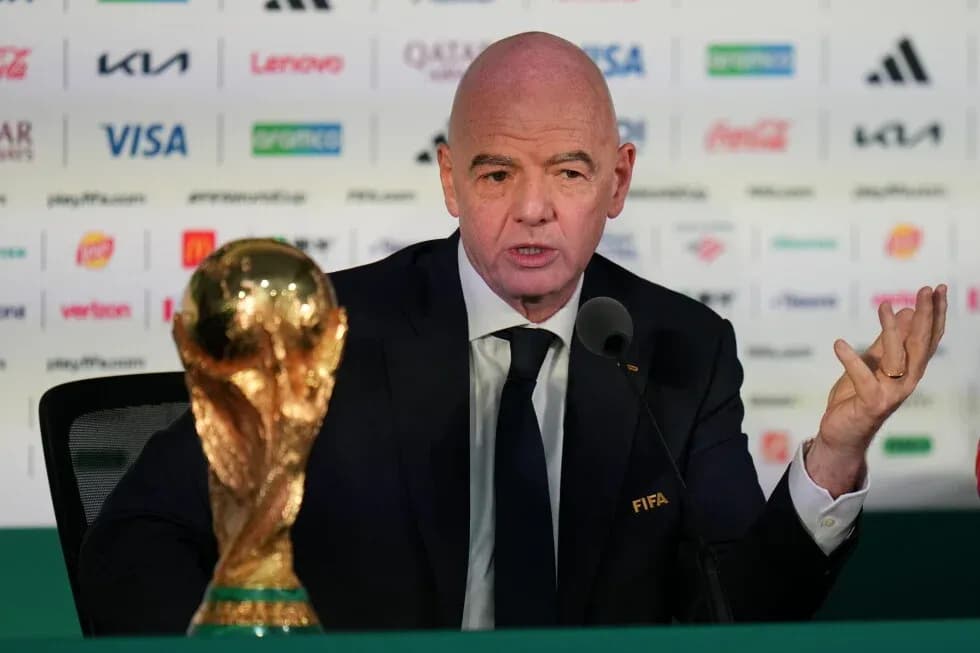
Gianni Infantino has put a price on the World Cup. Now he wants the world’s game to sign on the dotted line — fast.
On Wednesday in Geneva, the FIFA president gave all 211 member federations a stark choice and a hard deadline: accept a one-off $20 million payment each by Sept. 19 as part of a plan to sell a stake in FIFA’s crown jewels to private investors, or walk away with roughly half that amount over the next four years.
At the heart of the proposal is a new $20 billion FIFA subsidiary, tentatively called FIFA Forward Enterprise, that would run the organization’s competitions and events — World Cups, Club World Cups and more — with 20% of it sold to outside investors. The anchor backer: Thrive Capital, the investment firm founded by Joshua Kushner, brother of Jared Kushner.
Infantino calls it a “singular and unique funding opportunity.” Across world football, it is being called something else entirely.
UEFA Leads the Revolt
The backlash has been fierce and immediate. UEFA, already long at odds with Infantino’s expansionist vision, moved to convene an emergency online meeting of its 55 member federations, likely on Thursday.
“Having held discussions with many stakeholders across the game, UEFA knows there is significant and growing opposition to FIFA’s scheme,” the European body said in a statement.
Its anger goes beyond the numbers. UEFA’s message is blunt: the World Cup “is not FIFA’s to sell.” The suggestion is clear — FIFA is the guardian of the tournament, not its owner in a commercial sense, and any attempt to carve it up for private equity money crosses a red line.
The European confederation has a weapon it has used before. In 2021, UEFA-led resistance and the threat of a boycott helped derail Infantino’s push to stage the men’s World Cup every two years. That option is again on the table: refusing to play in FIFA competitions if the World Cup is turned into an asset class.
UEFA’s fury sharpened around the timeline. The rush to secure signatures, it said, “says everything you need to know about this plan. FIFA cannot continue to use our sport to enrich themselves and their friends.”
Global Shockwaves, Limited Consultation
This is not just a European revolt. The plan, kept under wraps until this week, caught other confederations cold.
CONCACAF, which governs North and Central America and the Caribbean, did not hide its unease. “We are deeply concerned by the lack of due process,” it said. In Asia, the AFC lamented that such a “matter of such significance” reached the public domain before its own members had the chance to even discuss it.
Clubs are equally blindsided. The European Football Clubs group, which co-manages the Champions League with UEFA, said it learned of the proposal “in the same way as most global football stakeholders — without warning and through the media.”
The pattern is familiar. During Infantino’s 11-year presidency, major strategic moves have often appeared fully formed, with limited consultation. From the ill-fated $25 billion private equity plan in 2018 for new men’s competitions, to the creation of a FIFA Peace Prize — awarded to Donald Trump at the World Cup draw in December — the president has repeatedly tested how far he can push the game’s structures.
Now he is testing them again, on a scale never seen before.
The Offer: Cash Now, Control Later
On paper, the offer looks irresistible for many federations. If the plan is approved by a simple majority of the 211 members, each association would receive $20 million from the four-year commercial cycle linked to the 2030 men’s World Cup.
Reject it, and they get $10 million over the same period, in line with existing commitments.
Over 12 years, Infantino’s letter suggests, the difference is stark: around $86 million per federation under the new private equity model, compared to about $36 million if they turn it down.
For dozens of national associations, this is not abstract. Many rely heavily on FIFA funding to run their operations. Their national teams rarely qualify for World Cups. Their best players seldom reach the elite club level. The promise of a sudden, transformative cash injection could mean stadiums built, pitches laid, and staff paid.
And this is where FIFA’s voting structure matters. One member, one vote. Germany and Gibraltar carry the same weight. Brazil and Bhutan are equal in the ballot box. The richest and most powerful football nations can easily be outvoted by a bloc of smaller, poorer federations with far more to gain from a short-term financial windfall.
Behind the scenes, Thrive Capital would not be alone. Infantino’s letter speaks of “a pool of diverse international investors” joining Kushner’s firm, with J.P. Morgan leading the process. For those investors, more frequent and larger World Cups and Club World Cups — for both men and women — would be the obvious way to drive up value.
That is exactly what alarms the continental bodies that run their own showpiece tournaments: the Champions League, European Championship, Copa America, and others. More FIFA events, with more teams and more dates, would crowd the calendar and threaten the prestige and revenue of existing competitions.
Football, For Sale?
The optics of the deal are explosive. Infantino’s proposal again places him close to figures in the orbit of former U.S. President Donald Trump. The FIFA Peace Prize. Trump’s intervention in the process that led to United States forward Folarin Balogun playing at the World Cup. Now a 12-year ownership tie-up with Joshua Kushner’s firm.
Sports governance expert Antoine Duval raised a different concern: what private equity ownership could do to the World Cup itself. With investors chasing returns, he suggested, FIFA would be incentivized “to further commodify the World Cup (think more hydration breaks and dynamic pricing) in a drive to increase its revenue.”
The fear is not just more matches. It is a slow erosion of what makes the tournament feel special — the rhythm of the games, the balance between spectacle and sport, even the experience for fans in the stadium and at home.
Political Fire in Britain
Resistance has also erupted in Britain, where football politics and national politics often collide.
Prime Minister Andy Burnham, a declared football devotee, came out swinging. His government is preparing to back a joint bid by England, Scotland, Wales and Ireland to host the 2035 Women’s World Cup, a bid FIFA is expected to confirm at an online meeting in November.
“Football does not belong to investors,” Burnham said in a video message on Instagram. “Once you have sold a piece of (the World Cup), you have sold out. Football belongs to the fans. It always has, and it always will.”
British lawmakers have form in this arena. In 2021, threats of legislation by then-Prime Minister Boris Johnson helped kill off the European Super League, a breakaway that would have torn at the heart of UEFA’s Champions League and which Infantino had discreetly supported. J.P. Morgan, now set to lead the investor process for FIFA’s new venture, was also the bank behind the Super League’s financing.
The political message from London is unmistakable: if FIFA pushes too far, governments may step in again.
Infantino’s Power Play and Future
For Infantino, this is more than a financial project. It may also be about his own future.
He has appeared on course to be re-elected unopposed as FIFA president for a fourth and final term, running through 2031. His rise and his grip on power have been underpinned by one consistent promise: more money for member federations. It was central to his election speech in 2016, and to his uncontested re-elections in 2019 and 2023.
Some within the game have long suspected he is eyeing a role beyond the presidency — something closer to a CEO or commissioner position, particularly if a powerful new subsidiary such as FFE is created to control competitions and commercial rights. A long-term executive seat there would keep him at the center of world football even after his presidential term ends.
This week’s move, though, has blown open frustrations that extend beyond the usual critics in Europe. Federations across confederations now have almost four months to decide whether to challenge him.
The deadline to register as a candidate for the FIFA presidency is Nov. 18. The election is scheduled for March 18 in Rabat, Morocco — a key Infantino ally and co-host of the 2030 World Cup.
By then, the sport will know whether its leaders chose $20 million now and a new era of private equity in the World Cup, or whether they drew a line and forced a rethink.
The question hanging over every federation today is brutally simple: how much of football’s soul is worth selling, and who gets to decide?