.svg&w=384&q=75 "Naijagoal logo")

Ibrahim Mbaye: Senegal's Young Star Shines at FIFA World Cup
There is a version of 16 June 2026 that disappears as soon as the final whistle blows.
France 3, Senegal 0, MetLife Stadium drifting towards closure, the noise thinning out with the clock. Didier Deschamps’ side are cruising, the world champions in all but name, and Aliou Cissé turns to a teenager on his bench. On paper, it looks like a concession to the moment, a change made for the future, not the present.
Ibrahim Mbaye refuses to play that role.
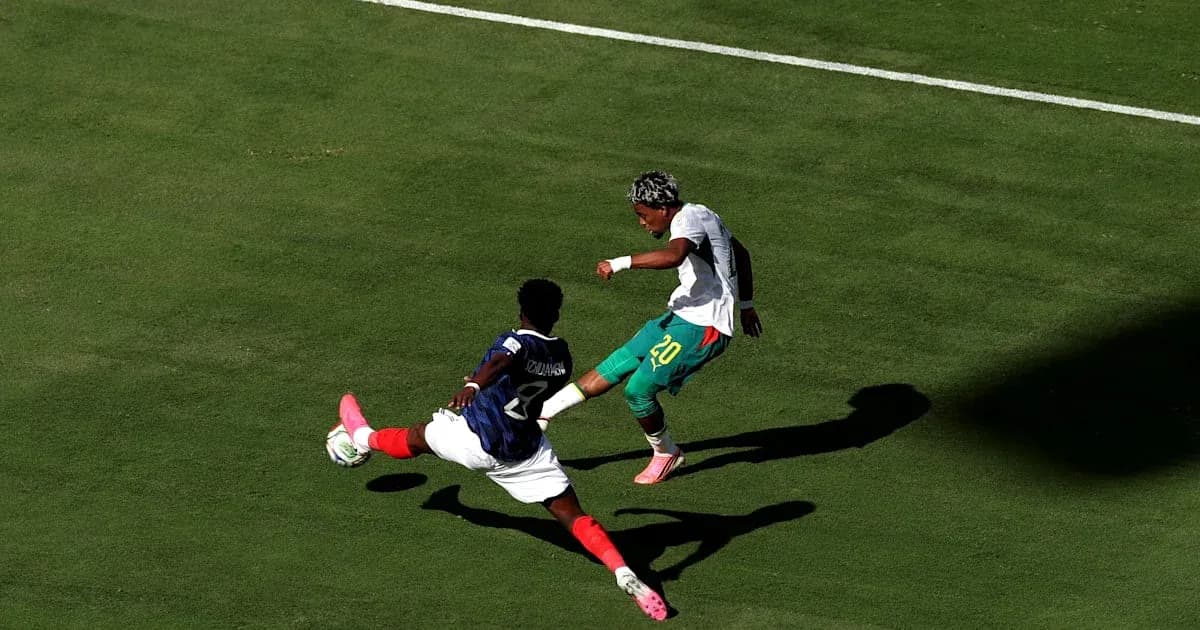
He steps on to the right flank as if the scoreline is still goalless. He demands the ball, faces up Théo Hernandez, and with a feint and a roll of his right foot, sends one of Europe’s most explosive full-backs the wrong way. The space opens for a heartbeat. Mbaye doesn’t blink. He lashes a low shot past Mike Maignan and into the far corner.
Stoppage time. Minute 95. France 3, Senegal 1.
On the night, it is a consolation. In the record books, it is a detonation.
At 18 years and 143 days, Mbaye becomes the youngest African ever to score at a FIFA World Cup, taking a record from another Senegalese full-back, Moussa Wagué, set in 2018. Look wider and the company gets rarer: only Pelé, Mexico’s Manuel Rosas, Spain’s Gavi and Lamine Yamal have scored younger on this stage.
C’est du sérieux. And the truth is, Mbaye has been operating in serious territory for a long time.
Books, then Ballon d’Or dreams
Rewind ten months. Paris Saint-Germain are heading south for a Ligue 1 date in Marseille. The squad boards the plane. One of the club’s brightest prospects is not with them.
Mbaye, then 17, is sitting his baccalauréat, the exam that marks the passage to adulthood in France. While his team-mates stretch and sleep, he is working through equations and essays. PSG arrange a separate journey. He joins up in time for the 8pm kick-off, his warm-up more algebra than rondos.
For most players, that story would be a career-defining anecdote. For Mbaye, it is just another day on the schedule.
At PSG’s academy, the school desk carries as much weight as the tactics board. The production line that has already delivered Warren Zaïre-Emery and Senny Mayulu runs on a simple belief: academic discipline and football intelligence are the same muscle. Director Yohan Cabaye can point to a 95 per cent baccalauréat pass rate among the club’s youngsters as proof.
In Mbaye, that philosophy has its poster boy. The nutmeg on Hernandez and the finish past Maignan are not flashes of street improvisation. They are a problem solved in real time, the same calm logic that gets you through an exam hall and a 95th-minute World Cup chance without your pulse spiking.
He treats both arenas the same way: read the situation, make the right choice, execute.
Trappes, three passports, one decision
Mbaye’s story starts in Trappes, a Paris suburb that already sits on the game’s map thanks to Nicolas Anelka. His father is Senegalese, his mother Moroccan, and his football education has been painted in blue: France’s youth teams at every step, a talent so obvious that few inside the French federation seriously imagined he would ever slip away.
Then came November 2025.
Mbaye chose Senegal. No pressure, no ultimatum, no political manoeuvring. His call, his shirt.
“I will never regret choosing to play for Senegal because it was a decision from the heart,” he told Senegalese broadcaster RTS after lifting the Africa Cup of Nations trophy in January, a teenager carrying himself among veterans twice his age. Months later, reflecting again, he sharpened the point: “If only you knew… it’s the best decision I’ve ever made in my life. The Senegalese have such huge hearts; it’s incredible.”
That is why the France game cut so deep. A boy raised in the Paris suburbs, polished in the country’s most storied academy, scoring his first World Cup goal against the nation that formed him — but wrapped in Senegal green.
Quelle histoire. A script neat enough that, in any other context, you would dismiss it as fantasy.
A career that refuses to wait
Look at the numbers and the pattern is obvious: Mbaye does not queue. He walks straight to the front.
He makes his Ligue 1 debut at 16 years, six months and 23 days, becoming PSG’s youngest-ever league starter, taking a record from Zaïre-Emery. He signs his first professional contract in February 2025, scores his first senior goal a few weeks later, and by August is on the pitch in a UEFA Super Cup, the youngest Frenchman ever to do so, surpassing a mark set by Ryan Giggs back in 1987.
In May 2026, with PSG chasing yet another title, he appears again at the decisive moment. Stoppage time away at Lens, the tension thick, the margin fine. Mbaye steps up and scores the goal that seals PSG’s 14th Ligue 1 crown.
Senegal’s timeline is just as compressed. A debut against Brazil in November 2025. A first international goal three days later, on his second cap. By December, he is the youngest player ever to feature at the Africa Cup of Nations. In January, he breaks his own record as Senegal’s youngest AFCON goalscorer, part of a run that ends with the trophy in his hands before CAF later rules to award the victory to Morocco.
The administrative twist does not touch his numbers. Four goals in 12 caps before his 19th birthday. The comparisons with Kylian Mbappé do not feel forced; they feel like the natural language of a sport that recognises a familiar kind of acceleration.
Ask those who work with him, though, and they do not start with pace or step-overs. They talk about decisions. When to carry. When to pass. When to slow the game down and when to rip through it. That sense of timing, of choosing the right action at the right second, belongs to a player with far more miles in his legs.
Mbaye does not need 20 touches to leave a mark. He often needs just one.
“Mbaye is world class, and he is ours, he did not choose France – he chose Gaindeyi,” Senegalese journalist Wahany Johnson Sambou told Olympics.com in January, invoking the Wolof nickname for the national team. “He’ll do great things, just watch.”
The evidence keeps stacking up.
Dakar, Los Angeles and the Olympic horizon
Senegal’s story in Olympic football still feels like a prologue. One men’s tournament appearance, at London 2012, was enough to launch Sadio Mané, Idrissa Gueye and Cheikhou Kouyaté into wider view, but the country has not been back since.
That may be about to change.
This October, Dakar hosts the Youth Olympic Games, pulling the Olympic spotlight onto Senegalese soil. It arrives at a moment when the senior side has an AFCON title in its hands — however the paperwork later reads — and a new generation snapping at the heels of the established stars.
Mbaye, born in January 2008, will be 20 when the football tournament kicks off at LA 2028, perfectly placed for an Under-23 competition that has previously paraded Lionel Messi, Neymar and Mohamed Salah. His name is already circulating in Olympic circles; he has been highlighted among Africa’s brightest prospects for those Games, and the logic is obvious.
It is not just the medals or the records that make the idea so compelling. It is his temperament. The same composure that allowed him to sit a crucial exam while his team flew to Marseille, then join them and perform. The same clarity that cut through the chaos of a World Cup opener against France in minute 95.
He keeps arriving at moments that are supposed to belong to older men and treating them like just another assignment.
For now, Ibrahim Mbaye continues as he always has: quietly ahead of schedule, forcing football’s calendar to bend around him. The rest of the world can either keep up — or keep looking over its shoulder.