.svg&w=384&q=75 "Naijagoal logo")
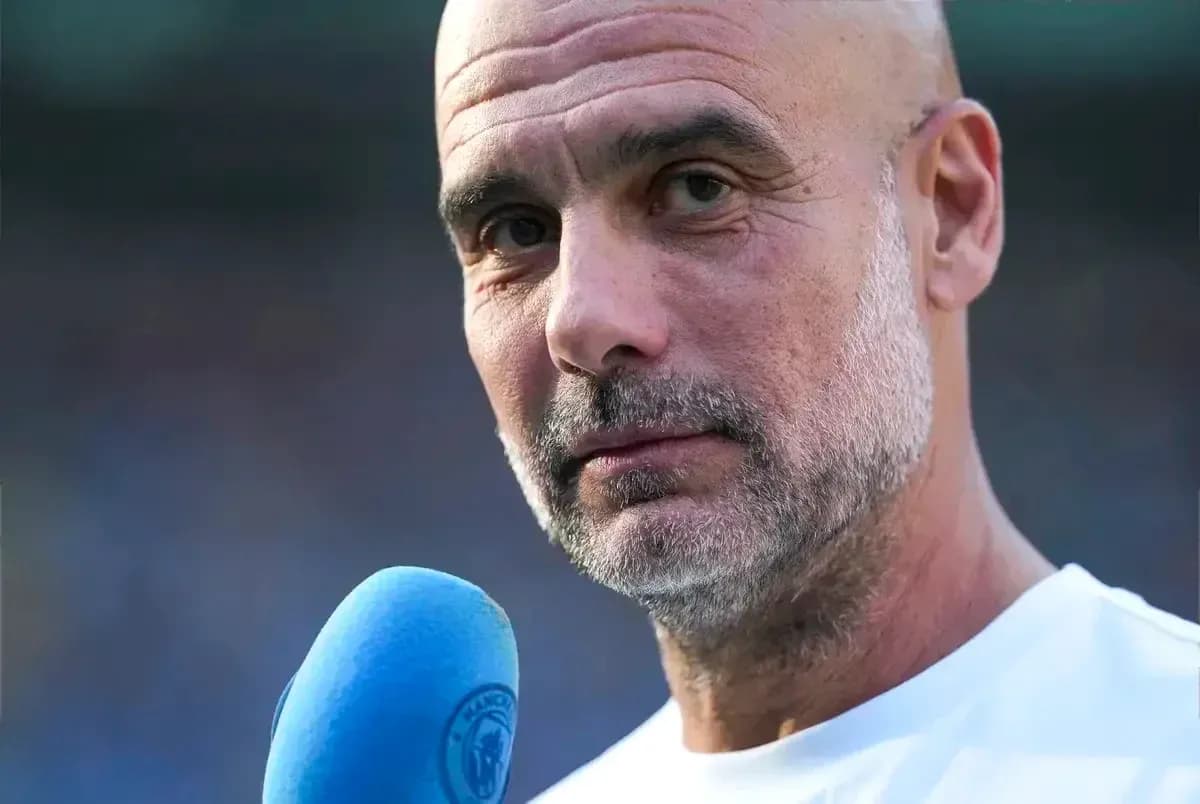

Guardiola's Stark Reality Check for Manchester City
Pep Guardiola has never been one for soft-focus nostalgia. Even as Manchester City move on without him, he is still setting the terms of the debate.
In a new interview with OKX, the former City manager has delivered a sharp, almost brutal piece of advice to sporting director Hugo Viana and new head coach Enzo Maresca: don’t kid yourselves about “young squads”, don’t expect stability, and above all, don’t get recruitment wrong.
Guardiola’s cold Manchester reality check
Guardiola spent 10 years at the Etihad Stadium rewriting what dominance looks like in English football: four Premier League titles in a row, three FA Cups, a first UEFA Champions League, and an era that turned City from ambitious project into benchmark.
That record gives weight to every word he says about what comes next. And this time, he didn’t dress it up.
“I spoke many times with the Manchester City sporting director(s) (former) Txiki Begiristain and (current) Hugo Viana, and said, ‘Now we have a young team for the next three or four years!’” Guardiola recalled.
Then came the punchline.
“It's not true. You don't know why, but it doesn't work. A lot of players, young players, don't play and say, ‘I want to leave! I'm here in cold Manchester, not playing, I want to leave!’ And you have to replace those guys.”
That is the heart of his warning. The fantasy of locking in a core of gifted youngsters for half a decade crashes into the reality of elite football: limited minutes, restless talent, and a city that doesn’t always sell itself to players sitting on the bench.
For Maresca, barely into his first pre-season, and Viana, overseeing one of the most significant overhauls of the squad in recent years, the timing is impossible to ignore. Guardiola isn’t just talking theory. He is describing the exact storm they are now walking into.
The hidden cost of depth
Across his decade in charge, Guardiola wrestled with the same problem now facing his successors: how do you keep a large group of top-level players satisfied when only 11 can start?
His comments carry an implicit admission that even he struggled with that balancing act. City’s current summer only underlines the point. Several players are already understood to be pushing for moves away, their pathways blocked or their roles reduced.
At a club of City’s stature, the pressure to compete on all fronts demands depth. The same depth breeds frustration when talented young footballers find themselves watching from the sidelines, week after week, in what Guardiola describes pointedly as “cold Manchester”.
This is not a gentle nudge to Viana and Maresca. It is a reminder that squad-building at this level is less about drawing up a neat five-year plan and more about constant firefighting: replacing those who want out, anticipating the next rupture, staying half a step ahead of the dressing room mood.
“Make as few mistakes as possible” – Guardiola’s core demand
For Guardiola, the response to that chaos comes down to one thing: the quality of decisions.
“The big task is how the club, organisation, sporting director, manager, CEO, hierarchy recruit the right players you need – everyone makes mistakes, but make as few as possible. That's the key point.”
It is classic Guardiola: process over noise, structure over sentiment. He namechecks Begiristain and Viana, but then widens the lens – CEO, manager, hierarchy. Recruitment is not one man’s job. It is the collective brain of the club either getting it right or paying the price.
The message is clear. You cannot stop players wanting to leave. You cannot guarantee that a “young squad” will grow together. What you can control is who you bring through the door, how well they fit, how few of those calls you get wrong.
At City, the margin for error is tiny. The standard he set ensures that.
Viana’s live test: a rebuild under scrutiny
This is not some distant, theoretical challenge for Hugo Viana. He is living it right now.
Maresca is deep into his assessment of the group he has inherited, working through each player ahead of the 2026–27 campaign. Around him, uncertainty hangs over several futures. Some will be sold, some loaned, some renewed. Every decision carries a ripple effect.
Guardiola’s warning about young players agitating for more football lands squarely in the middle of that process. City cannot promise regular minutes to everyone. They never could. The task for Viana is to decide who can accept a rotational role, who must play every week elsewhere, and who is worth reshaping the squad to accommodate.
On the incoming side, the club’s moves so far suggest they have heard Guardiola’s message. The club-record £116 million signing of Elliot Anderson from Nottingham Forest is not a panic buy. It is the product of long-term tracking, a calculated, high-stakes bet on a player they believe can anchor the next phase of this team.
One major signing does not define a rebuild. But it does show the direction of travel: fewer gambles, fewer short-term fixes, more conviction in the players they commit to.
Guardiola has handed Viana and Maresca a blunt checklist: expect churn, expect impatience, expect plans to be ripped up by human ambition. The only defence is clarity of thought in recruitment.
Now comes the real test – can City’s new regime make “as few mistakes as possible” in a landscape where even getting most things right is no longer enough?