.svg&w=384&q=75 "Naijagoal logo")
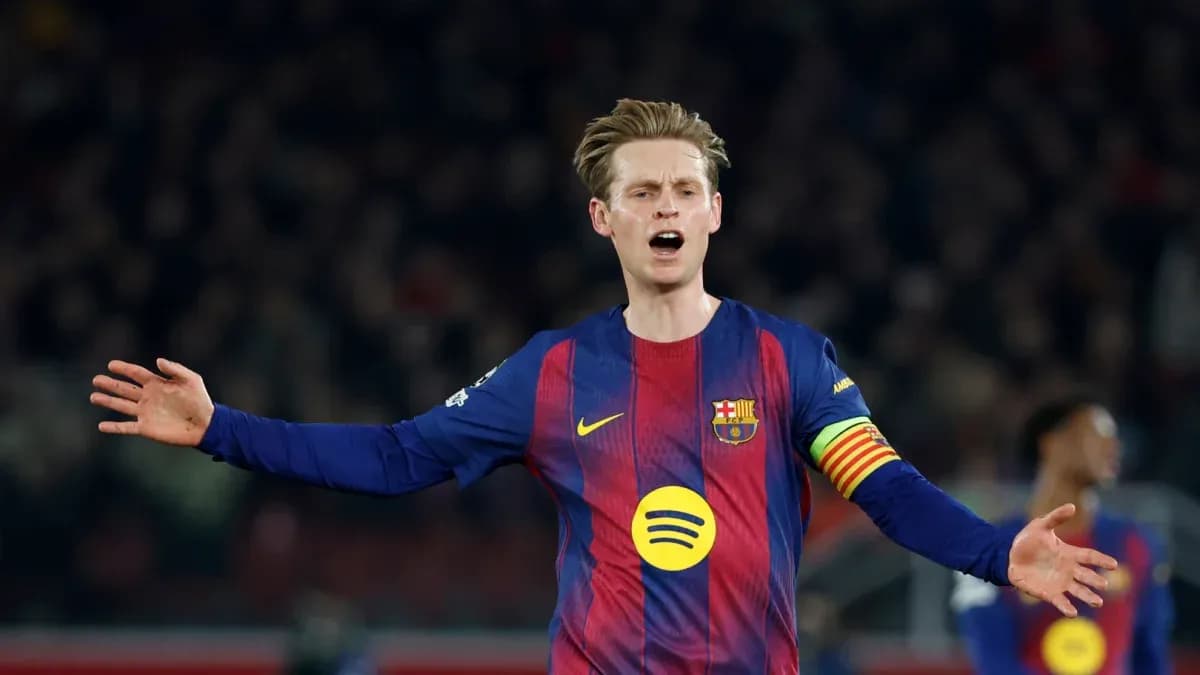

Frenkie de Jong’s Injury: A Ticking Clock for Barcelona
Barcelona are living on Frenkie de Jong’s ankle and a stopwatch.
The Dutch midfielder, once the untouchable axis of the team, has become the great uncertainty of the club’s medium-term planning. His latest ligament injury, suffered around the last World Cup and confirmed on his return to Barcelona after medical tests, has pushed the club into a waiting game it never wanted to play.
A complex treatment with a ticking clock
De Jong chose the conservative route. No immediate surgery, no dramatic intervention. A demanding, highly controlled treatment plan, scheduled to last two months and already at its halfway point. The idea: avoid the operating room, rebuild the ligament, and return in stages over the following weeks.
But the margin for error is tiny.
The medical staff know it, the player knows it, and so do the people in charge of building next season’s squad. Every session has to go right. Every response from that ligament matters. Because if the joint doesn’t respond as planned, the fallback is brutal: surgery, and with it a layoff that could stretch to four or even five months.
That scenario is not a distant, theoretical possibility. It remains very much alive in the conversations at the club. One setback in his progress, one sign that the conservative plan isn’t enough, and De Jong’s season—and Barcelona’s blueprint—changes shape overnight.
A midfield plan under threat
Sportingly, the injury lands at the worst possible time for the club’s planners. The Sporting Directorate had drawn up the roadmap for next season with one clear premise: no need to reinforce the midfield. Between established starters and emerging talent, they felt the centre of the pitch was covered.
So much so that, even with De Jong injured, the intention remains to sell Marc Casadó, a player who operates in the same area of the pitch. The idea was to cash in, trim the squad, and trust the existing hierarchy.
De Jong’s situation challenges that logic. If the conservative treatment fails and surgery becomes inevitable, Barcelona could be without their most complete midfielder for nearly half a year, with the absence stretching into the start of the 2026/27 campaign. That is not a gap you simply cover with rotations and youth players.
A worrying pattern, not a one-off
The real alarm inside the club does not come only from the prospect of four or five months out. It comes from the trend line.
De Jong is no longer the iron man who arrived from Ajax. Across the last three seasons, he has already missed 56 matches through various physical problems. That is almost a season and a half on the sidelines, accumulated in fragments: here a strain, there a relapse, now a ligament issue that refuses to be taken lightly.
Add to that the games he would inevitably miss at the start of 2026/27 if surgery is required, and the picture darkens. For Hansi Flick, who wants a dominant, high-intensity midfield, and for Deco, tasked with protecting the club’s sporting and financial assets, the equation is uncomfortable.
They are not just managing an injury. They are managing the risk profile of a key contract.
Market questions Barcelona did not want to ask
All of this forces a conversation that, until recently, Barcelona hoped to postpone. How much can they rely on De Jong as the fixed point of their midfield project? And if they cannot, how aggressively do they need to move in the market?
The original plan was clear: no major midfield signing, trust the core, and generate funds with exits such as Casadó. Now, every medical update on De Jong carries extra weight. A clean recovery keeps the roadmap intact. Any sign of trouble, and the club will have to look outside—whether they like it or not.
For now, Barcelona wait. The treatment continues, the ankle is monitored, and the scenario of surgery hangs over the season’s planning like a storm cloud that may or may not break.
If it does, the club will not just lose a midfielder for months. It will be forced to rethink what its midfield is supposed to look like in the first place.