.svg&w=384&q=75 "Naijagoal logo")
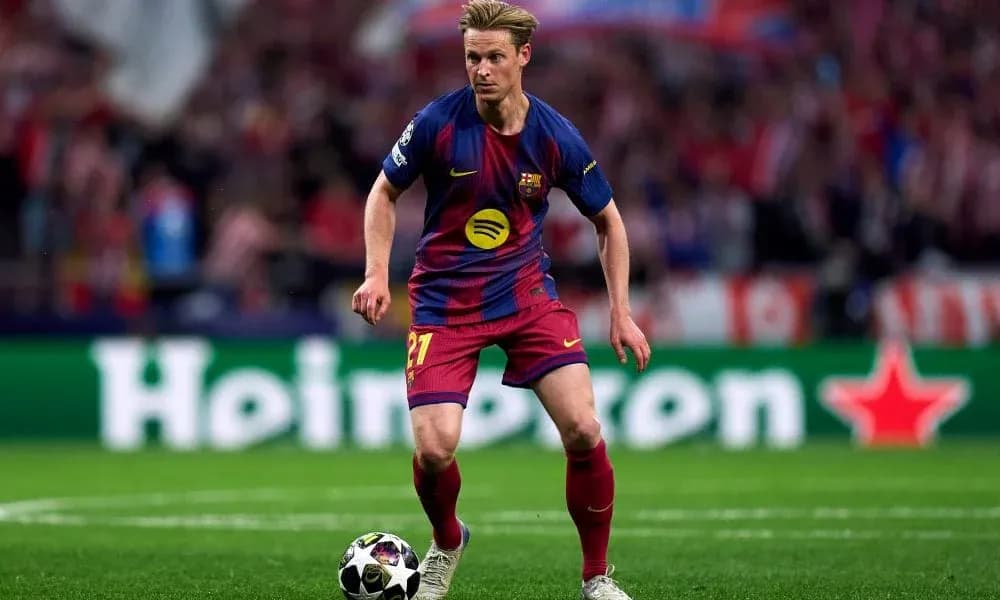

Frenkie de Jong Faces Uncertain Future at Barcelona
Frenkie de Jong’s future at Barcelona is back under the microscope, with one prominent Dutch voice warning this could be his final season in blaugrana.
Valentijn Driessen, speaking on De Telegraaf’s podcast, painted a stark picture of where the midfielder now stands. The arrival of Rodri, one of the most dominant holding midfielders in the game, has redrawn the map of Barça’s engine room just as De Jong battles another injury.
“He has been injured a lot; they already tried to get rid of him before, and now they bring Rodri,” Driessen said, noting the growing list of complications around the Dutchman’s status. He doesn’t see Barcelona forcing a transfer while De Jong is sidelined. But he does see an end point.
“I don’t think that now that he’s injured they’re trying to transfer him – I can’t imagine it – but I do think he’s in his last season at Barça.”
Rodri’s arrival shifts the hierarchy
De Jong has never hidden his dream: to spend his entire career at Barcelona. That romantic idea now runs into the cold reality of elite competition.
Barcelona have added a serial winner at the heart of midfield, and Rodri is expected to become a cornerstone in Hansi Flick’s structure. The Spanish international offers control, positioning and authority in the very zone where De Jong has built his reputation.
Driessen does not see Rodri’s signing as an automatic trigger for a sale. The club, he suggests, will not rush De Jong out of the door while he is recovering. But the dynamic has changed.
“He wanted to stay at Barcelona until the end of his career, but that’s a privilege granted to very few players,” Driessen argued. “He’s not the sort of player you’d think would remain a first-team regular at Barcelona until he’s 35. In short, he won’t see out the end of his career there.”
The Dutch journalist even questioned whether there is room for both Rodri and De Jong in the same starting XI on a regular basis.
“You always have to perform to keep playing. If an excellent player comes in who plays in your position, I can’t imagine those two playing together.”
A tactical crossroads for De Jong
For Driessen, everything now comes down to adaptation.
De Jong has built his career on dictating tempo from deep, gliding past pressure and knitting together phases of play. He is at his best when he can see the whole pitch in front of him, carrying the ball out of traffic and into space.
To coexist with Rodri, that comfort zone may no longer be enough. Driessen believes De Jong would have to push higher, take on more risk, and become a more incisive attacking presence. He is not convinced the midfielder can flip that switch.
“He might be able to try, but he needs to be more attacking, and that’s usually the point of criticism: that he lacks that. He’s never managed it.”
Whether Hansi Flick agrees with that assessment will define the next chapter. Barcelona’s midfield is packed with players who can interpret different roles, and the German coach has options to reshape his system once De Jong returns.
Nothing says Rodri’s arrival must automatically push De Jong out of the team. But the comfort of guaranteed status has gone. The battle for places is about to intensify, and for a player who once imagined himself a Barça lifer, the question now is brutal in its simplicity: adapt, or accept that this might be the end of the road in Catalonia.