.svg&w=384&q=75 "Naijagoal logo")
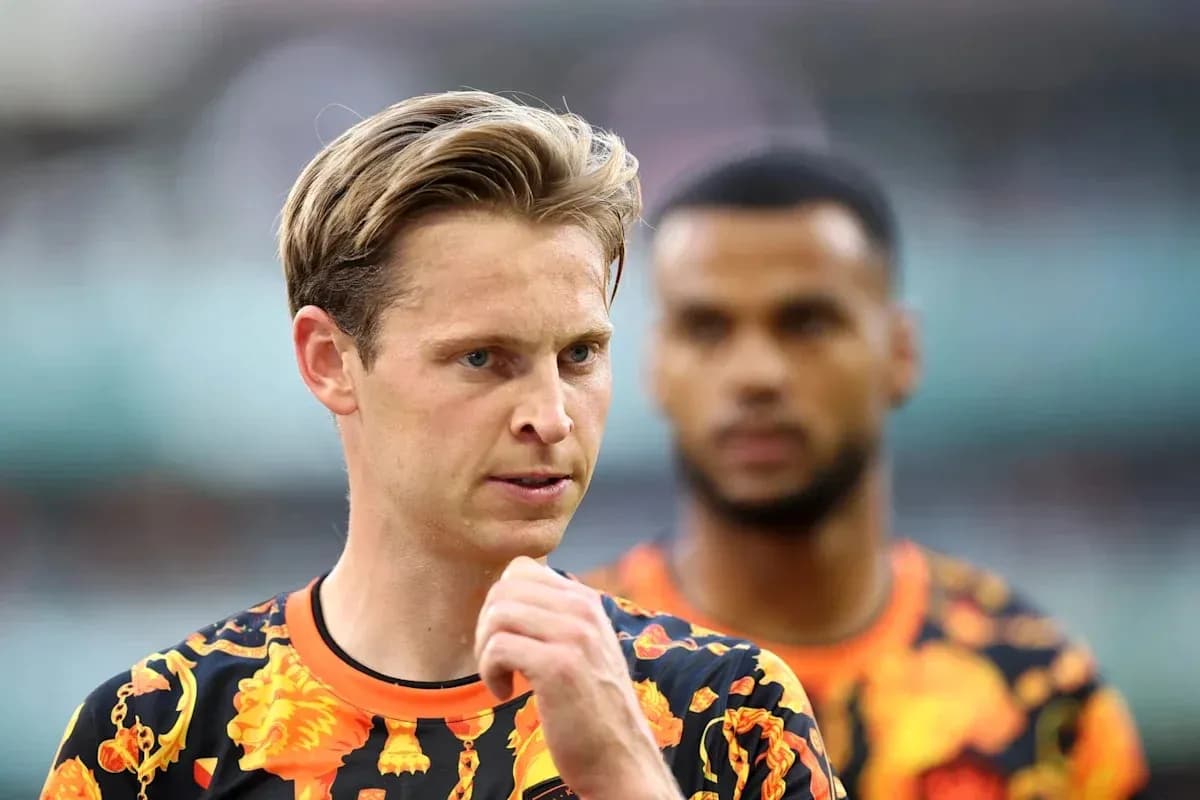

Frenkie de Jong Addresses Injury Controversy at Barcelona
Barcelona’s armband has felt unusually heavy this summer.
Two of the club’s four captains, Ronald Araujo and Marc Andre Ter-Stegen, have departed on loan to Liverpool and Ajax respectively, leaving Frenkie de Jong as the last senior figure standing. The Dutch midfielder should be the calm at the centre of the storm. Instead, he has found himself right in the middle of it.
Ruled out for several months after aggravating an injury at the FIFA World Cup, De Jong has been under intense scrutiny. Reports have suggested he mishandled his recovery and lost the manager’s trust. His condition has stalled, his name has been dragged through headlines, and the narrative has begun to turn against him.
So he pushed back.
De Jong fights the noise
In a lengthy, combative interview with Barcelona’s official media, De Jong addressed what he described as a wave of misinformation around his injury and his situation at the club. He laid out how the setback happened, insisting it was not down to negligence on his part, and made clear he was tired of being portrayed as the culprit.
Away from the controversy, the captain spoke like a man still deeply invested in the project.
One subject lit him up: La Masia.
“La Masia is incredible. Every year players come through that we don't even know, and then within a year they become very important players for the team. That is the DNA of the club,” he said, underlining how central the academy remains to Barcelona’s identity, even in a summer of upheaval and loans.
For a squad suddenly short on long-serving leaders, those words carry weight. The club’s next core may already be walking through the doors of the academy, and De Jong knows it.
Guiding the new faces
Barcelona have also turned to the market, bringing in new signings to refresh a dressing room that has lost Araujo and Ter-Stegen’s presence, at least temporarily. As captain, De Jong sees it as part of his job to smooth their transition into the club’s demanding style.
“They are very good players and very good people. They are going to help us a lot, and I'm trying to help them adapt as easily as possible,” he explained.
Even from the sidelines, he remains a reference point. The irony is stark: a captain whose body has betrayed him, yet whose influence on and off the pitch may be more important than ever while he recovers.
His absence is a serious blow. The midfield loses control, the dressing room loses a voice, and a team chasing major trophies loses one of its central pieces just as the season takes shape.
Eyes on the Champions League
Despite the injury, De Jong’s ambition has not dimmed. He spoke openly about the UEFA Champions League, framing it not as a distant dream but as a shared obsession inside the dressing room.
Lifting that trophy again, returning Barcelona to the summit of Europe, remains the ultimate target for him and his teammates. For a club wrestling with change, it is the clearest possible statement of intent.
The question now is simple and brutal: when De Jong finally returns, will Barcelona still be in a position to chase that dream, or will this long, fraught layoff have already reshaped the season beyond his control?