.svg&w=384&q=75 "Naijagoal logo")
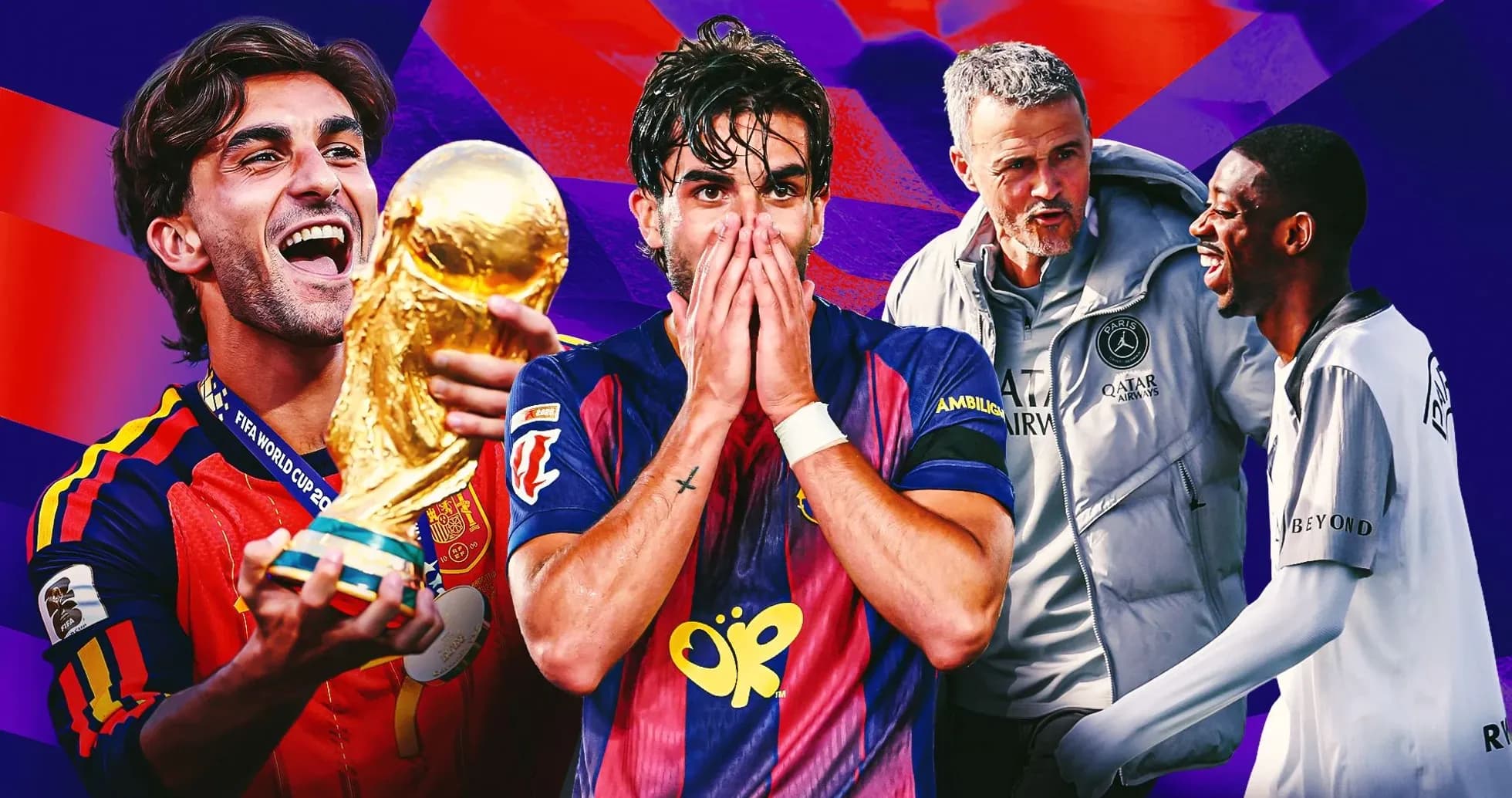

Ferran Torres' Future at Barcelona: A Complex Dilemma
Ferran Torres has never been shy, but this time his words cut straight through the calm at Barcelona.
“Every time these teams want you it’s a good thing… What do Barca need to do to keep me? They have to show me they want me, come to negotiate,” he told Sportico, leaning into his leverage with the kind of public challenge that tends to echo loudly around Camp Nou. It did. According to The Athletic, those comments “raised eyebrows” in the boardroom and sharpened a dilemma that was already complicated.
Because this is not just about emotion. It’s about money, clauses, and a club trying to reshape a squad on a tight budget.
A contract that costs more than a renewal
Barcelona’s sporting director Deco is said to be reluctant to extend Torres’ deal for one very specific reason. When the club signed him from Manchester City in January 2022 for a total of €65 million, they agreed a clause that now looms large: if Barca renew him, they owe City another €7m-€8m.
Renew him, and he becomes even more expensive. Sell him, and the books look a lot cleaner.
Diario Sport reports that Barca want to recoup their full €65m outlay if they let him go. If Paris Saint-Germain meet that price, it would be a rare piece of business that ticks every financial box. A sizeable fee, no extra money to City, and fresh funds to chase priority targets – with Julian Alvarez at the top of that list.
From Torres’ camp, Barca’s pursuit of the Atletico Madrid striker is seen as a lack of “faith” in the Spaniard. That sense of being undervalued is understandable. Hansi Flick has hardly soothed the situation either.
“I have complete confidence in Deco and we know we have to do something [about signing a new striker]. But it also depends on Ferran, so we will see what happens,” the coach said. Hardly a ringing declaration that Torres is untouchable.
Numbers that impress – and a flaw that won’t go away
Torres, though, has a case. A strong one.
Last season he scored 21 goals in 49 games across all competitions. Two more than Robert Lewandowski. Only Lamine Yamal, with 24, found the net more often in a Barca shirt. The previous campaign he hit 19. Those are not the numbers of a fringe forward.
Yet when the conversation turns to the pillars of Barca’s back-to-back Liga titles, his name rarely comes up alongside Yamal, Raphinha, Pedri or Lewandowski. There is a reason for that.
Flick has undeniably pushed him to a higher level since arriving in 2024, but the streakiness remains. Between January and April, the period that often defines seasons, Torres went 14 games without a goal. In a team that lives under constant scrutiny, that kind of drought becomes a storyline on its own.
Barcelona have already armed Flick with fresh attacking options. Anthony Gordon and Karim Adeyemi add versatility and pace to the frontline. If Alvarez arrives as well, Torres risks sliding from main protagonist to rotational piece. Yes, he can operate wide, but those lanes are already owned by Yamal and Raphinha.
From the club’s point of view, this is the perfect moment to sell: a player at peak value, with two strong seasons behind him, and a contract ticking down. From Torres’ point of view, it feels like being pushed towards the exit just when he believes he has proved he can lead the line.
PSG’s promise – and its brutal reality
On the other side of the equation sits PSG, and the lure is obvious.
Luis Enrique’s side have just won back-to-back Champions League titles. They eliminated Barcelona in Catalonia on their way to lifting the trophy in May. For a player who has already won plenty, the chance to add Europe’s biggest prize with the most dominant team of the moment is hard to ignore.
Torres is likely excited by the idea of a fresh start in Paris, reunited with a coach who knows him well and a system that suits his mobility. Luis Enrique has targeted him precisely because he fits that blueprint: a forward comfortable drifting wide, attacking from the half-spaces, and operating as a false nine.
PSG sold their only orthodox centre forward when Goncalo Ramos left for AC Milan at the end of June. Luis Enrique had already shown his hand by frequently preferring Ousmane Dembele through the middle in key games, rotating Ramos in and out. The message was clear: this attack is built on movement, not a traditional No. 9.
In that context, Torres makes sense. His flexibility should earn him more starts than Ramos enjoyed, particularly if Bradley Barcola completes a proposed move to Liverpool. But anyone expecting him to become the star of the show in Paris is fooling themselves.
Khvicha Kvaratskhelia, Dembele and Desire Doue form a front three that every major club in Europe envies. That trio is explosive, unpredictable, and already proven on the biggest stage. Torres will arrive as an important piece, not the centrepiece.
There’s another catch. Ligue 1, for all of PSG’s dominance, does not match La Liga for quality or intensity. Domestic goals will be treated as routine. Torres will be judged, harshly and almost exclusively, on what he does in the Champions League. His record there – 12 goals across four years with Barca – hardly screams inevitability.
He may well have a better shot at lifting the trophy in Paris than in Catalonia, even with Barca expected to strengthen significantly, including the anticipated arrival of his Spain teammate and Ballon d’Or winner Rodri. But from an individual standpoint, this move is unlikely to transform his legacy.
A system player in a superstar world
There were other paths. Atletico Madrid, Tottenham, Aston Villa, Napoli, Juventus – clubs linked with Torres this summer – could have offered him something different: the chance to be the main man, the forward everything revolves around, the one who decides games and seasons.
Instead, he stands on the brink of another role as a system player in a superclub machine.
His limitations help explain why. When he has space to run into, when the ball is played in behind, Torres is sharp, clever, and ruthless. Ask defenders who have been burned by his movement. But when he has to drop deep, receive under pressure, or hold off more physical markers, the flaws appear. His link play can be loose. His ability to create chances on his own is limited.
Those weaknesses have kept him in and out of Barca’s starting XI, and they were exposed on the international stage too: only one of his eight appearances for Spain at the World Cup came from the start. Luis Enrique’s tactical framework in Paris will be built to maximise his strengths and mask his shortcomings. That’s good for short-term output. It’s less good for genuine evolution.
He will not be forced to become a different kind of forward. He will be asked to be a better version of what he already is.
A parting that suits the club more than the player
Back in Barcelona, the relationship with the fans has always felt slightly strained. Torres’ work rate has never been in doubt, but the emotional bond never fully formed. His recent public flirting with PSG has not helped. When a player openly says the club must “show me they want me,” supporters tend to take that personally.
After his exploits in North America and his goal tally last season, he now holds a rare position of power. It seems to have emboldened him. Barca, though, are looking at the balance sheet, the squad depth, and the timing. From their vantage point, cashing in now looks cold but logical.
For Torres, the grass in Paris will be lush, the trophies plentiful, the stage enormous. What it will not be is forgiving. Nor will it necessarily be his.
If this move happens, he will not suddenly become the face of a project or the heartbeat of a club. He will remain what he has always been at the elite level: a valuable, versatile, relentlessly hard-working utility forward in a game that reserves its loudest applause for those who bend teams to their will.