.svg&w=384&q=75 "Naijagoal logo")
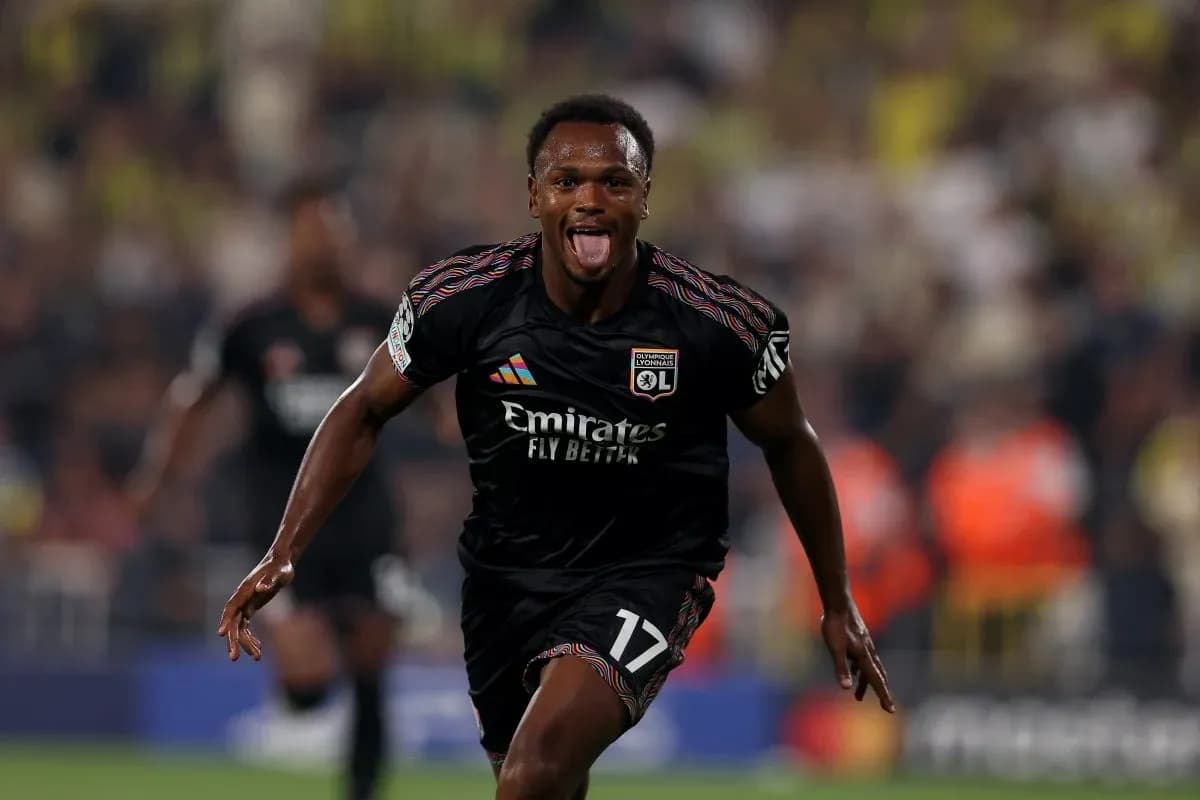

Fenerbahçe and Lyon Draw 1-1 in Tactical Clash
Fenerbahçe and Lyon produced a tactically tight 1-1 draw at Chobani Stadium in a Champions League Play-offs tie that was defined by mirrored structures, small adjustments in wide areas, and two disciplined midfields cancelling each other out more often than not. Both coaches stayed loyal to a 4-2-3-1, and the statistics – 12 shots each, 52%-48% possession, identical 5 shots on goal – underline how finely balanced the contest was.
First Half
Lyon struck first, using their right side as the main launchpad. With A. Maitland-Niles stepping high from right-back and E. Nuamah occupying the right half-space, Lyon created a lane for C. Tolisso to receive facing forward. The opening goal at 40' came exactly from this pattern: Tolisso advanced from the double pivot to connect with L. Openda, whose movement off the Fenerbahçe centre-backs was a constant early problem. Openda’s finish rewarded Lyon’s slightly more vertical use of possession in the first half, despite having only 48% of the ball overall.
Fenerbahçe’s 4-2-3-1 was built on the double pivot of N. Kanté and M. Guendouzi, tasked with both screening transitions and feeding the three attacking midfielders. Early on, the structure was conservative: full-backs N. Semedo and A. Brown were cautious, often forming a back four that stayed connected behind the ball. This limited Fenerbahçe’s ability to overload wide zones, leaving V. Muriqi somewhat isolated against Lyon’s pairing of R. Kluivert and M. Niakhaté. The 7 shots inside the box suggest that when Fenerbahçe did manage to work the ball into advanced areas, they found decent positions, but those moments were sporadic before the interval.
Second Half
The second half opened with a clear shift in Fenerbahçe’s attacking emphasis. The equaliser at 47' – M. Greenwood finishing from a K. Akturkoglu assist – showcased a more aggressive use of the wide playmaker roles. Akturkoglu’s positioning between Lyon’s left-back Abner Vinicius and left-sided centre-back created the angle to receive and slip Greenwood into a central finishing lane. It was the classic 4-2-3-1 pattern: the left “10” coming inside to playmaker, the right “10” attacking the box. From that point, Fenerbahçe’s front four behaved less like a line and more like a rotating unit, with Greenwood drifting inside and Talisca (before his substitution) trying to occupy pockets between Lyon’s midfield and defence.
Out of possession, both sides relied heavily on their double pivots to manage central spaces. For Lyon, T. Tessmann and T. Morton (later replaced by M. Bidstrup at 86') focused on blocking direct access into Muriqi’s feet and forcing Fenerbahçe to play around rather than through. Their success is reflected in Fenerbahçe’s 12 total shots but only 5 on goal, and in Lyon’s comfort defending crosses and cutbacks with a compact back four plus a narrow midfield line of three.
Substitutions
The substitutions around the 73' mark were telling. Fenerbahçe introduced D. Nene (IN) for K. Akturkoglu (OUT) and M. Asensio (IN) for Talisca (OUT), effectively adding more direct running and shooting threat from the right while bringing in a left-footed playmaker who prefers to come inside from the flank. This rebalanced the attack: Asensio’s tendency to receive between the lines gave Kanté and Guendouzi a clearer vertical target, while Nene stretched Lyon’s back line with depth runs. The trade-off was a slight reduction in defensive security on the flanks, which Lyon tried to exploit with fresh legs of C. Mata (IN) for R. Kluivert (OUT) and K. Boudache (IN) for E. Nuamah (OUT) at 75'.
Lyon’s changes were more about energy and maintaining defensive concentration than altering the structure. Mata gave them a more conservative right-back, helping protect against Nene’s directness, while Boudache offered pressing intensity on the right side of the attacking midfield line. Later, the introduction of M. Bidstrup (IN) for T. Morton (OUT) and M. Ouedraogo (IN) for M. Fofana (OUT) in added time further underlined Lyon’s intent to preserve the draw: fresh legs in midfield and on the flank to close passing lanes and contest second balls.
Defensive Strategies
Defensively, both back fours were well protected by their midfields, which helps explain the relatively low number of clear chances despite 24 combined shots. Fenerbahçe blocked 2 shots, Lyon 5, a sign that Lyon’s defenders and midfielders were especially quick to step out and get in the way of efforts around the box. The foul count – 13 each – and the card distribution also speak to a controlled but competitive game. Abner Vinicius (Lyon) received a yellow card at 37' for “Foul”, often the result of dealing with Greenwood and Akturkoglu’s rotations. For Fenerbahçe, N’Golo Kanté was booked at 81' for “Foul”, reflecting his role in disrupting Lyon’s counters, and Milan Škriniar followed at 84', also for “Foul”, as Fenerbahçe defended higher and risked more in the last phase.
Goalkeeping Performance
In goal, Ederson (Fenerbahçe) and D. Greif (Lyon) each made 4 saves, a symmetry that matches the 5 shots on goal per side. Ederson’s work was concentrated more in the first half when Lyon’s right-sided combinations found Openda and Nuamah in promising positions. Greif’s interventions were more spread, with the key moment being his handling of Fenerbahçe’s increased second-half pressure once Asensio and Nene entered.
Possession and Passing
On the ball, Fenerbahçe’s 453 total passes with 389 accurate (86%) versus Lyon’s 433 passes with 375 accurate (87%) confirm that both teams were comfortable circulating possession. Fenerbahçe’s slight possession edge (52%) came largely from longer spells of controlled build-up through Kanté and Guendouzi, while Lyon were more selective, using their 48% to play vertically when opportunities appeared. The corner count – 3-0 to Fenerbahçe – reflects the home side’s territorial advantage after the break, but Lyon’s compact box defending and Greif’s reliability ensured those situations did not tilt the tie.
Ultimately, the 1-1 scoreline mirrors the tactical equilibrium: two 4-2-3-1 systems, both well-drilled, both making logical in-game adjustments, and neither able to consistently unbalance the other. The return leg will likely hinge on which coach can find a way to free their No. 10 and wide playmakers more consistently between the lines without sacrificing the central stability that defined this match.