.svg&w=384&q=75 "Naijagoal logo")
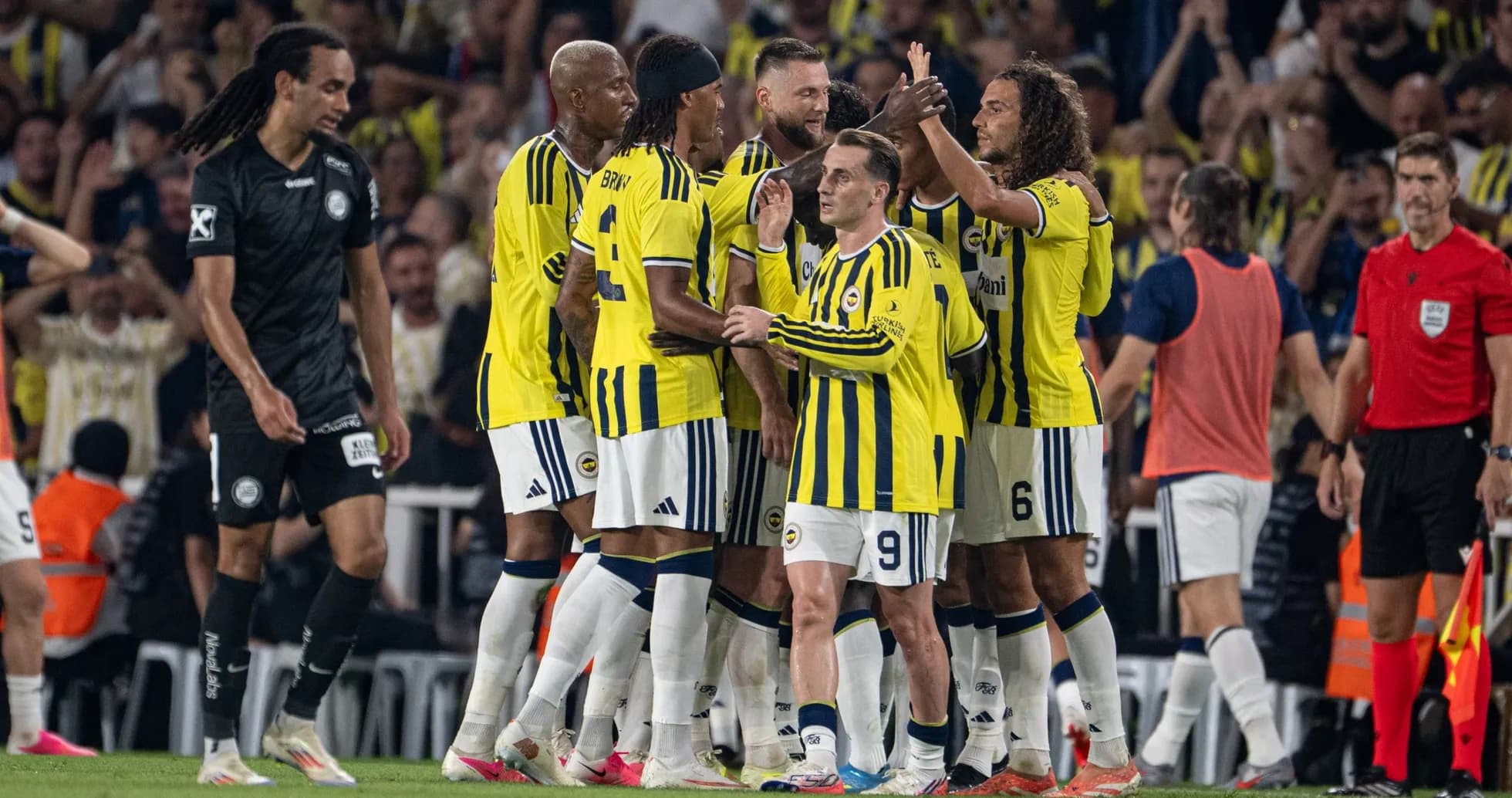

Fenerbahçe Dominates Sturm Graz 2-0 in UEFA Champions League
Fenerbahçe’s 2-0 win over Sturm Graz at Chobani Stadium was a textbook example of territorial domination built on structure and control. Ismail Kartal’s side translated a 72% share of possession into a sustained attacking siege, firing 17 total shots with 10 on goal, while allowing just 5 shots and a single effort on target. The scoreline matched the flow: a front four constantly rotating in front of a secure double pivot, against an opponent pinned back in a deep 4-4-2 block that rarely escaped its own half.
Tactical Setup
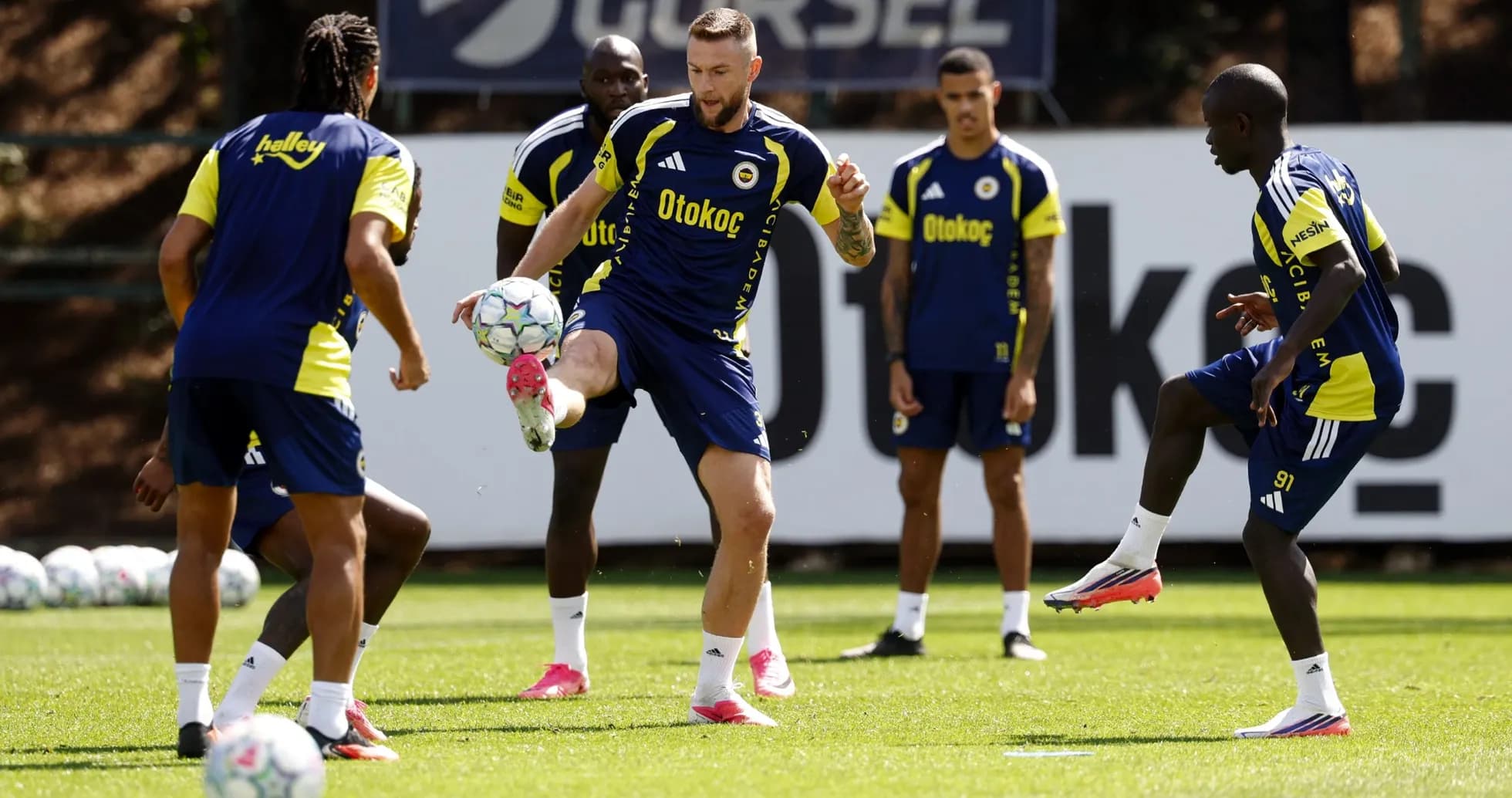
Kartal’s 4-2-3-1 was the game’s defining platform. With M. Gunok in goal, the back four of N. Semedo, M. Skriniar, N. Ake and J. Oosterwolde operated extremely high, compressing the pitch and allowing Fenerbahçe to keep Sturm Graz under permanent pressure. In front of them, the double pivot of M. Guendouzi and N. Kante controlled rhythm and rest defense: Guendouzi stepping forward to connect with the attacking midfield line, Kante anchoring transitions and sweeping second balls whenever Sturm attempted to play into their front two.
Ahead of them, the trio of M. Greenwood (right), M. Asensio (central) and K. Akturkoglu (left) constantly rotated around Talisca as the lone striker. The opening goal at 9' — Talisca finishing from a K. Akturkoglu assist — was emblematic of the structure: the wide players starting high and wide to stretch Sturm’s back four, then attacking the half-spaces with the full-backs providing the width. Fenerbahçe’s 12 shots inside the box underline how effectively they managed to progress into dangerous central zones rather than relying on low-percentage long-range attempts.
Sturm Graz's Struggles
Sturm Graz, in Fabio Ingolitsch’s 4-4-2, were forced into a reactive posture almost from kickoff. With S. Wlodarczyk and S. Jatta up front, the plan was clearly to spring counters once the ball was recovered, but the lack of sustained possession — just 222 total passes at 74% accuracy — meant their front two were often isolated. The midfield four of J. Hodl, L. Weinhandl, Jon Gorenc Stanković and S. Seidl had to collapse deep, turning their shape into a 4-4-1-1 or even a 4-5-1 out of possession, which limited their ability to support transitions.
The second goal at 45' from M. Greenwood, assisted by M. Asensio, effectively killed the contest before half-time. That combination spoke to the centrality of Asensio’s role as a roaming playmaker between the lines, pulling Sturm’s double pivot out of shape and creating pockets for runners from wide and from deep. With Fenerbahçe already 2-0 up and enjoying complete territorial control at the interval (2-0 half-time score), the second half became about game management more than chasing further goals.
Substitutions
In terms of personnel adjustments, Kartal’s substitutions were aimed at maintaining intensity while protecting key players. At 30', A. Brown (IN) came on for J. Oosterwolde (OUT), a like-for-like change at left-back that preserved the aggressive full-back profile. At 69', Fred (IN) replaced M. Greenwood (OUT) and I. Kahveci (IN) came on for M. Asensio (OUT), refreshing the attacking midfield line while keeping the same 4-2-3-1 structure and ball-dominant approach. Late on at 85', M. Muldur (IN) came on for N. Semedo (OUT) and O. Aydin (IN) replaced K. Akturkoglu (OUT), further rotating the wide corridors without altering the system.
Ingolitsch’s changes were more reactive and aimed at injecting directness. At 46', A. Kayombo (IN) came on for S. Wlodarczyk (OUT), adding fresh legs up front. A triple change at 64' — G. Mamageishvili (IN) for S. Seidl (OUT), R. Fosso (IN) for L. Weinhandl (OUT), and N. Weiper (IN) for S. Jatta (OUT) — was a clear attempt to add energy and ball-carrying in midfield and attack, but the structural problem remained: Sturm struggled to get out, finishing with only 2 corner kicks and 3 blocked shots as most of their attacks were smothered early. At 87', B. Beganovic (IN) for J. Hodl (OUT) was another offensive tweak that came too late to change the pattern.
Statistical Overview
Between the posts, the statistical profile underlines the asymmetry of the contest. M. Gunok (Fenerbahçe) faced just 1 shot on target and made 1 save, reflecting how well-protected he was by the high line and the compact double pivot in front of him. At the other end, D. Khudyakov (Sturm Graz) was under siege, making 8 saves from Fenerbahçe’s 10 shots on goal. His performance kept the scoreline respectable; without his interventions, the shot volume and territorial dominance suggest the margin could have been far heavier.
The disciplinary and physical data further explain the tactical story. Sturm Graz committed 19 fouls to Fenerbahçe’s 10, picking up 3 yellow cards, all for clear reasons: Jon Gorenc Stanković (Sturm Graz) booked for “Foul” at 21', Jurgen Heil (Sturm Graz) also for “Foul” at 58', and Axel Kayombo (Sturm Graz) for “Simulation” at 65'. These bookings reflect a side under constant stress — forced into late challenges to break up Fenerbahçe’s combinations and, in Kayombo’s case, searching for marginal gains in the attacking third. Fenerbahçe, by contrast, finished without a single booking, another indicator of how rarely they were forced into emergency defending.
Statistically, Fenerbahçe’s 578 total passes with 520 accurate at 90% underline a controlled, possession-heavy approach. Sturm’s 222 passes, 164 accurate at 74%, highlight their struggle to string sequences together against Fenerbahçe’s press and counter-press. The 4-2 edge in corner kicks for Fenerbahçe and the 5-3 advantage in blocked shots further illustrate where the game was played: mostly in and around the Sturm penalty area.
Overall, this was a tactically mature home performance in the UEFA Champions League 3rd Qualifying Round. Fenerbahçe leveraged their 4-2-3-1 structure, technical superiority and high pressing to suffocate Sturm Graz, convert pressure into goals early in each half, and then manage the game with intelligent substitutions and disciplined control. Sturm’s 4-4-2 never found a reliable outlet; their front line was starved, their midfield overrun, and their defensive line forced to defend the box for 90 minutes. The 2-0 final score, with a 2-0 half-time lead, is a fair reflection of a match where the tactical balance was decisively tilted towards the hosts from the opening minutes.