.svg&w=384&q=75 "Naijagoal logo")

Fantasy Premier League 2026/27: Key Player Reclassifications
The first big whistle of any new Fantasy Premier League season rarely comes from a stadium. It comes from the game itself.
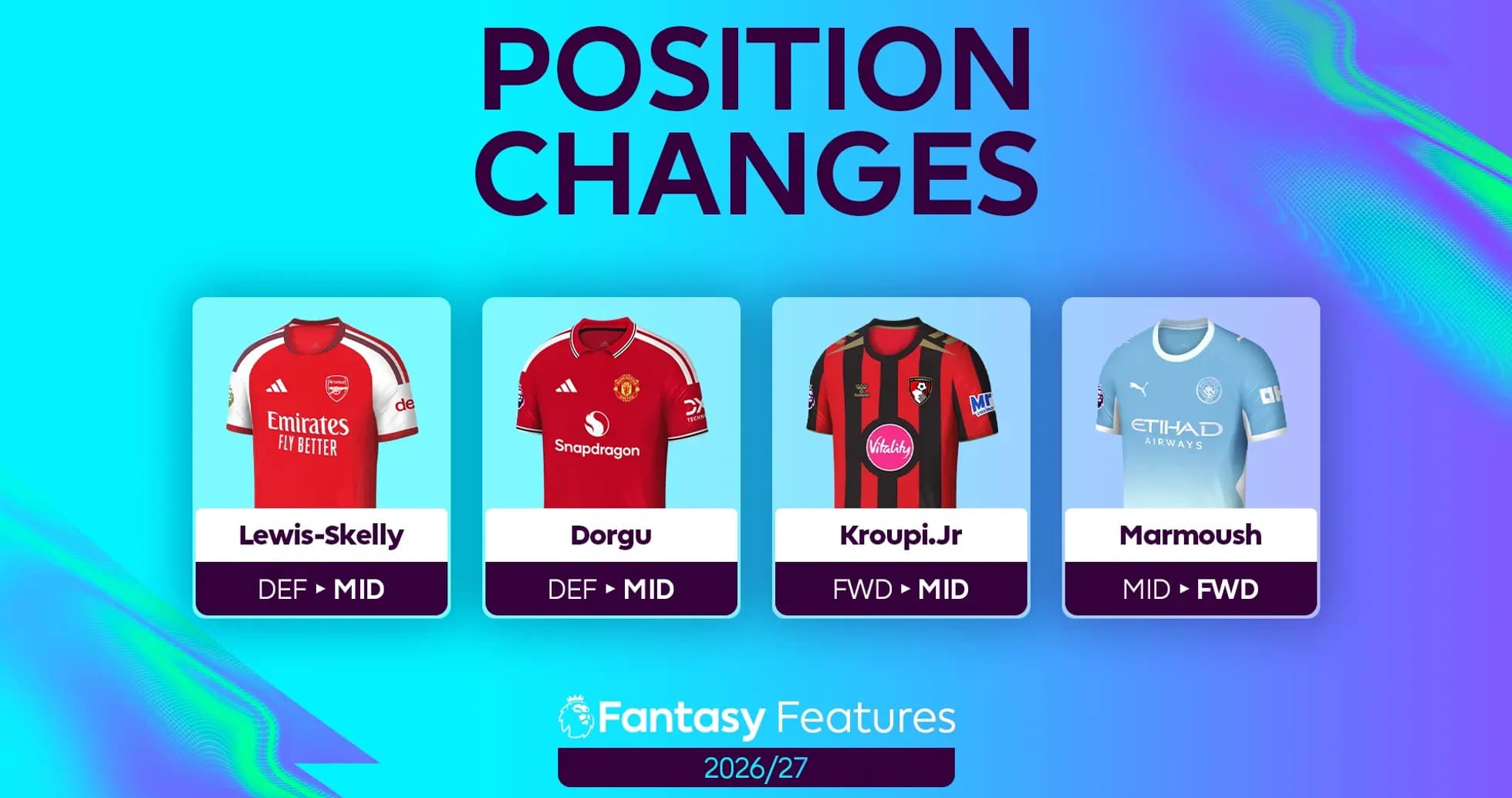
For 2026/27, that sound is the reshaping of the player pool: 11 footballers reclassified, some of them right at the heart of how serious FPL managers will build their squads.
And three names jump off the page: Junior Kroupi, Patrick Dorgu and Omar Marmoush.
Kroupi: From finisher to Fantasy goldmine
Bournemouth’s Junior Kroupi was already on the radar. Now he might be unavoidable.
Last season, the French teenager operated mostly as a No 10, floating behind centre-forward Evanilson, knitting attacks together but still arriving in the box with menace. FPL, though, had him listed as a forward.
That’s changed.
Kroupi is now classified as a midfielder after his breakout 2025/26 campaign, and the numbers behind that decision are exactly what Fantasy managers want to see. He scored 13 goals in 33 appearances, a return that would be eye-catching for any mid-priced striker. As a midfielder, it becomes a potential bargain.
The underlying data sharpens the picture. Kroupi averaged a goal every 134.0 minutes. To put that in context, among regular starting midfielders last season, Antoine Semenyo was the quickest to score, finding the net every 188.2 minutes. Kroupi beat that by more than 50 minutes per goal.
Now place that output in a scoring system that rewards midfielders with an extra point per goal and hands them clean-sheet bonuses. The reclassification doesn’t just tidy up his role on the pitch; it supercharges his Fantasy profile.
He’s no longer just a promising youngster behind a main striker. He’s a high-ceiling midfielder with elite-level efficiency, suddenly positioned to become a central figure in pre-season drafts.
Dorgu: Carrick’s winger gets a midfield badge
At Manchester United, Patrick Dorgu’s switch from defender to midfielder is a quieter change on paper, but it carries real tactical weight.
The reclassification reflects how Michael Carrick used him once he arrived in Gameweek 22. Dorgu barely started under the new manager – just three times – yet every one of those starts came in a far more advanced role: as a left winger.
And he made those minutes count.
He scored in all three of those starts. Arsenal. Manchester City. Brighton & Hove Albion. High-calibre opposition, same outcome: Dorgu on the scoresheet. Against Brighton he went one better, adding an assist to his goal.
When you line him up statistically alongside midfield team-mates Matheus Cunha and Bryan Mbeumo under Carrick, the picture becomes even more intriguing. Dorgu took a shot every 33.2 minutes, the quickest rate of the trio. He also matched Cunha’s total of three big chances, despite playing over 800 minutes fewer than the Brazilian.
That’s not the profile of a cautious wide defender. That’s a winger with license to attack.
The defensive classification masked that threat. As a midfielder, his attacking numbers now sit in the proper context. He loses the clean-sheet potential that comes with being listed at the back, but the reclassification makes his role far clearer for Fantasy managers: if he plays, he’s there to create and score, not just to hold the flank.
If Carrick leans into that left-wing experiment over a full season, Dorgu’s new tag could look like an early correction that pays off for those willing to back a small sample size.
Marmoush: Pep’s striker steps into the light
At Manchester City, Omar Marmoush moves in the opposite direction: from midfielder to forward.
Pep Guardiola used the Egyptian through the middle in his final campaign in charge, and FPL has now caught up with that reality. Marmoush led the line, and his output reflected a player adapting well to the responsibility: three goals and three assists.
On its own, that return is solid rather than spectacular. But the positional shift matters. As a midfielder, Marmoush benefited from extra points for goals and the chance of clean-sheet bonuses. As a forward, he loses those perks but gains clarity. He’s now judged directly against the other strikers in the game, in a role that mirrors how City actually deployed him.
For managers, that reclassification sharpens the question: is Marmoush a viable City forward option in a post-Guardiola era, or just a rotation piece in an attack packed with alternatives?
The wider shake-up
Around those headline names, the full list of reclassifications underlines a broader theme: FPL is tightening the link between tactical roles and game positions.
- Myles Lewis-Skelly (Arsenal) and Lamare Bogarde (Aston Villa) move from defence into midfield.
- Keane Lewis-Potter (Brentford) makes the same jump, rebranded from defender to midfielder.
- Mats Wieffer (Brighton & Hove Albion) shifts from midfield to defence.
- Georginio Rutter (Brighton & Hove Albion) goes the other way, stepping up from midfield to forward.
- Rio Cardines (Crystal Palace) and Ryan Sessegnon (Fulham) both transition from midfield to defence.
- Eric Moreira (Nottingham Forest) drops back from midfield into defence.
Each of these tweaks nudges value up or down in subtle ways: defenders moving into midfield often become more attack-focused assets; midfielders reclassified as defenders can offer clean-sheet potential with added attacking upside; forwards stepping out of midfield must now justify their place with pure goal involvement.
For seasoned FPL managers, these aren’t cosmetic changes. They’re fault lines that can shape early-season strategy.
Kroupi, Dorgu and Marmoush sit right on those lines. One becomes a potential midfield talisman, another a high-upside winger finally labelled correctly, the third a City striker now judged as such.
The game has moved the pieces. The question now is simple: who reacts quickest?