.svg&w=384&q=75 "Naijagoal logo")
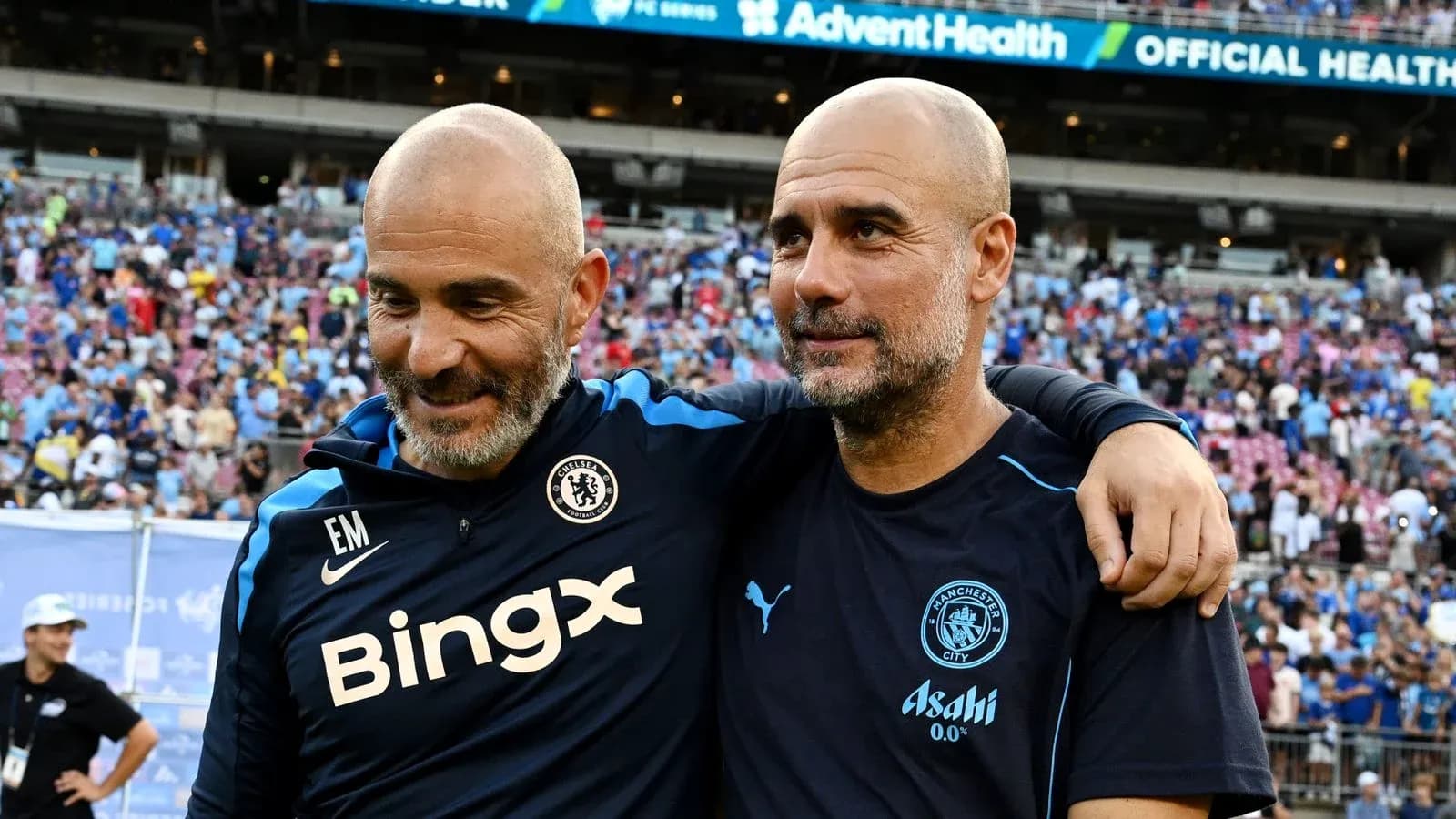

Enzo Maresca Takes Charge at Manchester City: A New Era Begins
Enzo Maresca steps into the light at Manchester City with the kind of brief that usually belongs in fantasy: follow Pep Guardiola, keep the trophies coming, and do it all without the aura of the man who built the modern City.
This is not a rebuild. It’s an inheritance. And a test.
A gentle opening – on paper
The fixture list has done Maresca a favour, at least at first glance. Bournemouth, Crystal Palace and newly promoted Coventry City form the opening trio of league games – a soft landing for a coach trying to stamp his ideas on a squad conditioned by Guardiola’s doctrine.
Those games should allow City to find rhythm without needing to hit top gear. They also give the club’s World Cup core a chance to breathe.
No one needs that more than Rodri. Spain’s midfield anchor barely missed a minute of their triumphant campaign and stands as City’s most obvious fatigue risk. Maresca can manage his minutes without feeling like he’s gambling with points. Those first three fixtures should still tilt heavily in City’s favour even if Rodri is eased back through cameos rather than 90-minute shifts.
But that kind start is a trap as much as a cushion. Drop points there and the questions arrive fast, because September bites hard: Manchester United and Liverpool in two of the next three league games. Those are not just fixtures; they are early markers of authority in a post-Guardiola landscape, emotional barometers for a fanbase that has grown used to dominance.
Maresca called it a “dream situation” when he walked back into the club, his third spell after stints as academy coach and then Guardiola’s assistant in the treble-winning 2022-23 season. He inherits a squad of depth, balance and experience that most managers would envy. It has been built, refined and hardened for a decade.
That, of course, is the point. The standards do not move with the manager.
Same gospel, different sermon
Stylistically, Maresca is no stranger to the City blueprint. He comes from the same school as Guardiola: possession as a weapon, control as a non-negotiable, aggressive pressing as the default setting.
But there are differences that will shape how this City side looks.
Under Guardiola, City often resembled a shape-shifting puzzle. Full-backs stepped into midfield. Centre-backs wandered into No 8 zones. Wingers tucked in to create overloads in the half-spaces. The structure flexed around Rodri, with players rotating through zones rather than clinging to chalk on their boots.
Maresca leans towards a more defined 4-2-3-1. Roles are clearer. The No 10 becomes central to the whole operation, the primary link between midfield and attack. At Chelsea, that was Cole Palmer, who thrived as the creative conduit in Maresca’s system.
At City, the Italian has Phil Foden and Rayan Cherki as his most natural candidates for that role. Both can drift, both can unlock, both can score. That choice alone will say a lot about how bold he wants to be from the outset.
The wide players, too, will feel the shift. Maresca likes wingers who stay high and wide, stretching the pitch, pinning full-backs, and opening lanes for the No 10 and striker. City’s wide men under Guardiola were often asked to move inside, combine, and help swarm central areas. Now they may find themselves living closer to the touchline, tasked with isolating defenders and providing a more old-school width.
The philosophy is familiar. The choreography will change. How quickly this group of serial winners adapts to slightly more rigid roles will shape the first months of the Maresca era.
A younger City, but with a leadership gap
Behind the scenes, City have already been shifting towards the future. Under sporting director Hugo Viana, the average age of the squad has dropped sharply over the last two to three windows, from 29 to just over 25. The refresh has been deliberate and expensive.
But it has come at a cost. Bernardo Silva and John Stones have gone this summer, following Kevin De Bruyne out of the dressing room. That is a heavy leadership void, both on the pitch and in the quiet moments that define a season.
The spine remains formidable. Rodri and Ruben Dias still set the tone. Erling Haaland has been nudged into a more vocal, visible leadership role. Marc Guehi and Josko Gvardiol bring composure and experience at the back, while Mateo Kovacic adds know-how in midfield.
Recruitment has been aggressive. Elliot Anderson has arrived from Nottingham Forest for huge money, a move designed to add robustness and long-term security in midfield. Jeremy Monga has been taken from Leicester, another young piece for the future.
City are still hunting. A right-back and a winger sit high on the wish list, with the club also tracking Lille teenager Ayyoub Bouaddi after his standout World Cup displays for Morocco. Arsenal like him too, so this is a race with familiar rivals.
Outgoings could reshape the squad further. Depending on offers, the club are prepared to listen for Savinho, Omar Marmoush, Nico Gonzalez, Jack Grealish, Tijjani Reijnders and Rico Lewis. With the World Cup now over, the market is expected to move quickly.
Maresca will have to build his hierarchy inside a dressing room in flux, blending new voices with the existing core. That is as much man-management as it is tactics.
The weight of expectation
For the first time since the Abu Dhabi takeover, City move into a season without a clearly defined long-term figurehead at the helm. A decade of planning went into luring Guardiola to the Premier League. That mission was accomplished, the vision realised, the trophies stacked.
Now the question is simple and brutal: what next?
City’s culture is wired to winning. Anything less than serious competition for major honours is unlikely to be tolerated for long. Supporters arrive at the Etihad expecting entertainment, but they demand victories. Maresca discovered at Chelsea how unforgiving that balance can be when performances don’t match the ideals.
He does at least step into a league full of new faces in big jobs. Andoni Iraola at Liverpool, Xabi Alonso at Chelsea, Michael Carrick at Manchester United – all compelling, all unproven at this level of expectation. The traditional order is wobbling, the hierarchy up for grabs.
For City, that is an opportunity as much as a threat. If Maresca can impose clarity faster than his rivals, if his tweaks sharpen rather than blunt a winning machine, this period of uncertainty across the league could be where he makes his mark.
Or where cracks appear.
The shadow of 115 charges
Looming over all of it are the 115 Premier League charges that still hang above the club. The case has not gone away. It will not quietly fade into the background.
Guardiola handled that scrutiny with a combative assurance. He knew the press pack, understood how to close down lines of questioning, and never shied away from confrontation when he felt the club was under attack.
Maresca’s experience in that arena is thinner. At Chelsea, criticism focused largely on football – results, selections, style. At City, he will be asked to front up on matters far beyond the touchline. How he navigates those questions, how he protects his players from the noise, will form a significant part of his first year in charge, especially if a verdict arrives within that time.
The tactical work will be intense. The pressure, relentless. The standard, unchanged.
Maresca knows the building, the faces, the expectations. He helped script one of City’s greatest seasons as an assistant. Now he has to write his own chapter, with fewer guarantees and no safety net.
Can he turn inheritance into legacy? The answer will define not just his career, but City’s next era.