.svg&w=384&q=75 "Naijagoal logo")

England's World Cup Build-Up: Chaos, Injuries, and Selection Drama
England’s World Cup build-up has descended into the kind of circus only English football can truly perfect: injuries, selection drama, weather scares, and a rolling thunder of outrage over almost nothing at all.
All before a ball has been kicked against Croatia.
Tuchel’s hard line with Maguire
The flashpoint this time is Harry Maguire. Or more specifically, how Thomas Tuchel told him he would not be going to the World Cup.
According to The Sun’s Tom Coley, Tuchel delivered the news over FaceTime. Not a quiet visit, not a phone call, not even a brisk message. A video call.
The detail has triggered outrage in some quarters, as if the choice of app is the real scandal here. The conversation itself was brutal enough. Maguire recalled Tuchel explaining that he had stuck with “the four lads that he got through the qualifying in the autumn camps where he felt like they did well during those six games,” then admitting he “can’t really give me an excuse.”
That, of course, was the excuse. A manager backing the players who carried him through qualifying. Cold, maybe. But clear.
For Maguire, it underlined his slide from guaranteed starter to expendable. For Tuchel, it was another reminder that every decision – even the method of delivering bad news – will be picked apart in a tournament where he has been told bluntly: reach the semi-finals at least, or be branded a failure.
No excuses, no perspective
That ultimatum came wrapped in a headline that could only surface on the eve of a major England opener. The Sun’s website trailed Martin Lipton’s column with: “Thomas Tuchel can have no excuses as England get World Cup underway – make the semi-finals at least or he has failed.”
No allowance for the chaos of tournament football. No nod to the quality of the field. No mention that Spain, reigning European champions and among the favourites, have already been reminded that this is hard, messy work.
For Tuchel, there is no soft landing. Anything short of a deep run will be framed as collapse, regardless of context.
Saka’s gamble, Arsenal’s “concerns”
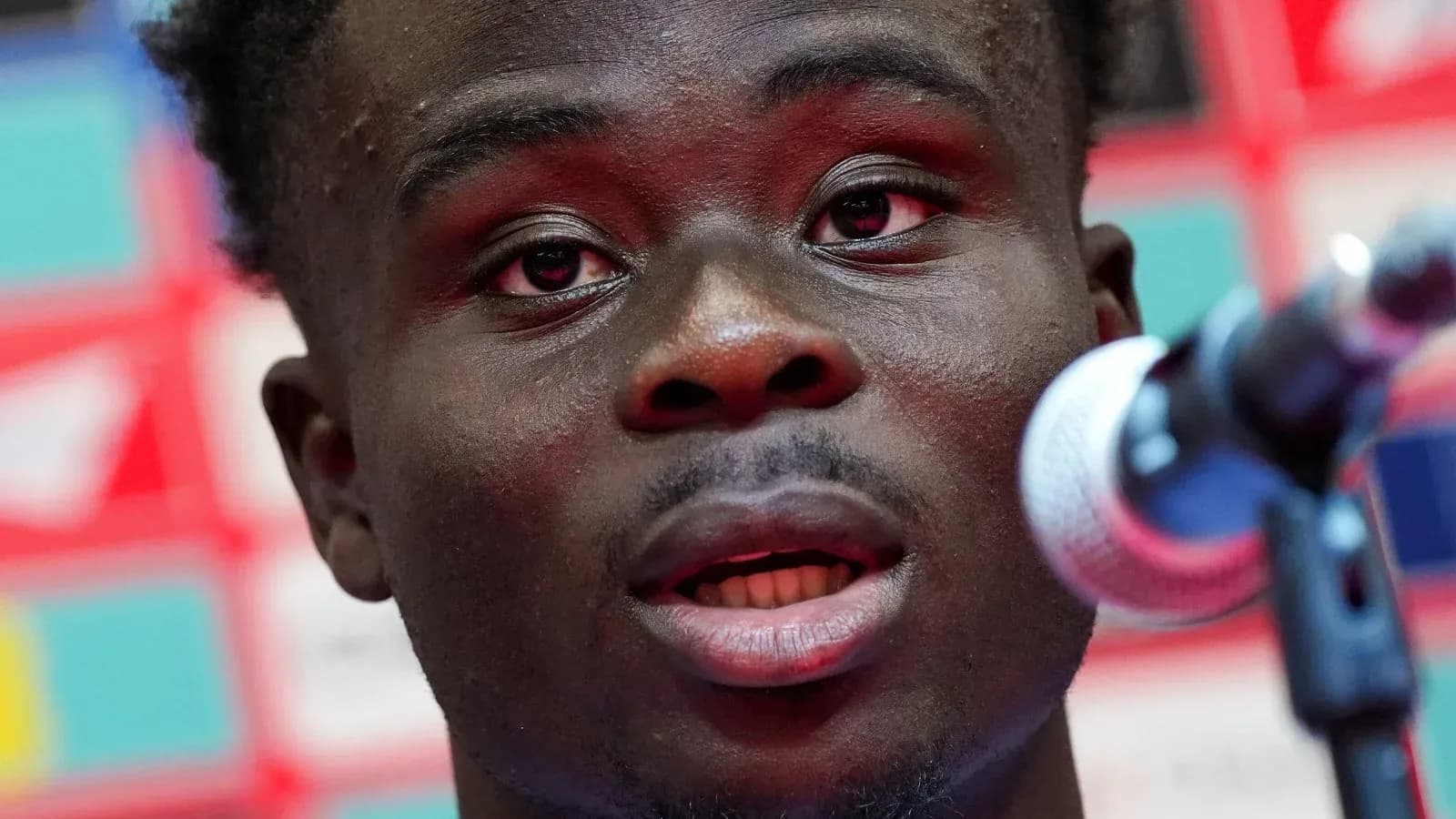
Then there is Bukayo Saka, who has become the lightning rod for another strand of pre-tournament anxiety.
Tuchel has already admitted “it is very unlikely he starts and finishes all the matches” at the World Cup. The numbers back that up. Since mid-March, Saka has started and finished just one game for club or country. He began only two of Arsenal’s final seven Premier League fixtures in the title race. He was managed carefully in the Champions League semi-final second leg, kept under an hour. For England’s warm-ups, he played less than half an hour and missed the March squad entirely through injury.
None of this is a secret. Saka himself spoke openly about it, saying he feels “ready to go” and is “happy to take the gamble” on his fitness for England. He also went out of his way to credit Mikel Arteta and “the Arsenal medical team” for working closely with England and managing him “amazingly since March.”
Tuchel echoed that praise last week, saying Arsenal “took very good care of him and were very aware of it.”
Yet that measured, nuanced reality did not survive the online headline machine. John Cross’s original Daily Mirror piece – sensibly titled around Saka’s “gamble” and the boost it gives England – was repackaged on the Daily Express website as: “Bukayo Saka sparks Arsenal concerns with alarming England comments at World Cup.”
“Alarming” comments? A player saying he wants to play and feels ready. “Arsenal concerns”? A club that has known for months he is not at 100% and has treated him accordingly.
The situation is complicated enough without the drama. England need Saka. Arsenal need him preserved. Both medical teams have been aligned. The only real gamble is how much strain his Achilles can take in the heat of a World Cup. Everything else is noise.
Storms, SWAT and manufactured peril
That noise has been deafening around England’s camp.
The Sun’s foreign editor Nick Parker has chronicled the supposed dangers stalking the squad. A tornado that “shook” England, even though it forced them to change nothing about their quiet, indoor evening. Now, a SWAT operation.
The latest headline screamed: “SWAT team rushes to armed standoff just mile from England World Cup stadium as suspect arrested.” The opening line underlined the drama: a SWAT team and armed police, an incident a mile from where England will play their first game.
Only by the seventh paragraph came the reality: “There is no indication the incident was connected to the World Cup or posed any threat to the tournament or its venues.”
So no link to England. No disruption. No danger to the stadium. Just a local police operation, inflated into tournament peril because of its proximity on a map.
At this rate, fireworks five miles away will be framed as a psychological test for Tuchel’s men.
Spain stumble, narrative sprints
Even Spain’s stutter has been roped into England’s story.
“Why England and all other World Cup rivals should be worried after Spain are humbled by Cape Verde,” ran one Sun headline, before conceding that Spain “still cannot be ruled out of contention for the trophy” despite drawing their opening game and having two group matches left.
It was a contortion that captured the tone of this build-up: every result, every gust of wind, every police siren spun into a warning, a sign, a reason to panic or to dream.
Spain falter? It’s either proof they’re vulnerable or a reminder they remain dangerous. England face a tornado? They’re “shaken,” even as they sit indoors and carry on as planned. A SWAT team responds to an incident with no World Cup link? That’s apparently part of the England story too.
Crossed wires over Isak
The confusion is not confined to England.
Jeremy Cross, writing in the Daily Mirror, argued that Liverpool will be quietly pleased to see Florian Wirtz and Alexander Isak shine at the World Cup. Fair enough. Wirtz impressed against Curacao. Isak did the same against Tunisia. Soft opposition, but useful minutes.
Then came the odd line: “Iraola will want this to continue. He would never admit it, but the Spaniard will hope Isak uses the biggest stage of all to find himself again, before taking that feeling back to Anfield.”
Why would Andoni Iraola “never admit” he wants his most expensive striker to find form on the biggest stage? Why would a manager be reluctant to say he wants his centre-forward confident and firing? The implication that his Spanish nationality, and the faint possibility of facing Sweden later in the tournament, somehow makes that hope secretive only adds another layer of confusion.
A manager wanting his best player to play well is the least controversial opinion in football. Dressing it up as something covert just adds to the sense of crossed wires.
England walk into the noise
So England head towards Croatia wrapped in a familiar storm: injured stars rushing to be fit, selection calls dissected to the last syllable, off-field incidents inflated into existential threats, and a manager told that anything less than the last four is failure.
Tuchel cannot control the weather, the headlines, or the way a FaceTime call becomes a national talking point. He can control only his team selection and the minutes he squeezes from players like Saka.
Between the tornadoes that changed nothing, the crimes that never touched them, and the “alarming” comments that were anything but, the real question is simple: when the noise finally stops and the whistle goes, how many of England’s best will actually be ready to play?