.svg&w=384&q=75 "Naijagoal logo")

England's Semi-Final Struggle Against Argentina: Kane's Disappearing Act
For an hour in New Jersey, England went toe-to-toe with the world champions and looked like they belonged. Thomas Tuchel’s team did not dominate Argentina, but they matched them stride for stride, tackle for tackle. When Anthony Gordon swept in the opener on 55 minutes, it felt less like a smash-and-grab and more like a fair reward for a side that had stood its ground.
This was the first punch. Everyone inside the stadium knew Argentina would throw another. The question was whether England could take it and swing back.
They couldn’t. They backed off. They shrank. Argentina, emboldened, poured forward. Lionel Scaloni spoke later of his team “smelling blood in the water”. Tuchel, by then, might as well have been tossing buckets of chum off the side.
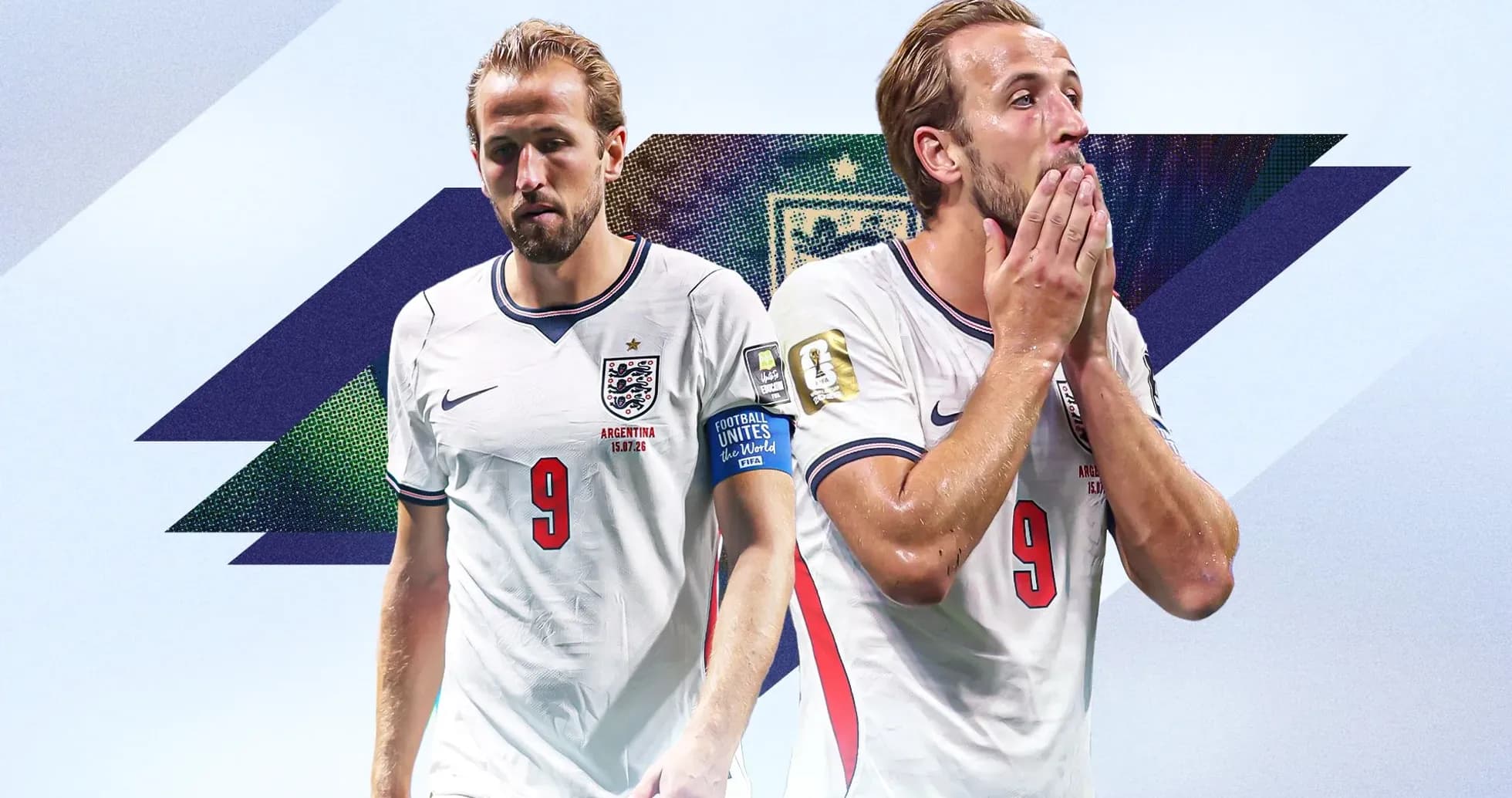
And through it all, Harry Kane drifted around the edges of the chaos like a man trapped in the wrong film.
His numbers are brutal: 26 touches, nine completed passes, one blocked shot, no touches at all in Argentina’s box. On paper, it reads like a disappearing act. On grass, it was more complicated than that.
This was a messy, bitty semi-final. England needed a street fighter as much as a finisher, and Kane answered that call in the first half. He hurled himself into duels, more of them than Lisandro Martínez or Alexis Mac Allister. He went to ground, he chased lost causes, he put his body where it hurt. For 45 minutes, when the game was more about collisions than combinations, that had value.
Once England scored, the demands changed. Kane didn’t.
Tuchel faced a knotty problem after Gordon’s goal. Just days earlier at the Azteca, England had survived a siege to beat Mexico, a backs-to-the-wall resistance that will live long in the memory. Kane stayed on for 89 minutes that night, scrapping, kicking, contesting everything. It had worked.
So Tuchel trusted him again. The captain stayed on. The game turned.
Kane himself admitted England retreated too far.
“For one reason or another, we struggled to be on the ball, we struggle to put pressure on the ball and it allowed them to create more momentum and created more attacks for them in our final third,” he said afterwards.
The sting in that assessment is that Kane was woven into the problem. England desperately needed an outlet, a striker to pin one of Argentina’s heavy-legged centre-backs and give their defenders a target to hit. Kane is as close to a complete No 9 as the modern game offers, but he cannot run away from anyone. So he did what he always does when the tide turns: he dropped off, tried to plug gaps, tried to calm things down.
He ended up neither protecting his defence nor threatening Argentina’s.
This was no longer a game for him. Tuchel should have hooked his captain, gone for legs and chaos and a ball over the top. Instead, Kane watched the storm build in front of him and then watched it rip England apart.
Strip away the emotion and it is still a bitterly underwhelming end to a season that had looked like the crowning of a career. In Germany, Kane was astonishing. He shattered the single-season goals record for a Bundesliga player with 58 in all competitions. No one in Europe’s top five leagues matched his 36 in domestic play. He became the fastest Bayern Munich player ever to reach 100 goal contributions. Bayern won the title by 16 points and could have made it uglier had they really cared to.
On raw numbers, the Ballon d’Or case was real. These are totals that Robert Lewandowski never touched in Bavaria. This was Messi-Ronaldo volume, territory English strikers simply do not enter. On output alone, Kane had a serious argument to become the first English winner of the award since Michael Owen.
Bayern’s failures when the lights were brightest dulled that argument. They traded blows with eventual Champions League winners PSG, but couldn’t overturn a first-leg deficit and fell 6-5 in the semi-final. The World Cup, then, loomed as a reset button. Kane knew it.
“I’d be one of the favorites, definitely,” he said before the tournament. “Given the trophies I’ve won this season and the number of goals I’ve scored, I’d be in the running. Especially as, should England win the World Cup, one could imagine the trophy going to an English player.”
For five games, he played like a man chasing that golden year. Two goals against Croatia, one against Panama, two more against Congo, an assist at the Azteca. He and Jude Bellingham set the tempo; everyone else followed.
The Golden Boot often tilts these debates. Going into the semi-final, Kane trailed Lionel Messi and Kylian Mbappé by two. If England were going to reach the final, logic said their captain would need to close that gap. The stage was set. Kane was poised.
He never landed the blow. By failing to score against Argentina, he has all but watched the Golden Boot slip from his grasp. Even a hat-trick against France in a third-place game he should probably sit out would likely not be enough, not with Messi waiting for Spain in the final.
He will fly back to Germany without the World Cup, without the Golden Boot, and without the personal coronation that seemed within reach. The chance has gone.
The cruel twist is that this might have been the last one that truly mattered.
Kane’s move to Bayern felt like a second act, a fresh script after a decade of carrying Tottenham further than they had any right to go. He stayed there too long, everyone knows that now. He was consistently among the Premier League’s finest, but the supporting cast was too often thin, the ambition above him too often timid. Only now, as he thrives elsewhere, have Spurs started to throw serious money at the problem.
His first two seasons in Munich have been a rebuttal to anyone who doubted his elite status. He can still dominate at the very top. He might not even have peaked yet. He talks often about longevity, about studying other sports, about athletes who bend age to their will. He wants to push back against the years. On the evidence of club football, he can.
International football laughs at those plans. There is no rhythm, no long arc of a season, no gentle load management. There are no midwinter rests, no careful periodisation. Camps are short, tournaments shorter. You arrive at the end of a draining year, and then it’s a sprint. In that sprint, at the moment of maximum strain, Kane’s legs and touch deserted him.
If this really is the last World Cup where he stands at the absolute centre of England’s hopes, then his legacy with the national team becomes one of football’s strangest puzzles.
On one hand, he is surely England’s greatest ever striker. If he stays fit, he will glide past 100 international goals. Peter Shilton’s 125-cap record is within reach; Kane is on 121 already. He has scored more penalties at World Cups than anyone else. He owns the 2018 Golden Boot.
On the other hand, the empty shelf where a major international trophy should sit will define him for many. He drifted through Euro 2024. He missed a pivotal penalty against France in Qatar. In 2018 and at the delayed Euro 2021, he operated in weaker squads than the one that just fell to Argentina, yet he never quite dragged England over the line in the way his numbers suggest he should. The giants of the goalscoring pantheon – Messi, Ronaldo, Pelé, Maradona, Henry – all have a trophy they can point to. Kane does not.
England have their own problem. Look behind him and the drop-off is steep. Tuchel brought a 30-year-old Ollie Watkins and a 30-year-old Ivan Toney to this World Cup. Both are fine forwards. Neither looks like the next great No 9. There is no prodigy kicking the door down. Pushing Kane aside will not be easy, nor obviously wise.
So the likely outcome is drift. Kane will lead the line at Euro 2028. England will be strong again. By then he will be on the wrong side of 30, deeper into the phase where his brain sees passes his legs can’t always reach. Yet there is nobody obvious to take the shirt from him.
He has no desire to give it up.
“The national team is my pride and joy,” he said. “It's what I love to do most more than anything. Obviously four years is a long way away, I'm 33 this summer but it never ended with Leo [Messi] there, he's still performing at the highest level. I never want to put a limit on these things.”
The problem is that tournaments impose their own limits. Kane has stood on this stage before, with history within reach, and watched it slide away. This one, with the Ballon d’Or dangling just out of reach and Argentina roaring back past a fading England, feels like the biggest miss of all.