.svg&w=384&q=75 "Naijagoal logo")

Dinamo Zagreb and Viking Draw 2-2 in Tactical UEFA Clash
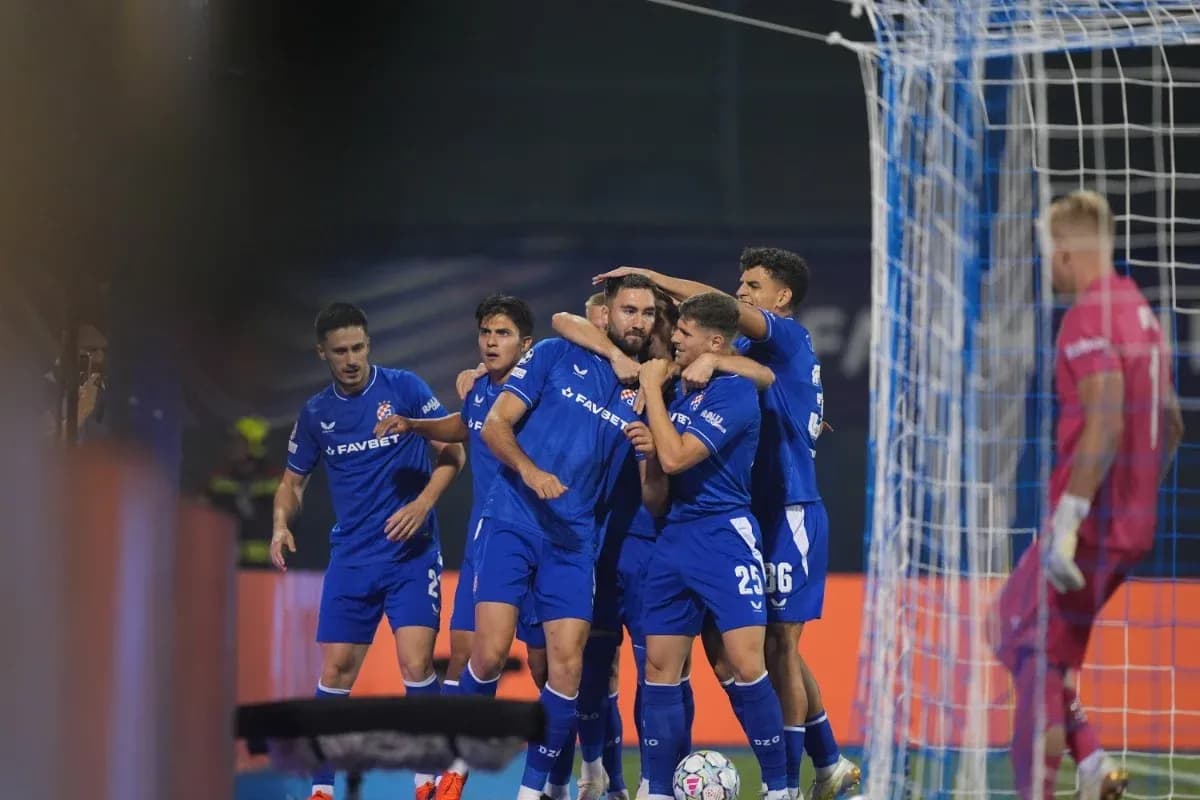
Dinamo Zagreb and Viking produced a tactically rich 2-2 draw at Stadion Maksimir in this UEFA Champions League Play-offs tie, a match where control and territory belonged overwhelmingly to the hosts but efficiency and transitional clarity kept the visitors level. Dinamo’s 4-1-4-1 under Mario Kovacevic imposed a clear positional structure, while Bjarte Aarsheim’s 4-3-3 for Viking was built around compactness, vertical counter-attacks and ruthless use of their limited shots.
EXECUTIVE SUMMARY
Dinamo Zagreb dominated the ball with 60% possession, generated 23 total shots (17 inside the box) and forced Viking into long spells of deep defending. Yet, despite this structural superiority, the hosts could not convert their territorial control into a decisive margin, finishing with only 4 shots on goal and being held to 2-2 after leading 2-0 inside ten minutes. Viking, with just 6 shots and 3 on goal, were remarkably clinical, using their front three and advanced midfield runners to punish Dinamo’s defensive spacing in the first half. The draw leaves the tie finely balanced, but the underlying tactical picture was one of Dinamo’s sustained control against Viking’s selective, well-timed attacking bursts.
SCORING SEQUENCE & DISCIPLINARY LOG
Dinamo’s aggressive start was immediately reflected on the scoreboard. At 6', D. Beljo (Dinamo Zagreb) finished a move assisted by overlapping left-back M. Perez Vinlof to make it 1-0. Four minutes later, at 10', the roles inverted in functional terms: M. Lisica (Dinamo Zagreb), running from midfield, scored after being supplied by Beljo, pushing the lead to 2-0 and confirming the effectiveness of Dinamo’s early vertical connections between the lone striker and the advanced midfield line.
Viking’s response came through their 4-3-3 front line exploiting transitional moments. At 26', P. Christiansen (Viking), assisted by T. Moi, struck to reduce the deficit to 2-1, a goal born from Viking’s ability to find their forward quickly once they broke Dinamo’s first pressing line. Then at 39', Z. Tripic (Viking), again assisted by T. Moi, equalised for 2-2, underlining Viking’s threat whenever Moi could receive and turn in midfield to release the forwards.
Discipline was relatively light but tactically relevant. Viking collected the first caution at 65': Joe Bell (Viking) — Foul. His booking reflected the strain on Viking’s midfield as they tried to disrupt Dinamo’s rhythm between the lines. Dinamo’s only card arrived at 83': Moris Valinčić (Dinamo Zagreb) — Foul, indicative of the hosts’ occasional vulnerability when Viking broke through their advanced full-backs and high midfield line. Totals: Dinamo Zagreb 1 yellow, Viking 1 yellow, no reds.
TACTICAL BREAKDOWN & PERSONNEL
Kovacevic’s 4-1-4-1 for Dinamo Zagreb was built on a clear spine: I. Nevistic in goal, a back four of M. Perez Vinlof, S. McKenna, S. Dominguez and M. Valincic, with J. Misic anchoring in front of them. Ahead of Misic, a line of four—M. Orsic, M. Zajc, L. Stojkovic, M. Lisica—supported D. Beljo as the lone forward. The structure aimed to pin Viking deep with width from Orsic and Lisica and half-space occupation from Zajc and Stojkovic.
In possession, Dinamo’s 60% share of the ball and 544 total passes (438 accurate, 81%) show a methodical, circulation-heavy approach. Misic’s role as single pivot was crucial to recycling possession and allowing the full-backs, particularly Perez Vinlof, to advance. The left-back’s assist for the opener illustrated how Dinamo sought to overload wide channels before delivering into the box, where Beljo’s physical presence and lay-offs were key—evident in his assist for Lisica’s goal.
Despite 23 total shots and 17 from inside the box, Dinamo produced only 4 shots on goal, a sign that Viking’s last-line defending and box density effectively narrowed shooting angles. The 7 blocked shots underline how often Viking’s defenders, notably G. Stensness and H. Falchener, stepped out to contest attempts at the edge of the area.
Out of possession, Dinamo defended high, but the spaces behind their advanced midfield line were exploitable. Viking’s two goals came when Moi and the central midfield trio managed to bypass the first press and find the front three early. With only 6 total shots and 5 inside the box, Viking showed that when they did reach advanced zones, they did so with numbers and precision.
Viking’s 4-3-3, with A. Ostbo in goal, a back four of K. Haugen, H. Falchener, G. Stensness and H. Heggheim, and a midfield of K. Askildsen, Joe Bell and T. Moi, was compact and horizontally narrow. Their 371 total passes (272 accurate, 73%) and 40% possession reflect a game plan centred on absorbing pressure and then breaking forward. Moi’s two assists were emblematic: he found pockets between Dinamo’s lines, then released Christiansen and Tripic into the half-spaces with minimal touches.
The substitution pattern highlighted tactical adjustments. Viking’s early change at 58', with S. Kvia-Egeskog (IN) coming on for T. Moi (OUT), suggested a shift towards fresher legs and perhaps more defensive stability in midfield, though it inevitably reduced their creative thrust. Later full-back and forward rotations at 72' and 87' maintained energy in the wide channels to cope with Dinamo’s sustained crossing and overlapping.
Dinamo’s changes were more about refreshing attacking ideas while keeping the basic 4-1-4-1 structure. L. Kacavenda (IN) for M. Zajc (OUT) at 60' injected a new profile between the lines, while the double change at 68'—R. Mudrazija (IN) for L. Stojkovic (OUT) and A. Hoxha (IN) for M. Lisica (OUT)—sought more direct penetration and perhaps stronger counter-pressing. Late defensive and attacking swaps at 84'—N. Galesic (IN) for M. Valincic (OUT) and S. Prevljak (IN) for M. Orsic (OUT)—indicated a push for a winner without sacrificing structural balance.
In goal, I. Nevistic (Dinamo Zagreb) made 1 save, a reflection less of his performance than of Viking’s low shot volume but high finishing efficiency. At the other end, A. Ostbo (Viking) made 2 saves; crucially, Viking’s defensive block did much of the work in front of him, limiting Dinamo’s clear sights of goal despite the heavy shot count.
THE STATISTICAL VERDICT
The numbers reinforce the tactical story of dominance without decisive cutting edge for Dinamo and ruthless economy for Viking. Dinamo’s 60% possession, 544 passes at 81% accuracy and 23 total shots (17 inside the box, 7 blocked) speak to a side that controlled territory, circulated the ball well and repeatedly entered dangerous zones. Yet, converting only 4 shots on goal into 2 goals suggests that Viking’s compactness and last-ditch defending successfully forced many efforts into crowded areas or suboptimal angles.
Viking, with 40% possession and 371 passes at 73% accuracy, operated in a more vertical, risk-accepting mode. Their 6 shots, 5 from inside the box and 3 on goal, yielded 2 goals—an efficiency that compensated for their territorial inferiority. The foul count (Dinamo 12, Viking 10) and equal yellow card tally underline a match that was competitive but not chaotic, with both teams generally maintaining structural discipline.
With no red cards and no extra-time or penalties, the 2-2 full-time score accurately encapsulates a contest where Dinamo’s structured dominance met Viking’s sharp counter-punching. From a tactical and statistical perspective, Dinamo will feel they left an advantage on the table, while Viking can be satisfied that their game plan maximised limited attacking opportunities and kept the tie finely poised.