.svg&w=384&q=75 "Naijagoal logo")

Dinamo Zagreb's Tactical Victory Over FC Thun in Extra Time
Dinamo Zagreb’s 3-2 extra‑time win over FC Thun at Stadion Maksimir was a tactical siege that eventually broke a stubborn, then numerically weakened, Swiss block. Over 120 minutes, Dinamo translated overwhelming territorial control and volume of attacks into a late, deserved turnaround, while Thun’s early 4-4-2 counterpunch and subsequent down-to-ten reconfiguration nearly produced a major upset in the UEFA Champions League 2nd Qualifying Round.
Mario Kovacevic set Dinamo up in a 4-1-4-1 with J. Misic as the single pivot underpinning an aggressive line of four attacking midfielders behind D. Beljo. The structure was designed for sustained occupation of Thun’s half and constant wide circulation. With 76% possession and 702 total passes (618 accurate, 88%), Dinamo imposed a positional-play game: full-backs M. Valincic and B. Goda pushed high, the advanced midfield line of M. Orsic, M. Zajc, G. Vidovic and M. Lisica sought to pin Thun’s back four, and Misic recycled second balls and rest defence.
Early, however, the structure was punished in transition. Thun’s 4-4-2 under Luca Privitelli Gian was compact and direct: F. Dursun and B. Labeau were the first pressing line, but the real threat came when the ball was won. At 4', Thun broke Dinamo’s first line and exploited space behind the advanced full-backs, with B. Labeau finishing a move assisted by N. Zoukit. At 22', a set-piece or second-phase situation allowed centre-back M. Burki, assisted by F. Fehr, to double the lead. Dinamo’s rest defence—particularly the spacing of centre-backs S. Dominguez and S. McKenna in relation to Misic—was too stretched for a side playing with such a high back line.
From that point, the match became a siege. Dinamo’s 29 total shots, including 18 from inside the box, show how relentlessly they pinned Thun back. Fourteen corner kicks to Thun’s one underline the territorial imbalance. Yet Thun’s defensive organisation in a low 4-4-2 block, later a 4-4-1 after the red card, initially limited Dinamo to lower-quality looks and forced many efforts from suboptimal angles, reflected in 16 shots off target and seven blocked.
Individually, the turning point was the reshaping of Dinamo’s attacking line after half-time. The interval substitution of M. Perez Vinlof (IN) for B. Goda (OUT) at 46' shifted the left flank dynamic: Perez Vinlof offered more aggressive overlapping, allowing Orsic to move into more central pockets before he was himself withdrawn at 59' for A. Hoxha (IN), who added directness and one‑v‑one threat. On the right, the 58' double switch—L. Kacavenda (IN) for G. Vidovic (OUT) and F. Topic (IN) for M. Lisica (OUT)—recalibrated the attacking midfield line. Kacavenda provided vertical runs between full-back and centre-back, while Topic offered fresher legs and better half-space occupation, which would later be crucial.
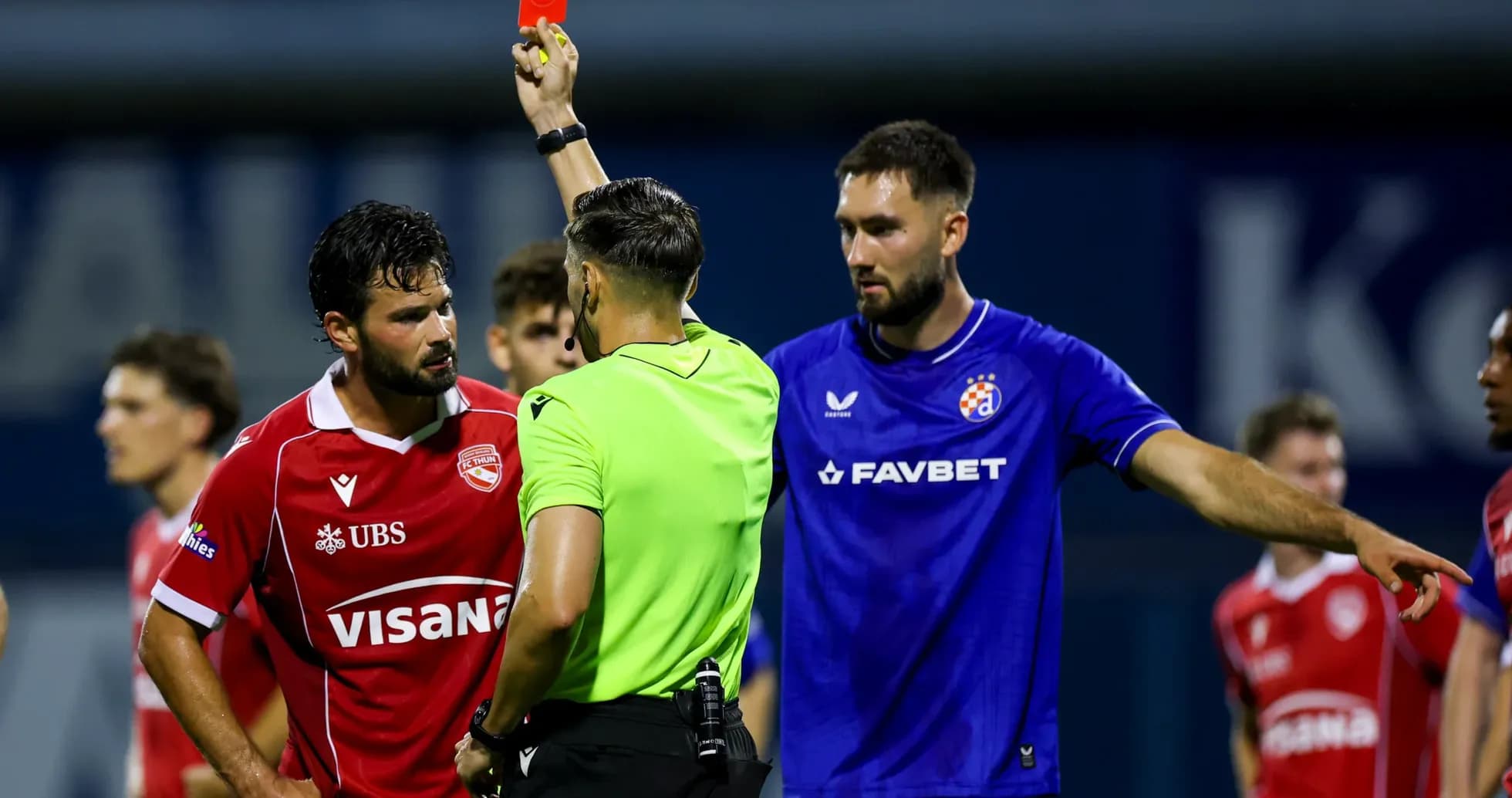
Thun’s substitutions were more reactive and structurally conservative. M. Gutbub (IN) for F. Dursun (OUT) at 46' freshened the front line but did not change the 4-4-2 shape. At 58', N. Maier (IN) for N. Zoukit (OUT) rotated the midfield line, but the key defensive event came through discipline rather than a change of shape: after a VAR “Card upgrade” review at 66', Marco Bürki’s foul was reclassified, and at 67' he was shown a red card for “Professional foul last man”. Down to ten, Thun had to abandon any meaningful pressing and retreat into a 4-4-1, with subsequent substitutions (N. Burgy for B. Labeau at 68', L. Dahler for N. Reichmuth at 77', and later C. Ibayi and L. Stewart) aimed purely at shoring up the block and adding fresh legs to survive waves of pressure.
The numerical advantage finally allowed Dinamo’s structure to bite. At 74', Valincic’s advanced positioning from right-back paid off, his delivery finding D. Beljo for 1-2. This was archetypal of Dinamo’s plan: full-back high, nine between centre-backs, and the pivot Misic securing rest defence. Four minutes later, at 78', Kacavenda’s inside‑right movements were rewarded, finishing from a cutback by Topic to make it 2-2 and reflect the pattern of sustained right-sided overloads and underlaps.
With extra time required, Kovacevic continued to manage the back line and midfield balance. N. Galesic (IN) for S. Dominguez (OUT) at 91' refreshed the centre of defence without altering the 4-1-4-1. Thun, under constant strain, introduced C. Ibayi for F. Fehr at 106' to add running capacity on the flank, but the structural picture remained a deep 4-4-1 defending their own area.
The decisive moment came in the second period of extra time. At 112', Misic, still the positional anchor, stepped higher to connect play and found Valincic, who had again advanced aggressively from right-back. Valincic’s goal for 3-2 encapsulated Dinamo’s tactical arc: full-backs as auxiliary attackers, the pivot as the organiser, and numerical superiority turning territory into decisive penalty-box presence.
Discipline played a significant tactical role. Dinamo collected five yellow cards—Miha Zajc (21', “Foul”), Bruno Goda (26', “Foul”), Josip Mišić (62', “Foul”), Fran Topić (64', “Argument”), and Arber Hoxha (120', “Argument”)—a reflection of aggressive counter-pressing and emotional intensity in the comeback. Thun’s bookings were more structural: Christopher Ibayi (116', “Foul”) in the dying minutes, and crucially the red card to Marco Bürki at 67' after VAR intervention, which fundamentally changed the match’s tactical geometry.
In goal, I. Filipovic (Dinamo Zagreb) was largely a spectator in open play, required for only one recorded save as Thun produced just three shots on target from eight total attempts. The real defensive work for Dinamo was positional, in rest defence and counter-press, rather than shot-stopping. At the other end, N. Steffen (FC Thun) made four saves under extreme pressure but was increasingly exposed by the volume and proximity of Dinamo’s attacks, with 18 shots inside the box eventually overwhelming his back line.
Statistically, the verdict is clear: Dinamo’s 76% possession, 702 passes to Thun’s 231 (134 accurate, 58%), 29-8 shot advantage and 14-1 corner count describe a match where the Croatian side controlled virtually every structural aspect. Thun’s early 2-0 lead and compact 4-4-2 game plan were tactically coherent for a counter-attacking underdog, but once reduced to ten men, their model became unsustainable against such territorial and numerical pressure. Dinamo’s 4-1-4-1, initially vulnerable in transition, ultimately proved the right framework to sustain attacks, recycle pressure and, with the aid of impactful substitutions and full-back aggression, turn statistical dominance into a hard-earned extra-time qualification.