.svg&w=384&q=75 "Naijagoal logo")

Curaçao's World Cup Journey: From Dutch Roots to New Flag
On a small Caribbean island that still flies the Dutch flag, the backbone of the Netherlands’ present and future wears another colour.
Curaçao, long tied to the Kingdom of the Netherlands, has watched generations of its people move to Europe and reshape Dutch football. Those families now fill the World Cup squad that plays under the island’s own flag, recognised by FIFA only since 2010. Of the 26 players heading into this tournament, just one was actually born on Curaçao. Fittingly, he is its most recognisable face: Tahith Chong.
Chong’s path is familiar to anyone who follows European football. A precocious winger at Manchester United, he broke into the first team but never quite nailed down a place, managing 16 competitive appearances before a short, underwhelming loan at Werder Bremen in 2021. He has since rebuilt at Sheffield United, and his story is only one strand of a squad that has quietly scattered across Europe.
Six of Curaçao’s World Cup players have passed through Germany. Chong had his spell at Bremen. Gervane Kastaneer featured for 1. FC Kaiserslautern. Riechedly Bazoer tried to restart his career at VfL Wolfsburg. Roshon van Eijma turned out for Preußen Münster. Jürgen Locadia and Joshua Brenet both wore the colours of TSG Hoffenheim.
It is Brenet, the right-back now lining up for Curaçao, whose journey stands out for its sharp turns and self-inflicted collisions.
From Eredivisie champion to Hoffenheim outcast
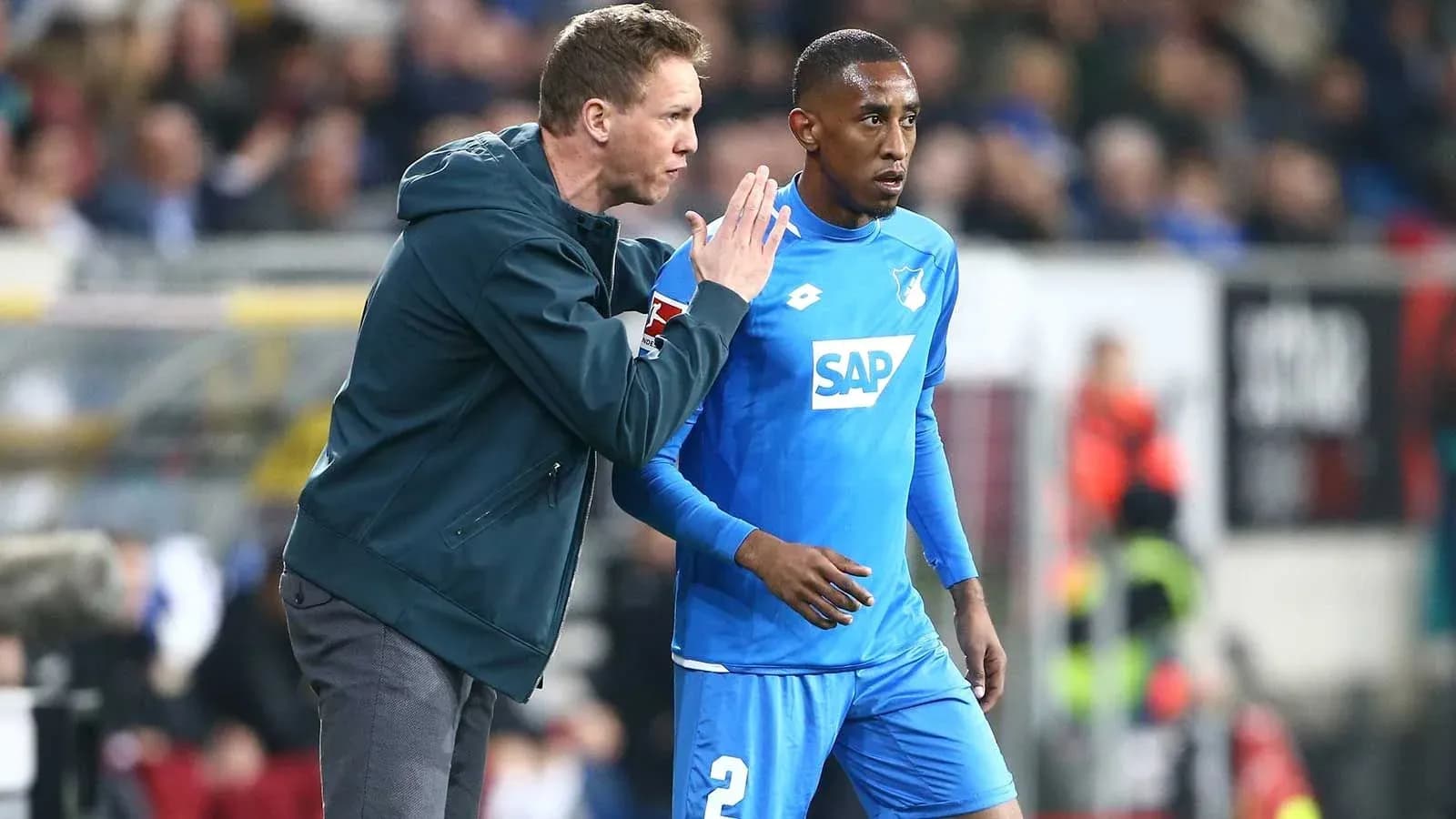
In 2018, Hoffenheim paid €3.5 million to prise Brenet from PSV Eindhoven, where he had already won the Eredivisie three times and earned two caps for the Netherlands. Julian Nagelsmann, then the rising star of German coaching and now in charge of Germany, helped drive the move. On paper, it looked shrewd: a versatile full-back, international pedigree, still with room to grow.
On the pitch, it never took off.
Brenet spent his first Bundesliga matches watching from the bench. Then came the moment that defined his time at Hoffenheim. Before the club’s first-ever Champions League game, against Shakhtar Donetsk, he skipped a video session. Nagelsmann reacted immediately and dropped him from the squad.
The coach eventually brought him back into the fold, but the relationship never fully recovered. Brenet drifted to the fringes, used only in flashes for the rest of the campaign. When Nagelsmann left, things got worse. His successor, Alfred Schreuder—now Nagelsmann’s assistant with Germany—did not use him at all. Sebastian Hoeneß later sent him down to the reserves in the fourth-tier Regionalliga Südwest.
The demotion reflected more than just form. Repeated disciplinary problems, including persistent lateness, damaged his standing inside the club. Hoffenheim tried to move him on, but no one was prepared to pay. Only in 2022, when he left on a free transfer to Twente Enschede, did the German side finally cut ties.
Red cards off the pitch
In Enschede, Brenet reminded people why top clubs had once chased him. His performances picked up again, his athleticism and attacking drive from right-back back on show. Then he undid his own revival.
In January 2023, Dutch authorities caught him driving without a licence twice in two weeks. He had already lost that licence in 2020 after a drink-driving offence. The pattern was impossible to ignore.
“He clearly has no regard for authority. It seems to me as though he is continuing to play football after receiving a red card,” the presiding judge said, before handing down a one-month prison sentence in 2024. It was not his first brush with the courts. In 2021, he had received a suspended sentence with a fine and community service for domestic violence.
On appeal, the prison term for driving without a licence was converted into community service. Twente did not wait for the dust to settle. They terminated his contract.
The nomad years and a new flag
From there, Brenet’s career scattered across continents. He signed for Al-Rayyan in Qatar, but played only six times in the 2024/25 season. By autumn he had moved again, this time to Livingston FC in Scotland. That stay was brief as well. For the second half of the campaign, he joined Kayserispor in Turkey.
Amid the churn of clubs, one decision gave his career a new direction. Despite representing the Netherlands extensively at youth level and making his senior debut for Oranje in the 2016 World Cup qualifiers, he applied to switch national allegiance to Curaçao, the country of his parents. FIFA approved the change.
Since making his debut for Curaçao in 2024, he has become a surprising pillar of the side. Six goals in 17 appearances tell their own story for a right-back. In the final warm-up game before the World Cup, against Aruba, he started on the right of defence and scored again.
Now comes the twist that football loves to script.
On Sunday at 7 pm, in their opening World Cup match, Curaçao will face Germany. On the opposite bench: Julian Nagelsmann and Alfred Schreuder, the coaches who once benched him, dropped him, and ultimately moved on without him.
For Brenet, it is not just a group-stage fixture. It is a collision of past and present—played under a different flag, for a different island, with everything to prove.