.svg&w=384&q=75 "Naijagoal logo")
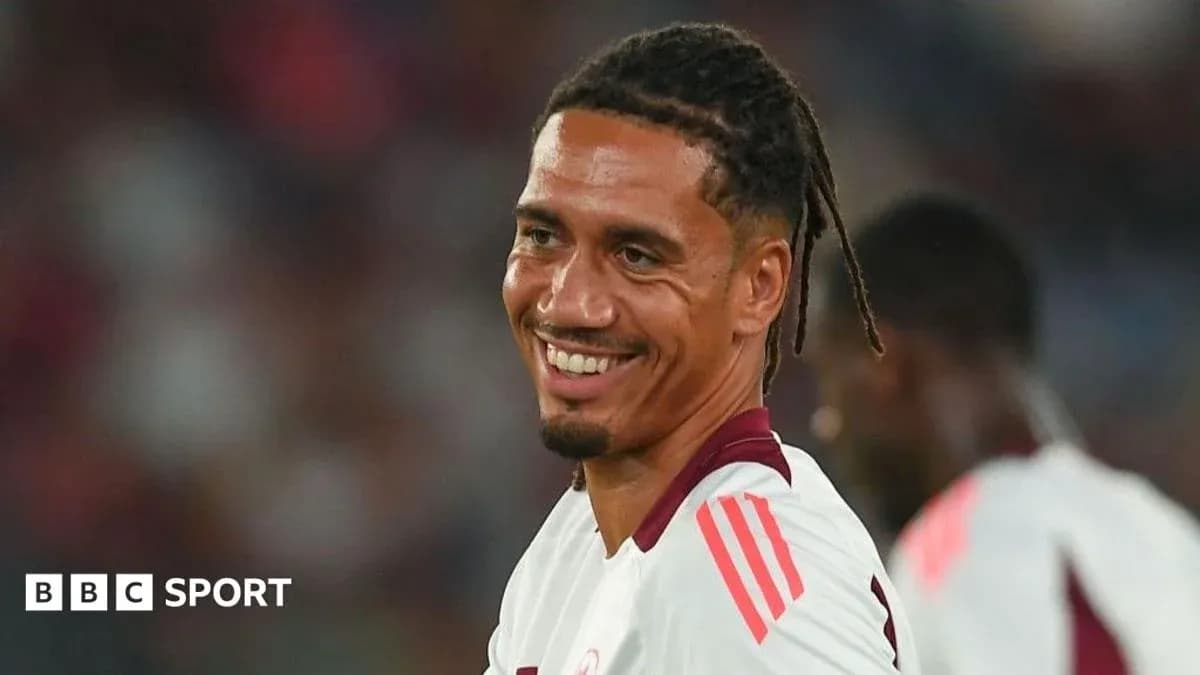

Chris Smalling: A Career Defying Expectations
Chris Smalling has never really followed the script.
He says one sentence and it’s obvious: this is not a footballer killing time before the next contract. This is a 36-year-old who has gone from non-league Maidstone to a Champions League final in three years, collected 580 club appearances in three countries, played under Sir Alex Ferguson and Jose Mourinho, won trophies with Manchester United and Roma, and still talks like someone who thinks the next step might be the most important one.
Now he is back in the north west of England with his family, weighing that next move. Not retirement. Not yet. A new club.
“I know my body now better than when I was 26 and that's shown in the games I'm playing,” he says. It doesn’t sound like a cliché. It sounds like a man who has spent years obsessing over the details.
He remembers when Ferguson first nudged the dressing room towards marginal gains. Ryan Giggs doing yoga. The idea that after 30, every year is borrowed time and must be treated that way.
“Actual training is a very short time,” Smalling says. The work, as he sees it, starts long before a whistle blows. “The longevity and recovery starts very early in terms of what I'm eating and doing between sessions, even down to my supplements now.”
Pre-season blood tests are standard in elite football. Smalling went further. Genetics testing. A deep dive into how his body works and what it needs. “A lot of my supplements were changed because of that,” he explains. It sounds more like an elite endurance athlete than a centre-back who came through the non-league grind.
Last season he was ever-present for Al-Fayha in the Saudi Pro League. At 36, in a league that has turned into a magnet for big names, he played every game. He’s proud of that. Proud because his career was never supposed to look like this.
“It wasn't even plan D,” he says, going back 18 years.
Back then, he was at Maidstone, with his life mapped out away from the pitch. University, financial economics, a sensible future. “I had everything set out. I already had my A levels, and I was looking at other non-league clubs near Leicester because I still wanted to play.”
Football, at that level, was a passion, not a plan. Then, late in the summer, came a chance so slim he barely believed it. Fulham wanted a look.
He turned up, played a practice game. Roy Hodgson watched. Within a week, Smalling was in the manager’s office, being offered a contract. “It wasn't even a full week,” he says. “I didn't have any time to get my head around it. I was just in total shock.”
That wouldn’t be the last time Hodgson would change his life in a matter of minutes.
On 17 January 2010, Smalling travelled with Fulham to Blackburn for a Premier League game. He didn’t get on the pitch in the 2-0 defeat. The important moment came the night before.
“There had been a lot of talk about other clubs but not Manchester United,” he says. Then Hodgson pulled him off the coach. Fulham had accepted a bid. Sir Alex Ferguson was on his way to the hotel. He had 45 minutes to process that his entire career path had just shifted.
He rang his mum. Then he sat in his room, trying to work out what on earth he was going to say to the most powerful manager in English football.
They spoke for “at least a couple of hours”. Ferguson, he recalls, was “so calming and reassuring”. Smalling, 20 years old and facing a dressing room full of established centre-backs, had doubts. “I wanted to develop and wondered 'how do I fit in?'”
Ferguson told him he would get a chance. Told him he believed in him. It was enough. “To be able to share the dressing room and the pitch and have conversations with him, is just incredible.”
That personal touch, Smalling insists, is what separates the truly great managers from the rest. The ability to look a player in the eye and make him feel 10 feet tall.
From the outside, his relationship with Mourinho at United is often reduced to one moment: the public criticism in November 2016 over his reluctance to play through an injury. Smalling doesn’t see it that way.
“For United or Roma, Jose picked me for most games because we had a good relationship and he trusted me,” he says. Trust, for him, is the thread that runs through both managers.
“It's very easy to influence younger players but the beauty of Sir Alex and Jose is that they were able to create that belief in senior players.” The ones who have seen everything, heard every team talk. “A lot of managers can give good team talks but if you look at some eye-to-eye, see the passion and real belief that 'it's going to happen' senior players follow and the rest lock in. That's the beauty of top-class manager.”
Then there’s the story behind that injury row. Smalling describes playing through a broken toe, taking injections, pushing himself beyond sensible limits because that was the mentality Mourinho had drawn out of him. “I was having injections in broken toe because he had created that mentality in me that I could do anything, even if, maybe, I shouldn't.”
Eventually, he hit the medical limit for injections. He had to stop in a warm-up. Mourinho was disappointed. For some, that would have been the breaking point. For Smalling, it became something else.
“It gave me even more belief because it was easy to choose another centre-back but he wanted me.” That, in his mind, is what counted.
He still messages Mourinho. When the Portuguese coach took over at Real Madrid this summer, Smalling sent him a good-luck note. The bond is real, even if their time together was not always smooth from the outside.
What Smalling won’t be doing is following Ferguson or Mourinho into the dugout.
“I don't think it will be my route,” he says. “I'm quite comfortable with the next stage.” That next stage is already taking shape. He is working on an education programme for young players with the Global Institute of Sport, aimed at giving the next generation tools he had to learn on the fly. “I've got three or four of these types of projects,” he adds.
They can wait. For now, the focus is still on playing. “Once my football career comes to an end, I can put more time to them but at the minute it's all focused on playing because I have that passion and drive and physically my stats are good.”
Whoever signs him next will not just be getting an experienced centre-back.
At Al-Fayha, his influence went beyond the pitch. He pushed for improvements to the gym, to make sure the facilities matched what a modern professional needs. At every club, he says, he wants to leave something behind, not just a set of appearances on a spreadsheet.
He is proud that former teams remember him well, that his impact stretched into the dressing room, the training ground, the culture.
It all goes back to that decision as a teenager. University, financial economics, the “safer route”, as he calls it, or a gamble on a thin sliver of opportunity.
“In that first year, I was not earning a lot of money,” he says of his early Fulham days. “I was playing for the reserves and the 19th man for the first team, travelling around but not quite on the bench. There was no guarantee I was going to earn more money.”
Then came Manchester United. A four-year contract. Then, after the first year, a new one. Another a year later. Another 18 months after that. “There was always this carrot. I never took anything for granted.”
He still doesn’t. A veteran now, with a body tuned by science and a mind sharpened by experience, waiting for the next call.
Some careers are mapped out from academy to retirement. Chris Smalling’s was never meant to happen like this. That might be exactly why there’s still a little more left to write.