.svg&w=384&q=75 "Naijagoal logo")

Chelsea's Midfield Crisis: Two Right-Backs and a Missing Anchor
Chelsea walked off the Emirates pitch beaten 2-1 by the champions, and finished with a sight that jarred with the scale of their summer: two converted right-backs standing side by side in central midfield.
This after spending £349m in one window.
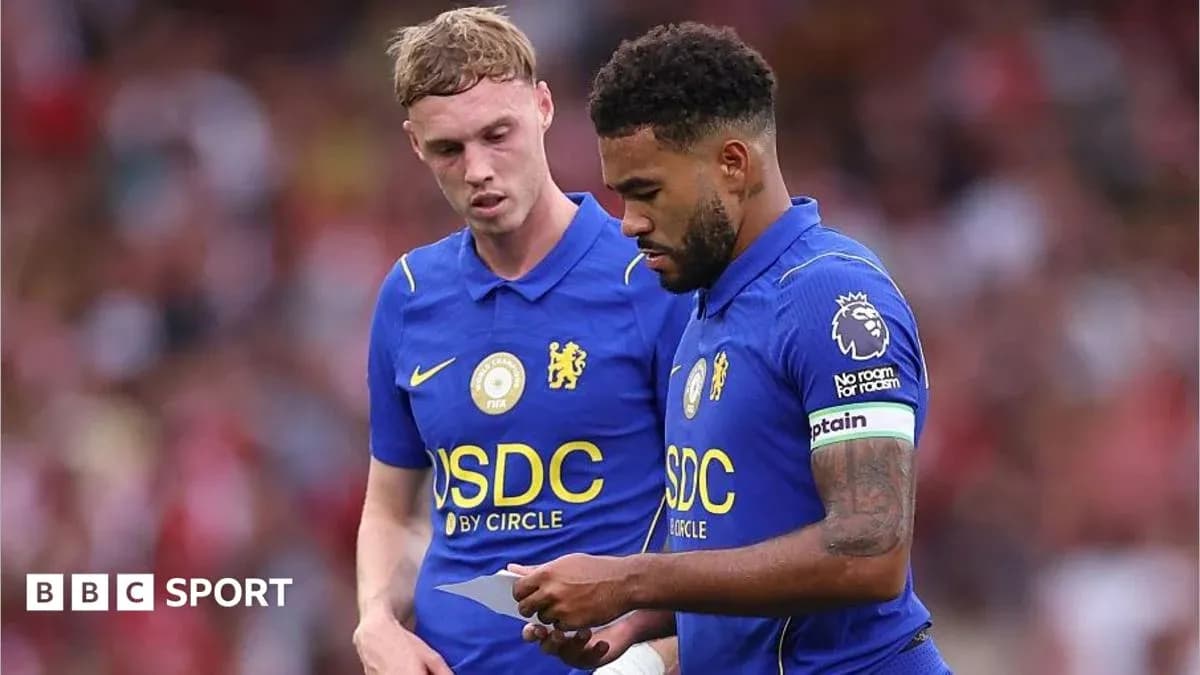
Reece James, the academy right-back reborn as a midfielder, was at the heart of the story. He had played well for long spells, snapping into tackles, using the ball neatly, showing the qualities that persuaded Xabi Alonso to declare before the game that James could become one of the best midfielders in the world. James spent almost half of last season in that role. This is not a wild experiment.
But when the decisive moment came, he switched off. James failed to track Martin Odegaard’s run, the Arsenal captain ghosted into space, and Chelsea’s resistance cracked. One lapse, one finish, one reminder that this is still a work in progress.
Two right-backs, one big question
The image that lingered wasn’t just James watching Odegaard wheel away. It was the closing stages, when Malo Gusto – another natural right-back – came on for Romeo Lavia and joined James in the middle of the pitch.
Chelsea, the big spenders of the summer, trying to chase down Arsenal with a makeshift midfield.
Ashley Young, watching on for BBC Sport, didn’t bother dressing it up.
“Chelsea don't have European football this season so they're playing less games and can concentrate on the Premier League. But the worry is you're finishing a game against the champions, and you've got two right-backs in midfield,” he said.
He went straight to the core of the issue.
“You look at Lavia, who was injured a lot last season. The front line are going to send fear throughout the league but behind that you see the midfield and they're playing right-backs there.
“Teams will be seeing the game today, seeing that Chelsea will sit in there and get men behind the ball, but there's still spaces through the lines, and Arsenal found that out.
“Chelsea are giving up a lot of possession and they're playing counter-attacking football. Today there was probably only once with Pedro Neto down the right side when they capitalised on the counter.”
The gaps through the lines, the lack of control, the reliance on transition. It all circles back to one name.
Life without Caicedo
Chelsea’s midfield problem starts with the absence of Moises Caicedo.
The Ecuador international, one of the most durable midfielders in Europe over the past three seasons, is out with an unspecified injury. He broke down just 11 minutes into a substitute appearance against Brighton last week and has not featured since.
For a player who had missed only two matches in three seasons – one through a knock, one through illness – Alonso suddenly finds himself in rare territory for a Chelsea manager: planning without his anchor.
Asked about Caicedo’s status, Alonso admitted the staff had already made one misstep.
“Not longer term, but it is about assessing the risk. Probably last week we brought him back too early and I don't want to make the same mistake again,” he said.
How much Chelsea knew about the extent of Caicedo’s problem as deadline day unfolded remains unanswered. What is clear is that they tried to act.
Monaco pulled the plug on a £47m move for Lamine Camara at the last minute, infuriating officials at Stamford Bridge. Earlier in the summer, Chelsea had seen bids of up to £64m rejected for Bournemouth’s Alex Scott. A move for France international Manu Kone collapsed when Roma head coach Gian Piero Gasperini blocked it.
Inside the club, the line is that Camara was a market opportunity rather than a necessity. Chelsea insist they are satisfied with their summer work and trust the options already in the building.
That stance looked bold – some would say reckless – even before Enzo Fernandez left for Manchester City on deadline day for a joint British-record £125m fee, with no like-for-like replacement arriving.
Now, with Caicedo sidelined, it looks like a gamble.
Thin cover, heavy burden
Caicedo is not alone in the treatment room. Jordan Henderson, signed to add experience and control, is still recovering from a broken arm suffered in bizarre fashion – tumbling over an advertising hoarding while an unused substitute at the World Cup.
Valentin Barco, a natural midfielder brought in from Strasbourg in the summer, has barely been trusted. Alonso has overlooked him in all three Premier League games, preferring Gusto as an auxiliary midfielder.
The numbers tell their own story. With Gusto starting in midfield in last weekend’s 4-3 win over Brighton, Chelsea had just 25.6% possession – their lowest figure since records began in 2003-04.
The pattern is already emerging. Chelsea sit deep, soak up pressure, and spring forward through their front line. It’s exhilarating at times, fragile at others.
Alonso argued before the Arsenal game that a season without midweek European fixtures, and a fully fit group of midfielders, would be manageable. Five central options, no extra competitions, plenty of training time. On paper, it makes sense.
But that theory depends on Caicedo being available. Right now, he isn’t.
Attack shines, defence creaks
For all the hand-wringing over the midfield, there were positives at the Emirates.
Morgan Rogers, the club-record signing, struck again in the second minute. He became the first Chelsea player to score or assist in each of the club’s opening three Premier League matches of a season since Eden Hazard in 2018-19. That is not a trivial comparison.
Alongside him, a resurgent Cole Palmer and the prolific Joao Pedro have carried Chelsea’s attacking threat in the opening weeks. They look sharp, unpredictable, dangerous. They give Alonso a cutting edge that last season’s Chelsea simply did not have.
But the cost of that attacking tilt is clear. Seven goals conceded in three league matches is too many for a side with ambitions of closing a 33-point gap to last season’s top two.
“We want to be tighter,” Alonso admitted. He knows that without a solid platform, the front line’s brilliance can only take them so far.
Against Arsenal, Chelsea arguably produced one of their better performances in a run of 10 matches without a win against their London rivals. They pressed, they broke with purpose, they competed.
They still lost.
Phase one, or a missed chance?
Alonso walked into the press room after the game with a familiar message.
“We came to win. We knew that we were not that far, but it went their way,” he said.
“It hurts, [we're] disappointed for sure. But this is the first defeat, this is going to be a long way and it doesn't have a big impact in our mood and in our mindset.”
He has repeatedly described this summer as “phase one” of Chelsea’s rebuild. Ten first-team players signed, a new attacking core assembled, a squad tilted towards youth and resale value.
But Arsenal remain the benchmark. Chelsea beat them to the signing of Rogers, yet on the pitch they still trail the London standard-setters – and, right now, the Premier League’s.
Sunday underlined that the failure to land a midfielder on deadline day has left a potential fault line right through the centre of Alonso’s project. If Caicedo returns quickly and slots back into place, the narrative softens. Five fit midfielders, no European strain, and the right-backs can go back to their natural habitat.
If he doesn’t, or if the same problems keep surfacing, the question will sharpen: did Chelsea misjudge their “phase one” – and will they be forced back into the market in January to fix what they chose not to replace when Fernandez walked out the door?