.svg&w=384&q=75 "Naijagoal logo")

Celtic's Title Triumph: A Day of Joy and Reflection
The phone says 4.47pm, May 16th. Celtic Park. Same goalmouth, same green grass, but a very different scene.
Martin O’Neill, 74 years old and supposedly just passing through as Celtic’s interim manager, is in an old-school tracksuit, standing in goal. His young grandchildren roll and scuff shots at him from a few yards out. He dives, laughs, dusts himself down. It is gentle, almost domestic. A family kickabout in a stadium that had been a madhouse little more than two hours earlier.
Scroll back to the previous photo. Time stamp: 2.30pm.
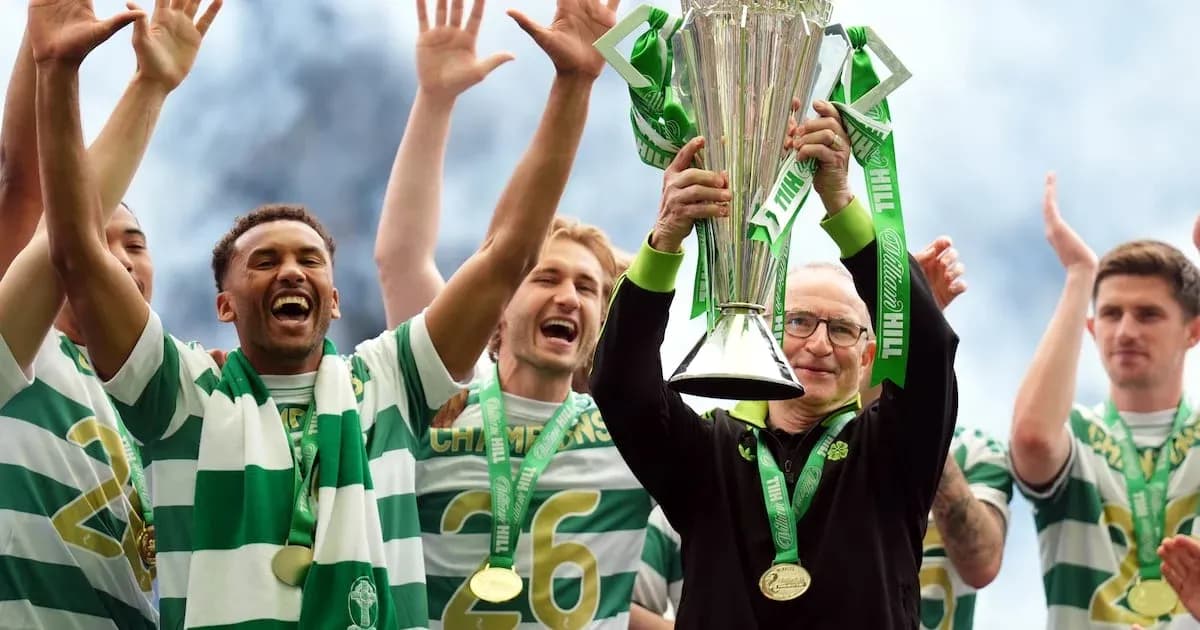
Same goal. This time it is Callum Osmand, not O’Neill’s grandkids, deciding the afternoon. Osmand has just slammed in Celtic’s third against Hearts, the goal that finally sealed the Scottish Premiership title. You cannot see him in the picture. He is buried under a tidal wave of players, staff and supporters who have poured from the stands – some of them topless, all of them delirious.
On the same pitch, a few yards away, Hearts players are on their knees or frozen to the spot, hands on heads. Sixty-six years they had waited for a league title. They were three minutes away from it. Three minutes from what, in 2026 language, would be called a Mayo moment. Then Daizen Maeda tore up the script.
Celtic’s 14th title in 15 seasons sounds routine on paper. It did not feel routine. Hearts’ unlikely surge, the Rodgers-O’Neill-Nancy-O’Neill shuffle in the dugout, Rangers stumbling through another campaign – all of it fed into a season that felt jagged and alive.
At the centre stood O’Neill, fielding questions about “fairytales” and talk of a double, with the Scottish Cup final against Dunfermline and Neil Lennon looming a week later. Everyone assumed that would be his Celtic goodbye.
The chaos at full time – or what everyone thought was full time – did not help Hearts’ mood. No whistle had been heard amid the pitch invasion. Their players, confronted by in-your-face celebrations, left Celtic Park immediately, still in full kit, no chance even to shower away the sting. Celtic issued a formal apology the next day. It barely registered beyond a line in the news cycle.
O’Neill, though, was allowed to soak in it all. He spoke about the title giving him “a reason to live”. Supporters spoke about a statue. It felt like a finale.
It wasn’t.
Twenty-six days later, the club announced that the interim had become permanent. O’Neill signed a one-year deal with an option for another. The reaction was mixed: amazement at the romance, pleasure at the familiarity, dismay at what looked like another short-term fix in a club that talks long term but often acts on impulse. Celtic is divided more often than it is united; O’Neill knew it, which is why he leaned so heavily on the word “unity” in that title-winning afternoon.
Thirty-seven days on from Hearts’ heartbreak, Celtic were back at Parkhead. Same stadium, very different mood. Middlesbrough were the visitors for a pre-season friendly. In his programme notes, O’Neill called the Hearts game “dramatic and thrilling”. The stands did not echo the sentiment.
Barely 6,000 Celtic supporters turned up. The sun still shone, O’Neill still wore the tracksuit, but the place felt hollow. Explanations were offered – summer, opposition, timing – yet underneath sat something deeper: a fanbase uneasy with the club’s direction. Season ticket renewal stood at an extraordinary 99.5 per cent, but the discontent hummed in the background.
Two notable faces were missing. Kelechi Iheanacho, scorer of that season-shaping, highly contentious 90+9th-minute penalty at Motherwell three days before Hearts came to town, had gone. He chose Bursaspor in Turkey’s second tier over a Celtic return. Maeda was on his way to Ipswich Town.
For Brendan Rodgers, watching from a distance, there would have been a familiar echo: Kyogo Furuhashi, Nicolas Kühn, Adam Idah – key forwards moving on, key questions left behind. Many supporters raged at the board’s reluctance to meet Iheanacho’s wage demands. Others, more pragmatic, understood the financial line the club refused to cross. Glasgow being Glasgow, a rumour soon surfaced that O’Neill himself was considering walking over the recruitment strategy.
He didn’t. Last Saturday, he was back on the touchline as Celtic hosted AC Milan in their final pre-season friendly, this time in front of more than 20,000. The mood had shifted again.
On the pitch, a new striker offered a glimpse of something different. Camilo Duran, a Colombian centre-forward signed from Qarabag, had already scored against Benfica in last season’s Champions League and had found the net against Middlesbrough. By the time Milan arrived, Duran had three goals in three pre-season outings. It gave O’Neill at least a sliver of reassurance.
Then came another forward, Kasper Høgh, arriving for around €13 million, roughly matching the fee banked for Maeda. Høgh’s calling card? Two goals in Bodo/Glimt’s 3-1 Champions League win over Manchester City last season. If he and Duran can score at that level, they should fancy their chances against Dundee on Monday night, and then Kilmarnock, Falkirk, Aberdeen and St Mirren in the weeks that follow. Those are Celtic’s first five league fixtures. None finished in Scotland’s top five last term.
It is as gentle an opening as a champion could hope for, a stretch that should allow O’Neill to juggle domestic duties with a far more treacherous assignment: a Champions League qualifier, home and away, in the middle of next month. Celtic have stumbled here before. Kairat Almaty last year left Rodgers incandescent. Selling remains central to the club’s economic model, and the projected departure of Arne Engels would fit that pattern, but if exits are matched with genuine reinforcements, early momentum is there to be seized.
That phrase – cautious optimism – would have sounded fanciful last October, when Dermot Desmond publicly referred to a “toxic atmosphere” around the club. The scepticism has not vanished. It will not until this squad shows that it can do more in Europe than simply turn up and survive.
All of this plays out with the transfer window still wide open. A month remains until it closes on August 31st. Across the city, Rangers have been busier, and they cannot afford another season as scattergun as the last.
The Hearts manager who stalked the touchline at Parkhead in May was Derek McInnes. He is now at Ibrox. Hearts’ captain and goalscorer that day, Lawrence Shankland, has joined him. So has Cammy Devlin, the midfielder voted Hearts’ player of the season. A maroon core imported to stiffen a Rangers squad that has too often looked flimsy when it mattered.
McInnes is Rangers’ sixth permanent manager in five years, the third in 12 months. Russell Martin and Danny Röhl never convinced in their brown brogues. McInnes, a former Rangers player, feels like a more natural fit. But this is a club that has ended three of the last four seasons without a trophy. Sentiment will not buy him time. He has to start fast, beginning at Tannadice on Friday night.
His exit from Hearts has opened the door at Tynecastle for Wouter Vrancken. The Belgian’s introduction has been harsh. Two games, two defeats, both to Sturm Graz in a Champions League qualifier. The fear is obvious: how do Hearts, and a new coach, recreate the ferocious energy that dragged so many neutral eyes towards Scottish football last season?
They went the distance. They pushed. They were three minutes from rewriting history at Celtic Park.
The calendar says this season will end on May 16th, 2027 – the same date that now lives in Hearts’ nightmares and Celtic’s photo albums. O’Neill’s grandchildren should probably circle it. So should everyone else.