.svg&w=384&q=75 "Naijagoal logo")

The Tragic Day Celtic Lost John Thomson, Their Prince of Goalkeepers
Tragedy gets thrown around too easily in football. A late goal, a cup final defeat, a missed penalty – they’re painful, but they’re not tragic.
On 5 September 1931 at Ibrox, the word fitted. Perfectly. Terribly.
That afternoon Celtic’s 22‑year‑old goalkeeper, John Thomson, went out to play in an Old Firm league match and never came home. Many who were there would later say that Scottish football lost two lives that day – the brilliant young keeper, and the carefree innocence of the game itself.
From the pits to the posts
John Thomson was born on 28 January 1909, not in Cardenden as many still assume, but in Kirkcaldy. Within a year, his family moved to the Fife mining village that would define his life and, later, his legend.
Cardenden shaped him. The coal pits, the harsh shifts, the tight community. As a teenager he followed the same path as so many local boys, working as a labourer at Bowhill Colliery. The mines paid the wage, but football offered the escape.
He stood out at school level, yet it was in Junior football that his name really began to travel. First with Bowhill Rovers, then from 1925 with Wellesley Juniors, he built a reputation as a fearless, agile goalkeeper. Local newspapers tipped him for the top, unusual praise in an era when Juniors were awash with rugged talent.
Trial matches followed with Raith Rovers and Cowdenbeath. The real turning point, though, arrived in October 1926. Celtic scout Steve Callaghan went to an East of Fife Cup tie against Denbeath Star to look at another goalkeeper. He left talking only about Thomson.
On 1 November 1926, Celtic signed the 17‑year‑old for £10. The story of his contract being signed on top of a fuse box after a tramcar journey into Glasgow’s east end has passed into club folklore. The fee was modest. The find was anything but.
Rapid rise to the top
Thomson made his Celtic first‑team debut on 12 February 1927 at Dens Park in a 2–1 win over Dundee. Supporters and coaches were immediately struck by his composure and athleticism. He was less impressed with himself, blaming his own standards for the Dundee goal and vowing to improve.
He did. Quickly.
By the end of that season he had helped Celtic lift the 1927 Scottish Cup, a 3–1 win over East Fife in front of almost 80,000 fans. Another Scottish Cup followed in 1931, this time against Motherwell, Celtic winning 4–2 in a replay after an initial 2–2 draw. Three Glasgow Cup medals arrived as well. Between 1927 and 1931 he made 188 appearances, becoming the bedrock of the side.
His form could not be ignored beyond Parkhead. Between 1930 and 1931 he earned four caps for Scotland, keeping three clean sheets and conceding just once. His debut came in Paris, where he helped Scotland to a 2–0 victory. His final international outing was equally emphatic – a 2–0 win over England at Hampden, watched by 131,000.
Thomson also represented the Scottish League XI four times. Clubs in England took notice, with Arsenal among those keen to tempt him south. Celtic had a star on their hands and knew it.
What set him apart was not only his agility but his courage. This was an era when goalkeepers received little protection and every cross, every loose ball in the box, carried real danger. Thomson never flinched. That bravery thrilled the terraces and terrified his mother. Her fears grew after a serious injury against Airdrie in 1930.
She was right to worry.
Ibrox, 5 September 1931
On the morning of the Old Firm match, Thomson left his flat in Victoria Road on Glasgow’s southside. His destination was another southside landmark: Ibrox Park, where Celtic would face Rangers in a league fixture.
The first half ended goalless. Thomson was in command, steadying Celtic’s defence and allowing his teammates to attack their Light Blue rivals with confidence.
Then, early in the second half, the moment that would define the day.
Rangers forward Sam English broke through the Celtic back line. Thomson reacted instantly, racing from his goal and diving bravely at English’s feet to claim the ball. Both men were fully committed. They collided heavily. English’s knee caught Thomson on the head.
At first, many in the crowd thought it was just another collision, the kind that dotted every game in that physical era. But Thomson lay still. The concern spread quickly.
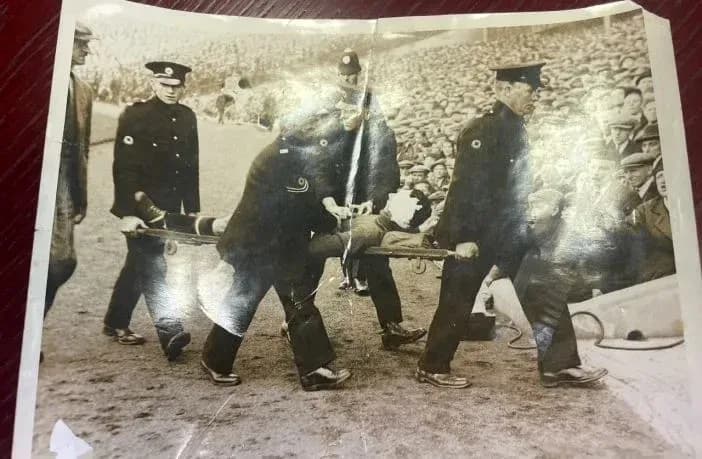
Medical staff sprinted on. He was carried off on a stretcher, motionless.
In a decision that now feels chilling, the match went on. With no substitutes permitted, Celtic defender Chic Geatons, another Fifer, pulled on the goalkeeper’s jersey. The game drifted to a 0–0 draw, but by then the football barely mattered. Thousands inside Ibrox were thinking only of the young man taken away to hospital.
A life cut short
Thomson was rushed to the Victoria Infirmary. Doctors fought to save him, but the damage was too great. He had suffered a fractured skull and severe brain injuries.
A car was sent to bring his parents from Fife to Glasgow. By the time they arrived, the prognosis was hopeless. Their son died shortly afterwards. He was 22.
An inquiry later ruled the death accidental. Witnesses and officials were clear: Sam English had done nothing malicious. It was a horrible, freak outcome from a challenge both players had gone into with full commitment. The verdict did little to ease English’s conscience.
Scottish football reeled. Celtic fans mourned. Rangers supporters mourned. Neutrals mourned. A memorial service at Trinity Church in Glasgow’s west end drew huge crowds. The Celtic and Rangers teams attended together, with English among them. Police had to help the players through the packed streets outside the church doors.
Cardenden says goodbye
On 9 September 1931, Cardenden buried its most famous son. Around 40,000 people attended the funeral, an extraordinary number for a small mining village. Thousands travelled from Glasgow, some walking the 55 miles to Fife.
Celtic teammates carried the coffin, a stark image of grief and brotherhood. The headstone that followed bore a line that has become inseparable from his story:
“They never die who live in the hearts they leave behind.”
For Celtic supporters, that inscription is not just sentiment. It is a statement of how Thomson’s memory has been kept alive.
The tragedy did not end with his burial. Sam English continued his career, but the psychological scars never faded. He faced taunts from rival fans for years, despite repeated assurances from Thomson’s parents that they forgave him and did not blame him for their son’s death. The noise in the stands ignored the compassion shown in private.
Legacy of the ‘Prince of Goalkeepers’
Celtic as a team struggled in the months after losing their goalkeeper. Eventually, Canadian Joe Kennaway took over the position, but Thomson’s absence lingered in the dressing room and on the terraces.
Poems and songs were written in his honour, many still sung or recited around the club today. Books and articles have revisited his life and that fateful day at Ibrox. Supporters continue to make the journey to his grave in Cardenden, often tying visits to charity events and memorial gatherings.
For all the trophies he helped win, all the clean sheets for club and country, one truth remains clear: the loss of a young life dwarfs any result. John Thomson died playing for Celtic, doing what he did best – throwing himself into danger to protect his goal.
Decades on, the green‑and‑white support still speak of him with the same simple title.
Their own Prince of Goalkeepers.