.svg&w=384&q=75 "Naijagoal logo")

Brazil's Olympic Gold: A Historic Night in Rio 2016
On 20 August 2016, the Maracanã carried a nation’s weight. More than 63,000 people inside, millions more outside, all chasing the same ghost: the one prize Brazilian football had never claimed.
Olympic gold.
Germany stood in the way. Again.
The final was tense, tight, and full of scars from 2014 that nobody needed to mention. Brazil, urged forward by a restless crowd, found its moment in the 26th minute. Neymar, the captain and undisputed star of that team, stood over a free kick on the left edge of the box. One swing of his right foot, the ball arcing over the wall and crashing into the top corner, and the stadium erupted. Brazil 1, Germany 0. A release more than a goal.
But the script was never going to be that simple.
Germany grew into the game. Just as Brazil seemed to be managing the occasion, Max Meyer appeared with the equaliser in the 15th minute of the second half, finishing a move that sliced through the Brazilian defence. Silence, then nerves. Brazil 1, Germany 1. The Maracanã had seen this kind of tension before.
Extra time brought more running than clarity. Legs tired, minds tightened. Chances flickered and vanished. No breakthrough. Penalties would decide the first Olympic gold in Brazilian football history.
A shootout for a century of expectation.
From the spot, both teams were flawless through the first four kicks. Renato Augusto, Marquinhos, Rafinha Alcântara and Luan converted calmly for Brazil. Ginter, Gnabry, Brandt and Süle answered for Germany. Every successful strike ratcheted up the pressure on the next man.
Then came Nils Petersen, one of the tournament’s leading scorers, against Weverton. The Brazilian goalkeeper guessed right, plunged low and saved. The stadium exploded again, this time with a roar of pure belief.
That save handed Neymar the ball, the moment, and the weight of generations.
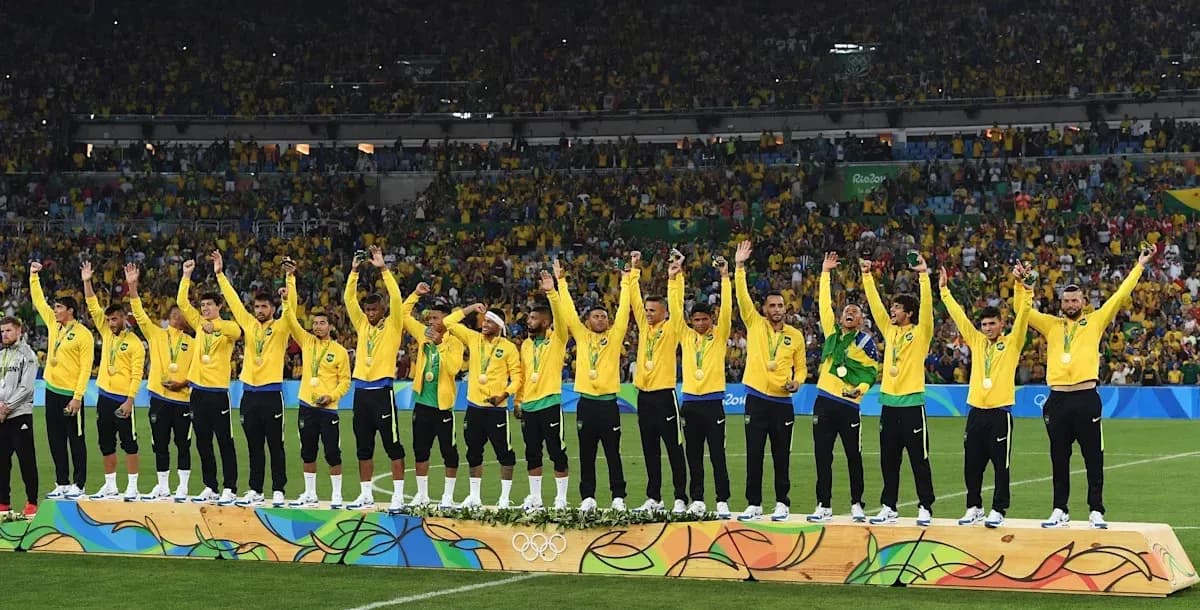
He walked up, paused, and buried the fifth penalty. Gold. History. Redemption of a sort, but on its own stage. Neymar collapsed to his knees, swallowed by teammates. Brazil, at last, stood on top of the Olympic podium.
The road to Rio glory
The journey had not started well.
Drawn in Group A, Brazil opened its campaign at the National Stadium in Brasília under heavy scrutiny. Two games, two goalless draws – first against South Africa, then Iraq. The football was flat, the mood sour. A team expected to dominate suddenly stood on the brink of embarrassment.
Everything shifted in Salvador.
Needing a win to top the group and calm the storm, Brazil dismantled Denmark 4-0 at Arena Fonte Nova. Gabriel Barbosa scored twice, Gabriel Jesus added another, and Luan completed the rout. The performance felt like a collective exhale – the attack finally clicked, the goals finally flowed, and the path to the knockout rounds looked a little less treacherous.
From there, the tournament changed tone.
In the quarterfinals at Arena Corinthians in São Paulo, Brazil met a rugged Colombia side that had emerged from Group B after draws with Sweden and Japan and a win over Nigeria. This time, the Seleção imposed itself. Neymar struck, Luan followed, and a 2-0 win pushed Brazil into the last four with at least a bronze medal guaranteed.
Honduras awaited in the semifinal, but there would be no drama.
At the Maracanã, Brazil tore through the Central American side 6-0. Neymar and Gabriel Jesus each scored twice, Marquinhos added his name to the sheet, and Luan continued his outstanding tournament with another goal. The result wasn’t just a win; it was a statement. Brazil had arrived at the final playing with the authority expected of a host chasing destiny.
Eighteen names written into history
That gold medal did more than complete a collection. It carved 18 players into a unique chapter of Brazilian football.
- Goalkeepers Weverton (Athletico-PR) – the man who stopped Petersen and opened the door to glory. Uilson (Atlético Mineiro).
- Full-backs William (Internacional). Douglas Santos (Atlético Mineiro). Zeca (Santos).
- Centre-backs Rodrigo Caio (São Paulo). Luan Garcia (Vasco da Gama). Marquinhos (Paris Saint Germain, FRA).
- Midfielders Thiago Maia (Santos). Rodrigo Dourado (Internacional). Rafinha Alcântara (Barcelona, ESP). Renato Augusto (Beijing Guoan, CHI). Felipe Anderson (Lazio, ITA). Walace (Grêmio).
- Forwards Neymar (Barcelona, ESP). Luan (Grêmio). Gabriel Barbosa (Santos). Gabriel Jesus (Palmeiras).
One more name deserves a quieter, but no less important, mention: Fernando Prass. Called up as an overage goalkeeper, he never made it to the group stage, ruled out by an elbow injury suffered in the warm-up before a friendly against Japan at Serra Dourada in Goiânia. His medal hopes ended before the tournament began, but his place in that story remains.
Ten years on, the images still linger: Weverton’s save, Neymar’s penalty, the Maracanã shaking under the weight of celebration. Brazil had won World Cups, Copa Américas, Confederations Cups. Yet that night, under Olympic lights, it finally claimed the one prize that had always seemed to slip away.
The question now is simple: when the next generation steps onto that stage, can anyone match the pressure, the drama, and the sheer release of Rio 2016?