.svg&w=384&q=75 "Naijagoal logo")

Bodo/Glimt's Tactical Mastery in 3-2 Extra-Time Victory Over Union St. Gilloise
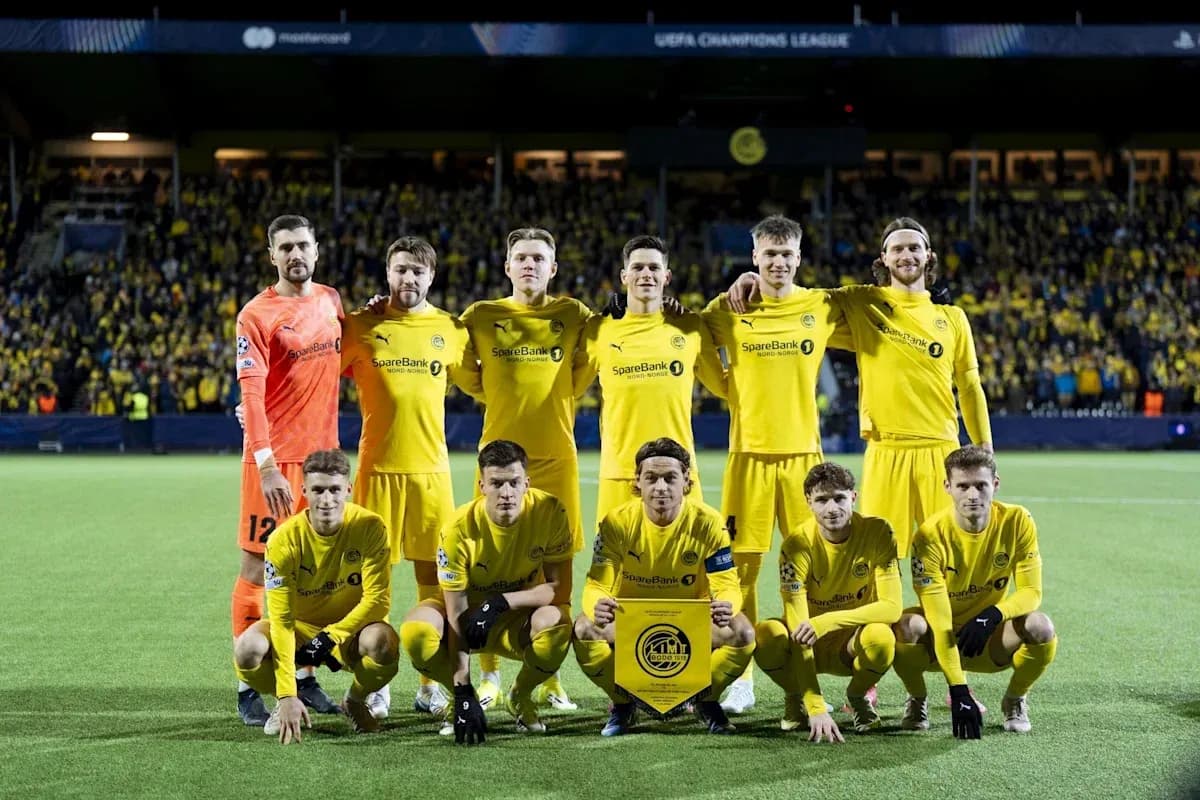
Bodo/Glimt’s 3-2 extra-time win over Union St. Gilloise at Aspmyra Stadion was, tactically, a story of territorial domination, structural patience and eventually exploiting the numerical advantage. Across 120 minutes in this UEFA Champions League 3rd Qualifying Round tie, Bodo/Glimt’s 4-3-3 systematically pinned back Union’s 3-5-2, turning 70% possession, a 23–19 shot edge and a 10–1 corner count into sustained pressure that finally told in extra time.
From the outset, Bodo/Glimt’s shape was textbook Knutsen: a high, aggressive 4-3-3 with full-backs F. Bjorkan and F. Sjovold pushing on to create a five-man front line in possession. The midfield trio of S. Auklend, P. Berg and S. Fet provided the platform—Berg as the central metronome, Auklend and Fet stepping beyond the first line to overload Union’s double forwards and central midfield. With 999 passes attempted and 889 accurate (89%), Bodo/Glimt didn’t just keep the ball; they circulated it with purpose, constantly shifting Union’s back three and wing-backs laterally.
Union St. Gilloise’s 3-5-2, under David Hubert, was clearly built for transition. The back three of N. Havenaar, M. Sylla and K. Mac Allister stayed compact, while wing-backs L. Patris and Guilherme Smith dropped deep to form a back five for long spells. In possession, Union were far more direct, completing 427 passes at 78% accuracy and looking early for the front pair P. David and D. Olaru, plus Smith attacking from the left side of midfield. Their plan was to absorb and then break quickly into the spaces left by Bodo/Glimt’s advancing full-backs.
The shot profile underlines the territorial imbalance. Bodo/Glimt produced 23 total shots to Union’s 19, with 17 of those coming inside the box and 9 on target. Union still managed 15 shots inside the box and 5 on target, but they did so from far less sustained possession and with only one corner, highlighting how rare their extended attacking phases were. Bodo/Glimt’s 6 blocked shots show how often Union’s low block got bodies in the way, especially in the second half of normal time, but the volume of entries into the area eventually eroded that resistance.
First Half
The opening goal at 51’ came as a direct reward for Bodo/Glimt’s positional structure. With Union’s block compressed centrally, the wide forward lanes became critical. J. Hauge, operating from the left of the front three, found a pocket to deliver for O. Blomberg, who had been holding a high, narrow right-wing position. The 4-3-3’s width pulled Union’s wing-backs into dilemmas: track the wingers all the way back or protect the half-spaces. On this occasion, Blomberg’s timing and Hauge’s service punished a brief lapse in that chain.
Union’s equaliser at 61’ through Guilherme Smith, assisted by D. Olaru, was a classic transition moment. It followed almost immediately after a substitution that brought M. Fuseini on for P. David, refreshing the front line. With Bodo/Glimt’s full-backs high, Union exploited the vacated channels, Smith driving from midfield and combining with Olaru. The 3-5-2’s strength—central numbers ready to spring forward—was evident here, showing that despite limited possession, Union’s attacking pattern was coherent when they escaped the press.
Second Half
Knutsen’s in-game management then sharpened Bodo/Glimt’s attacking edge. At 70’, J. Kitolano (IN) came on for S. Auklend (OUT), and A. Helmersen (IN) replaced O. Brynhildsen (OUT), injecting fresh legs and more vertical threat between the lines. Helmersen quickly justified the change, assisting Hauge’s 76’ strike for 2-1. That goal encapsulated Bodo/Glimt’s positional play: rotations in the front three, a runner arriving into the inside channel, and a secondary forward finding space against a tiring back three.
Union’s response was to adjust their attacking personnel: R. Schoofs (IN) for A. Zorgane (OUT) at 70’, M. Biondic (IN) for D. Olaru (OUT) at 74’. Yet their structural problem remained—too deep without the ball, too stretched when they tried to counter. Still, they found a late lifeline at 88’, when L. Patris advanced from wing-back to assist Fuseini’s goal for 2-2. It was again rooted in transition, using the athleticism of the wing-back to exploit the spaces left by Bodo/Glimt’s adventurous full-backs.
Disciplinary Actions
The match’s disciplinary pivot at 90+6’ was decisive tactically. Kamiel Van de Perre, already booked for a foul at 81’, received a second yellow card for foul and then a red card (also listed for foul) in the same 90+6’ sequence, leaving Union down to ten. This followed a yellow card for argument to Guilherme Smith at 90+6’, underlining the psychological strain in Union’s camp. Reduced to a 5-3-1/5-2-2 hybrid out of possession, Union were forced even deeper in extra time, unable to contest midfield as they had sporadically in regulation.
Extra Time
In extra time, Knutsen doubled down on fresh width and energy. I. Maatta (IN) for F. Bjorkan (OUT) at 103’ and U. Saltnes (IN) for S. Fet (OUT) at 104’ re-energised the left flank and central lanes. Later, at 120+1’, V. Nielsen (IN) came on for J. Hauge (OUT), adding defensive stability to see out the result. On Union’s side, R. Mofokeng (IN) for B. Zeneli (OUT) at 91’, R. Florucz (IN) for L. Patris (OUT), and O. Niang (IN) for Guilherme Smith (OUT) at 120+1’ were largely reactive, aimed at shoring up legs rather than changing the structure, especially once they were a man down.
The winning goal at 117’ from A. Helmersen, unassisted, was the logical endpoint of Bodo/Glimt’s territorial siege. Against ten men, with Union’s block compressed almost onto their own area, the home side’s 4-3-3 morphed into a 2-4-4 in possession, both full-backs and at least two midfielders stationed high. The shot and corner disparity—23 shots to 19, 10 corners to 1—became overwhelming in that context. Union’s reduced midfield simply couldn’t prevent repeated entries into the box, and eventually Helmersen found the decisive opening.
Between the posts, N. Haikin (Bodo/Glimt) was relatively untroubled given the flow of the game, credited with 3 saves against Union’s 5 shots on goal. His main tactical contribution was as a sweeper, enabling Bodo/Glimt’s high line and compressed structure. At the other end, V. Chambaere (Union St. Gilloise) made 5 saves under sustained pressure. That figure, combined with Bodo/Glimt’s 9 shots on target and 6 blocked efforts, underscores how much of the match was played in and around Union’s penalty area.
Fouls were balanced—11 for Bodo/Glimt, 10 for Union—but card distribution reflected the strain on the visitors’ defensive system. Bodo/Glimt picked up two yellows (Sondre Auklend for foul at 16’, Haitam Aleesami for foul at 92’), mostly tactical infractions to break transitions. Union accumulated four yellows and a red: Van de Perre’s dual yellows (foul at 81’, foul at 90+6’ leading to red for foul), plus Guilherme Smith’s yellow for argument at 90+6’ and Kevin Mac Allister’s yellow for argument at 117’. Those late cards illustrated a side defending deeper and deeper, increasingly reacting rather than controlling.
Statistically, Bodo/Glimt’s passing volume and accuracy—999 passes, 889 accurate at 89%—speak to a team fully committed to positional dominance. Union’s 427 passes at 78% were respectable but framed by a game plan that ceded territory. Even without xG figures, the shot distribution, possession and corner counts indicate that Bodo/Glimt consistently engineered higher-quality territory and pressure. Over 120 minutes, that structural superiority, combined with targeted substitutions and the exploitation of Union’s late red card, justifiably translated into progression via a 3-2 victory after extra time.