.svg&w=384&q=75 "Naijagoal logo")
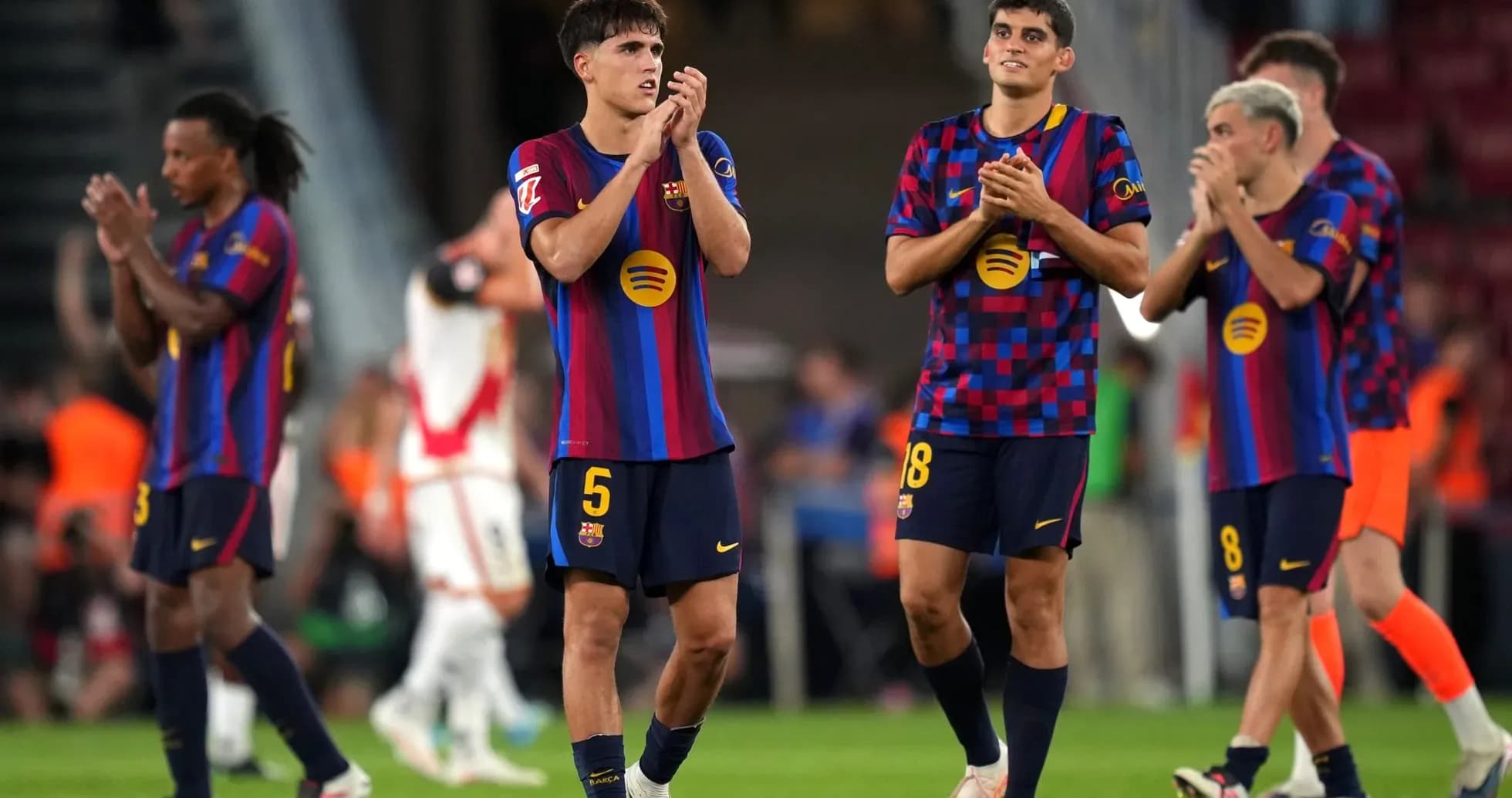

Barcelona Dominates Rayo Vallecano 5-2 in La Liga Showdown
Under the Camp Nou lights, this was billed as a meeting of opposites: Barcelona, perfect and purring at the top of La Liga, against a Rayo Vallecano side already glancing anxiously at the relegation places. By full time, the 5-2 scoreline had confirmed the trajectory of both teams, but the way it unfolded told a richer story about structure, talent and tactical ceilings.
I. The Big Picture – Flick’s Barcelona take shape
Following this result, Barcelona sit first in La Liga with 9 points from 3 matches, their overall goal difference a commanding +10, built on 12 goals for and only 2 against. At home, they have now played 2 league games, winning both with 7 goals scored and 2 conceded. The numbers are not just dominant; they are coherent with what Hansi Flick is trying to build.
He leaned into his preferred 4-2-3-1 again, trusting a young, technically secure back line: J. Garcia in goal behind a defence of J. Kounde, P. Cubarsi, A. Christensen and the emerging X. Espart. Ahead of them, M. Bernal and Pedri formed the double pivot, with a devastating band of three – Lamine Yamal, D. Olmo and A. Gordon – supplying Raphinha as the lone forward.
The structure mirrored Barcelona’s season profile. Overall, they average 4.0 goals for per match, with 3.5 at home and a remarkable 5.0 on their travels. Defensively, they concede 0.7 goals per match overall, 1.0 at home and 0.0 away. The 5-2 here matched their “biggest home win” pattern and underlined how quickly they can overwhelm visiting sides.
Rayo, by contrast, arrived with the same 4-2-3-1 but a very different emotional context. Sitting 18th with 1 point from 3 games, their overall goal difference is -4 (4 scored, 8 conceded). On their travels, they have now lost 2 from 2, scoring 3 but conceding 7. Benat San Jose set them up with D. Cardenas in goal, a back four of I. Balliu, F. Lejeune, P. Ciss and J. Vertrouwd, O. Valentin and G. Bouare as the screen, and a lively attacking quartet of J. de Frutos, U. Lopez, A. Garcia and S. Camello.
II. Tactical Voids – Absences and fragility
If anything, the most striking element of Barcelona’s performance was how little they seemed to miss some of their most recognisable names. Gavi and F. de Jong were both out with knee injuries, while R. Bardghji and M. Casado were unavailable, and D. Livakovic listed as inactive. Yet the double pivot of Pedri and M. Bernal handled control and progression with a serenity that made the absentees feel like a luxury rather than a necessity.
Pedri’s role was pivotal: dropping alongside Bernal to build, then stepping into the half-spaces to link with Olmo and Lamine Yamal. With no red cards all season and only a single yellow card for Barcelona arriving between minutes 16-30 in previous matches, Flick’s side again managed their aggression smartly, pressing high without losing defensive discipline.
Rayo’s absences cut deeper. In defence, M. Kumbulla and Luiz Felipe were both missing through muscle and hamstring injuries respectively, stripping San Jose of two potential leaders at the back. In attack, I. Palazon’s injury removed one of their more inventive outlets, while A. Batalla was also sidelined. For a team that has yet to keep a clean sheet this season – with 0 clean sheets both at home and on their travels – the loss of defensive experience was brutally exposed by Barcelona’s rotations.
Disciplinary trends underline Rayo’s fragility under pressure. Their yellow cards are heavily concentrated late: 50.00% between minutes 61-75, 33.33% from 76-90, and 16.67% in added time. It speaks of a team chasing games, forced into desperate interventions as structure collapses. Against a side that sustains pressure as relentlessly as Barcelona, that is a recipe for repeated suffering.
III. Key Matchups – Hunter vs Shield, Engine Room battles
The headline duel was always going to be Raphinha against Rayo’s back line. Heading into this game, the Brazilian already led La Liga’s scoring charts with 5 goals and 1 assist, converting 7 of 8 shots on target, and carrying a 9.03 average rating. He had also scored his only penalty of the season, giving Barcelona a perfect penalty record so far: 1 taken, 1 scored, 0 missed.
Rayo’s “shield” was fragile. On their travels, they concede 3.5 goals per match, and their biggest away defeat is now 5-2 – exactly the scoreline at Camp Nou. F. Lejeune and P. Ciss were repeatedly dragged into wide and vertical channels they did not want to defend, with Raphinha’s diagonal runs and Gordon’s clever movement forcing constant recalibration. Every time Rayo’s line stepped up, Lamine Yamal or Olmo threatened the space behind.
In midfield, the “Engine Room” matchup pitted Pedri and Bernal against O. Valentin and G. Bouare. Barcelona’s pair used their superior passing range and press resistance to dictate tempo, while Rayo’s double pivot was too often forced into firefighting. U. Lopez, nominally the creative hub ahead of them, found himself pinned by Bernal’s positioning and Pedri’s counter-press, rarely able to connect cleanly with Camello.
Up front, S. Camello tried to justify his place among the league’s top scorers. He came into the match with 3 goals from 3 appearances, 4 shots on target from 5 attempts, and a 7.4 rating. His movement between centre-backs did cause moments of discomfort for P. Cubarsi and A. Christensen, but with Rayo averaging only 1.3 goals overall and 1.5 on their travels, his threat was always going to be sporadic rather than sustained against a defence that has kept 2 clean sheets in 3 games.
On the flanks, A. Garcia – with 1 goal, 1 assist, and even 1 blocked shot this season – tried to stretch X. Espart. But Espart, already with 2 assists and 5 interceptions in the league, again showed why he is rapidly becoming a two-way force: aggressive in duels, tidy in possession, and increasingly influential in the final third.
IV. Statistical Prognosis – A gulf in tiers
Following this result, the numbers sketch a clear hierarchy. Barcelona remain perfect in La Liga: 3 wins from 3, no draws, no defeats, 12 goals scored and just 2 conceded overall. They have yet to fail to score in any match and already boast 2 clean sheets, one at home and one on their travels. Their average of 4.0 goals per game, married to just 0.7 conceded, is title-winning form, and their use of 4-2-3-1 in 2 of the 3 matches suggests Flick has found his base structure.
Rayo, meanwhile, are still searching for a foothold. They have 0 wins from 3, 1 draw and 2 defeats, with 4 goals scored and 8 conceded overall. On their travels, 2 defeats from 2, with 3 scored and 7 conceded, tell of a side that cannot yet protect its own box. They have not missed a penalty this season, but they have not taken one either; their problems lie in the volume and quality of chances conceded, not in spot-kick variance.
Tactically, this match felt less like a one-off and more like a projection. Barcelona’s attacking ecosystem – Raphinha as the ruthless finisher, Lamine Yamal as the creative dribbler, Gordon as the connector, and Pedri as the metronome – looks sustainable. Their defensive platform, anchored by Espart’s emergence and Cubarsi’s composure, is already robust.
For Rayo, the blueprint is less comforting. Their late-game card surge reflects structural fatigue and mental strain, and their away defensive average of 3.5 goals conceded per match suggests that any trip to an elite attack will be a damage-limitation exercise. Until key defenders return and the midfield screen tightens, they will remain vulnerable to exactly the kind of multi-lane assault Barcelona unleashed at Camp Nou.