.svg&w=384&q=75 "Naijagoal logo")
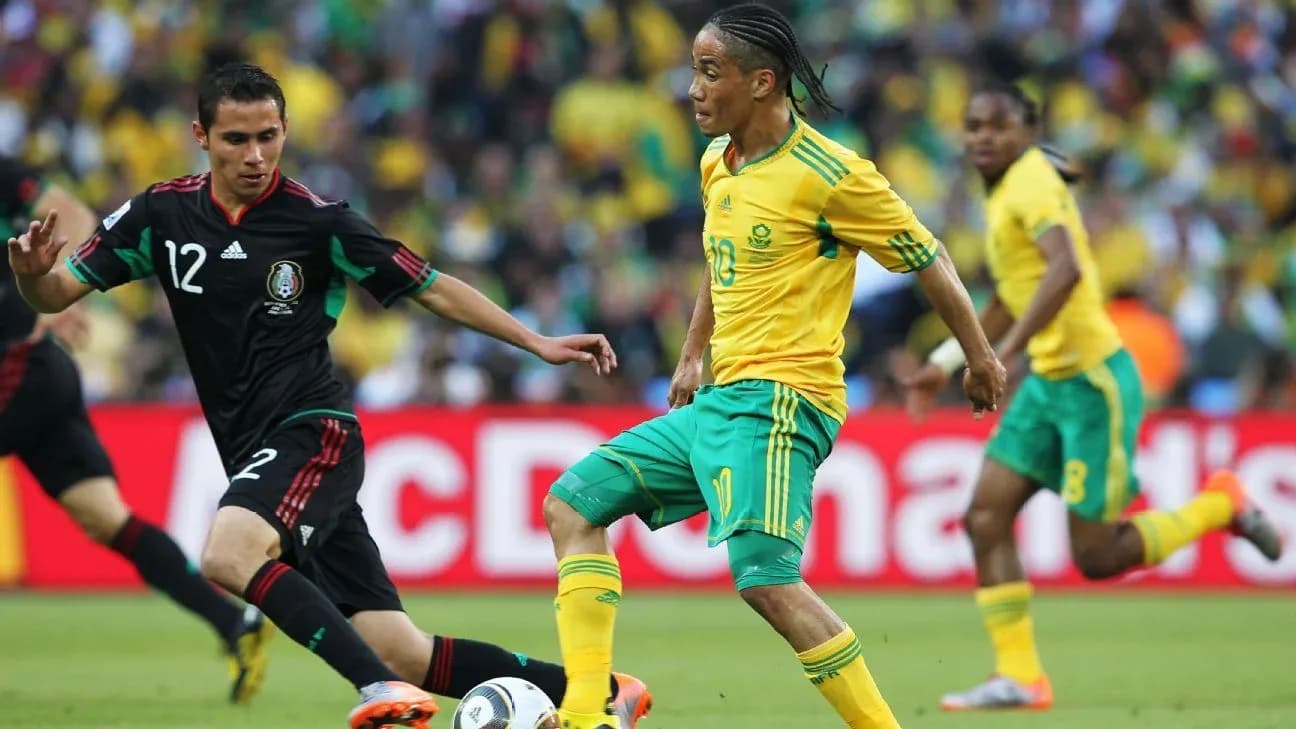

Bafana Bafana's World Cup Struggles: Pienaar's Call for Bravery
Steven Pienaar has never been shy of a hard truth. From Ajax to Dortmund to the Premier League, he built a career on sharp movement and sharper thinking. Now, watching his country edge nervously through another World Cup group stage, he wants Bafana Bafana to move — and move with intent.
South Africa scraped their first point of the 2026 FIFA World Cup with a 1-1 draw against Czechia in Atlanta on Thursday, Teboho Mokoena’s late penalty rescuing a contest that had threatened to drift away from them. It kept Bafana alive. It did not convince Pienaar.
“They all want the ball to feet”
As the game unfolded, the former South Africa, Everton and Tottenham Hotspur playmaker turned to X and cut straight to the issue that has bothered so many Bafana coaches down the years.
“Why is there no running of the ball from Bafana? They all want the ball to feet, no deep runs,” he wrote.
It was a damning verdict on a side that, for long spells, played in front of Czechia’s defence rather than behind it. The late surge, sparked by Mokoena’s equaliser in the 83rd minute, brought pressure, half-chances and a sense of what might have been. The pattern, though, had already been set.
Even after the final whistle, Pienaar refused to soften his stance. Praise, yes. But with a sting.
“Well done boys. Now, on to the next. Please, next, we game we need breaking runs – please boys,” came his follow-up post.
The message was clear: effort is not enough. Not at this level. Not in a group this tight.
A familiar World Cup tightrope
The draw leaves South Africa bottom of Group A heading into a decisive clash with South Korea in Guadalupe next Wednesday, a match that kicks off at 3 a.m. on Thursday morning back home. The margins are brutal.
Mexico sit in control with six points. South Korea have three. Czechia and Bafana are locked on one point each, the Europeans ahead only on goal difference.
It is a scenario that carries an uncomfortable echo for South African fans of a certain age. Pienaar himself was part of the 2010 World Cup squad that beat France 2-1 in their final group game yet still fell short of the knockout rounds. That team, like this one, reached their last match with a single point from two outings.
This time, the format offers a sliver more hope. With an expanded tournament and a round of 32, third place might be enough to squeeze through. But “might” is doing a lot of work. South Africa have never made it out of the group in any of their previous three World Cup appearances. History is not on their side. Urgency has to be.
No Premier League star, but a new heartbeat
There is no current English top-flight name to lean on. Lyle Foster’s relegation with Burnley stripped the squad of its one Premier League representative, a symbolic reminder of where South African football stands in the global pecking order.
Yet the domestic game tells a different story.
Mamelodi Sundowns, the dominant force at home, secured a second CAF Champions League title in the 2025-26 season. Mokoena, the same midfielder who kept South Africa alive against Czechia from the spot in Atlanta, delivered the decisive goal in the final second leg against AS FAR in Rabat.
That parallel is hard to ignore. The man driving Sundowns to continental glory is now the one dragging Bafana back from the brink on the world stage. His penalty on Thursday did more than level the score; it underlined who carries the responsibility in this side when the pressure rises.
Runs, risk and a date with South Korea
So the equation for Guadalupe is stark. South Africa must be braver without the ball, not just tidy with it. The sideways patterns that lulled Czechia into comfort will not trouble South Korea, a team that thrives when given time to read the game in front of them.
This is what Pienaar is railing against. He knows what it looks like when South African attackers stretch a back line, when midfielders time their surges beyond the last defender, when defenders are forced to turn and chase instead of stepping up and dictating. He lived it at the highest level.
Breaking runs change everything: the angles, the tempo, the psychology of a match. They drag markers out of shape, open pockets for playmakers, create the chaos from which goals are born. Without them, Bafana become predictable, easy to funnel into congested areas, easy to suffocate.
One point, a late equaliser and a sliver of hope are all that remain now. The group is alive. The path is narrow.
If South Africa are finally to step into a World Cup knockout round, someone in green and gold will have to do what Pienaar keeps asking for: stop waiting for the ball to feet — and run into the space where this country’s story can change.