.svg&w=384&q=75 "Naijagoal logo")


AS Roma Dominates Fiorentina 4-0 in 2026 Serie A Opener
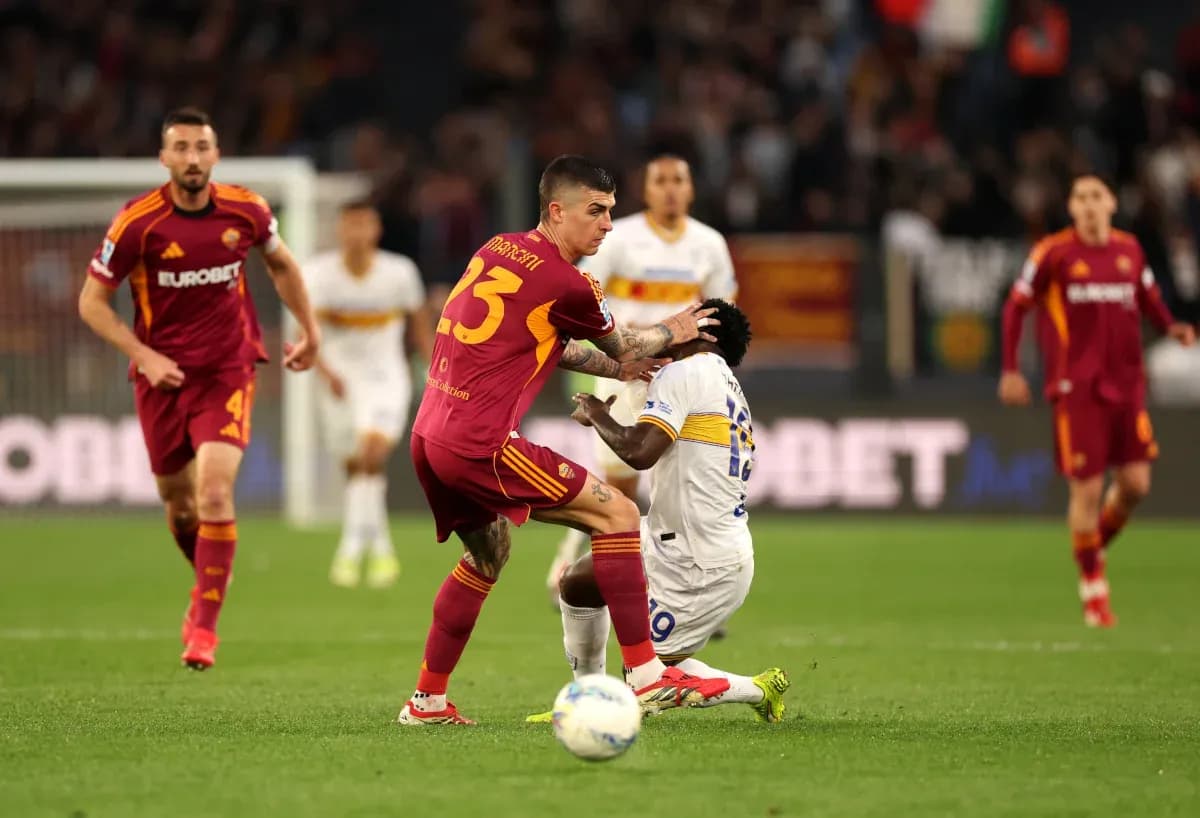
Under the Roman lights at Stadio Olimpico, the opening night of the 2026 Serie A season turned into a statement of intent. AS Roma, under Piero Gasperini Gian, dismantled Fiorentina 4–0, a scoreline that now shapes the early identity of both squads heading into the campaign.
I. The Big Picture – Early identities forged
Following this result, Roma sit 1st in Serie A with 3 points and a goal difference of +4, built entirely at home: 4 goals scored and none conceded in their only match so far. Their overall attacking average stands at 4.0 goals per game, mirrored exactly by their home average, and defensively they have yet to allow a single goal.
On the other side, Fiorentina find themselves 20th with 0 points and a goal difference of -4. All of that damage has come away from home: on their travels they have conceded 4.0 goals per game and are yet to score. Their overall attacking average is 0.0, and they have failed to score in their only fixture so far.
Tactically, this was a clash of mirrored Christmas trees: Roma in a bold 3-4-2-1, Fiorentina in a 4-3-2-1. But the symmetry on paper gave way to asymmetry on the pitch, as Roma’s structure amplified their stars while Fiorentina’s shape left their front line isolated.
Roma’s offensive spine is already clearly defined. Donyell Malen, leading the line in the 3-4-2-1, has exploded out of the blocks: in total this season he has 3 goals from 4 shots (3 on target), earning a perfect rating of 10 in his 68 minutes. Just behind him, Paulo Dybala orchestrated the night with 3 assists and 4 key passes, his 9.3 rating underlining his status as the league’s early creative benchmark.
II. Tactical voids – Absences and discipline
Roma’s performance gains further weight when framed against their absentees. M. Bah and L. Pellegrini both missed this fixture through injury (knee and thigh respectively), removing a potential engine and a technical leader from Gasperini’s midfield. In their absence, B. Cristante and M. Kone anchored the central band, while Wesley Franca and E. Lulli provided width and verticality. The fact that Roma still produced 4 goals without Pellegrini’s control speaks to the depth and adaptability of this squad.
Fiorentina were also shorn of options. F. Parisi and R. Sottil were unavailable, depriving Fabio Grosso of a natural attacking left-back profile and a direct wide forward who might have stretched Roma’s back three. Without them, Fiorentina’s 4-3-2-1 felt narrow and easier for Roma’s compact central block of G. Mancini, E. Ndicka and M. Hermoso to manage.
Disciplinary patterns add another layer. Roma’s season card map is sparse but telling: both of their yellow cards so far have arrived between 31-60 minutes, with 50.00% of their yellows in the 31-45 range and 50.00% in the 46-60 range. Hermoso, already on the league’s yellow-card list, embodies this edge: in his 68 minutes he committed 2 fouls, drew 1, and was booked once. It hints at a Roma side that ramps up aggression around the half-time pivot, pressing harder as fatigue and tactical tweaks bite.
Fiorentina’s yellow profile is similarly clustered but speaks more to strain than control: 50.00% of their yellows came between 16-30 minutes and 50.00% between 61-75. Nicolò Fagioli, with 1 yellow and a 6.2 rating, is emblematic of a midfield forced into reactive challenges. The absence of any red cards for either side keeps the narrative on tactical, not numerical, superiority.
III. Key matchups – Hunter vs shield, engine room battles
The headline duel in this fixture was Roma’s “hunter” versus Fiorentina’s defensive “shield”. Malen, supported by Dybala and R. Mora, confronted a Fiorentina back line that has, on their travels, conceded 4.0 goals per game. Radu Dragusin and L. Ranieri could not contain the depth runs and diagonal movements that Malen thrives on. With Dybala threading passes from the right half-space and Wesley Franca and Lulli pinning the full-backs, Fiorentina’s back four were repeatedly forced into last-ditch defending rather than proactive control.
Behind Malen, Dybala’s matchup against Fiorentina’s midfield screen was decisive. Positioned as one of the dual “2” in Roma’s 3-4-2-1, he floated between the lines, dragging C. Ndour and Fagioli into uncomfortable zones. Fiorentina’s trio – M. Brescianini, Fagioli, Ndour – were structurally outnumbered whenever Roma’s wing-backs advanced and Cristante stepped into the first build-up line, creating a de facto 3-2-5 in possession. Dybala’s 3 assists and 4 key passes underline how often he found pockets between Fiorentina’s midfield and defence.
In the “engine room”, Cristante’s understated authority anchored Roma. His presence allowed Ndicka and Hermoso to defend proactively – Hermoso, in particular, posted 2 tackles and 3 interceptions, and his willingness to step out of the line compressed the space where Fiorentina’s advanced midfielders F. Mastantuono and A. Atta tried to operate. With M. Pellegrino isolated as the lone forward, Fiorentina rarely converted midfield possession into threatening final-third sequences.
IV. Statistical prognosis – xG implications and defensive solidity
While explicit xG numbers are not provided, the underlying indicators are clear. Roma’s overall average of 4.0 goals for and 0.0 against after 1 match, combined with Malen’s shot profile (4 shots, 3 on target) and Dybala’s chance creation, points to a side generating high-quality opportunities rather than relying on low-percentage efforts. The fact that Roma have yet to win or miss a penalty in total (0 taken, 0 scored, 0 missed) suggests their output so far has come entirely from open play and structured attacks, strengthening the sustainability of their attacking blueprint.
Defensively, Roma’s early-season solidity is absolute: in total they have 1 clean sheet from 1 match, with 0.0 goals conceded on average both overall and at home. The back three of Mancini, Ndicka and Hermoso, shielded by Cristante and Kone, offers a blend of aggression and recovery pace that suits Gasperini’s high line. Hermoso’s inclusion among the league’s top card recipients is a by-product of this front-foot defending rather than a structural weakness.
Fiorentina’s prognosis is more fragile. In total they have failed to score in their only match, while conceding 4.0 goals per game overall and away. Their clean sheet tally stands at 0, and their biggest defeat so far – a 4-0 loss on their travels – is already their defining statistical marker. With no penalties won, scored, or missed, their attacking threat has not yet translated into box presence. Until Grosso can connect the midfield trio to Pellegrino and integrate bench options like A. Gudmundsson or M. Kean more effectively, Fiorentina’s xG profile is likely to lag behind their defensive exposure.
Following this result, the narrative is stark. Roma emerge as an early, coherent contender: a side whose 3-4-2-1 maximises Malen’s finishing, Dybala’s creativity and a rugged back three. Fiorentina, by contrast, are a work in progress, their 4-3-2-1 still searching for width, penetration and defensive balance. If these trends persist, Roma’s numbers hint at a season spent near the top of the table, while Fiorentina’s data warns of a campaign spent fighting the undertow of relegation pressure.