.svg&w=384&q=75 "Naijagoal logo")

Artificial Intelligence in Football: Transforming Recruitment and Player Health
In boardrooms and boot rooms across the game, artificial intelligence has quietly stopped being a gimmick. It’s in scouting meetings, medical briefings, academy reviews. It’s in the hands of people who, not long ago, trusted only their eyes and their gut.
They’re not all convinced. But they’re all looking.
From Arsenal blog to global data arm
Ask Bracha how this started and he’ll take you back to his living room, not a lab. A devoted Arsenal fan with a blog, he spent nights breaking down the Gunners and flagging players big clubs should sign, blending his own “eye test” with whatever data he could scrape together.
The blog took off. The day job in tech got busier. So he did what tech people do: he built a tool.
He trained an AI model to spit out the skeleton of his posts. Then he layered his own analysis on top. Somewhere in that mix of human instinct and machine pattern-spotting, he began flagging players others had missed.
Soon, scouts started sliding into his inbox.
“I started to get inbox requests from professional scouts and at clubs asking me, 'How do I know about that on a player?’” Bracha recalled. “I was like, ‘I don't know any of that about the player. Like, it's just ChatGPT.’”
If that impressed professionals, he wondered, what were they actually using?
The answer, he discovered, was messy. Clubs were drowning in numbers, not starving for them. Wyscout helped trigger the data boom in the early 2010s, but rival platforms exploded around it. Every provider had their own metrics, their own definitions, their own dashboards.
“In the past 10 years, this industry has moved from complete scarcity to data overload,” Bracha said. “There are so many different data providers.”
His company, Marquee, exists to cut through that fog. It works as a kind of outsourced analytics department for clubs, automating what he calls “glorified spreadsheet processes” and stitching together data scattered across multiple platforms into a single, usable system.
This is not, he stresses, Football Manager with a slicker interface. Marquee builds tailored player profiles for paying clients, suggesting potential signings based on ability, tactical fit and club-specific parameters. Recruitment teams can ignore the recommendations if they like. But they’re listening.
Marquee already works with several Premier League sides and has been publicly endorsed by Barcelona and MLS outfit Chicago Fire. Whether it has unearthed the next superstar is still an open question. What’s not in doubt is that it has become part of how modern clubs think.
When the machine spots fatigue before the player does
The influence of AI isn’t limited to the transfer market. In FC Cincinnati’s MLS clash with Nashville SC last year, the club’s tech flagged something subtle but ominous in Matt Miazga’s movement.
Five minutes before the defender signalled he needed to come off, the system detected “an irregular movement pattern.” The data wasn’t live, so nobody rushed to pull him based on an algorithm. The injury wasn’t prevented. But the machine had already seen what the human eye was only just catching up to.
The next question is even more important: when will he be truly ready to return?
That’s where Springbok Analytics steps in. Their pitch to clubs is simple and blunt: send us your most complicated injury. Most of the time, that means the hamstring.
Football still hasn’t cracked the hamstring problem. A 2020 NIH study found that hamstring issues account for 12 percent of all professional soccer injuries, with a re-injury rate that can spike as high as 68 percent. Teams have tried everything: load management, GPS tracking, eccentric strengthening, endless rehab tweaks. The numbers haven’t dropped. They’ve climbed.
“We’ve got all the new technology that exists every which way, all the new ways of testing people… how much force can you produce? What does running look like? Hamstring injuries have not gone down. They've gone up,” said Matt Brown, Analytics Director at Springbok.
Brown believes the sport has misjudged the data problem. The injury itself is obvious. Quantifying what’s happening inside the muscle over time is not. Measuring strength, balance, atrophy and how they change month by month is slow, manual, and often imprecise.
“You want to scan a player at the time of injury, two months later, six months later, to track atrophy and see if you're getting the stimulus and the changes that you're going after with muscle,” he explained.
Springbok’s technology was born far from football. At the University of Virginia, researchers developed ultra-detailed MRI analysis to help children with cerebral palsy, building 3D muscle graphics so surgeons could calculate tendon-lengthening procedures with pinpoint accuracy. Once that worked, Springbok took the same approach into elite sport.
The NBA came on board in 2023. MLS selected Springbok for its Innovation Lab this year.
Traditional MRIs, as Brown puts it, are “thousands and thousands of slices of [two-dimensional gray images].” Doctors stack those slices and mentally reconstruct a 3D picture, a process that’s part art, part science, and very time-consuming.
Springbok uses AI to pre-process those images, automatically identify muscle boundaries and generate a “beautiful 3D digital twin” of the athlete. What used to take a week can be turned around in hours.
They don’t treat the injury. They don’t promise to stop it happening again. They give medical teams sharper, faster numbers.
“We are the support system in that we can make imaging from an MRI way more impactful and actionable,” Brown said. “We are providing you the measurements. But you're trained in this. You've done 10 years of this. You have your own thesis.”
Four photos, 10 seconds, and a glimpse of the future
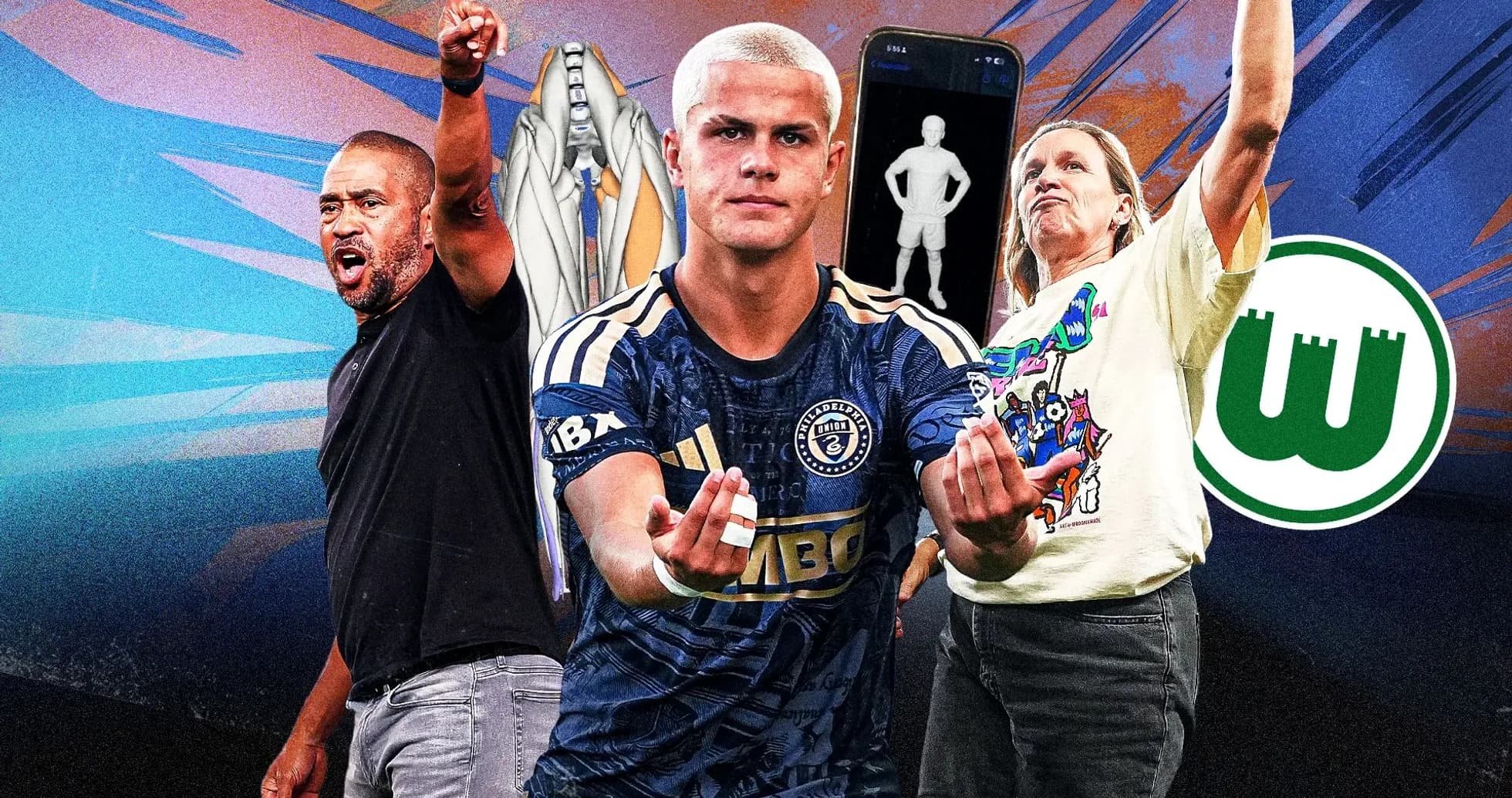
On the other side of the age spectrum, the questions are different but just as fraught. Every day at the Philadelphia Union academy, staff are trying to judge how much a teenager’s body can handle. How fast should they push someone like Cavan Sullivan into senior football? How much is talent, how much is physical readiness?
Historically, those decisions sit on a pile of strength tests, growth charts and educated guesses. They take time. They’re inconsistent. They’re subjective.
Fit:Match wants to strip away some of that subjectivity with nothing more than a smartphone and a few seconds.
Here’s the process: a coach or parent takes four photos of a player from different angles. The phone calculates height, body mass, wingspan and a host of other measurements. Then the system projects likely height, growth maturation and a basic outline of what full physical development could look like. Within half a minute, the user has a detailed physical profile.
Founder Haniff Brown half-jokes that it’s “ChatGPT for soccer.” Underneath the line is a serious idea: compress a process every pro club already does into a few taps and a near-instant report.
Brown didn’t start in sport. His first challenge was fashion: use quick body scans to stop customers buying four shirts and sending three back.
“How can we allow [a user] to upload a body profile of himself so that he doesn't have to buy four shirts and return the three that don't fit? You'll just buy one and boom,” he said.
Hospitals and healthcare firms noticed. Then, in 2024, an unnamed European club asked Fit:Match to scan its academy players. Brown saw the opportunity to build something bigger.
He set a ruthless time limit.
“I was very clear from the start that it had to take no more than 15 seconds,” he said. “Coaches don't like assessments that take too long. They want the kids going back, doing their drills. The longer and more complicated the assessment is, the less likely they are to use it.”
The club bought in. Others followed. Another problem soon emerged: even basic physical testing could produce different results depending on who held the tape measure.
“What we saw was one coach would, for the same player, measure and get one result, and from the same team, another coach would measure that same player and come up with a different result,” Brown said.
Fit:Match removes that human variance. Four photos, 30 seconds, and a standardized profile drops into the system. Clubs use it. So do families.
“When parents register their children to go into an academy, they can actually upload their photos. It generates their digital twin, and then on the back end, we tell MLS all these stats on that player,” Brown explained.
That allows MLS and its clubs to make more informed calls on age groups and development pathways. Youth football still leans heavily towards early physical bloomers. Fit:Match gives decision-makers a clearer picture of who is just big early and who might catch up later.
“A player who is a 14-year-old but an early developer is far different from a player who's 14 and a late developer,” Brown said. “Now MLS can scientifically tell that, and then make better pathways for those late developers so that they don't drop out of the ecosystem.”
Ethics, jobs and the build-or-buy dilemma
All of this sounds seductive: faster scans, smarter scouting, fairer pathways. But the sport isn’t just wrestling with what AI can do. It’s wrestling with what it should do.
Projecting a teenager’s future is loaded with risk. Automating recruitment decisions touches livelihoods. Handing decisions to algorithms unsettles people whose careers have been built on judgment and experience.
“The first step was getting people comfortable,” Brown admitted.
Marquee has learned the same lesson. It doesn’t try to bulldoze existing departments. It tries to sit alongside them.
“It's more about them, to be fair, to kind of feel comfortable with everything that we do together,” Bracha said. “And then once we create some successful stories together, we will definitely publish it.”
There’s also the cold financial logic that clubs can’t ignore. Building an internal AI operation is expensive. Staff costs already dominate budgets.
“From an ROI perspective, it will always be faster, quicker, righter to go to us because we've already built something, and we're investing a lot to improve it. It's your only expense,” Bracha argued. “One of the largest expenses in football clubs today is salaries. So do they want to hire more to build such a thing or just buy externally? It's like the AI’s most common question nowadays: build or buy? In this case, I think buy.”
The market has already produced cautionary tales. Wolfsburg were early adopters, claiming AI saved them €1 million a year in admin and injury-prevention work. On the pitch, they faltered. Their public championing of AI clashed with poor results and drew heavy criticism.
The club has doubled down rather than backed away. Sevilla have gone down a similar route, using IBM WatsonX to manage their data.
When ChatGPT helps pick a back five
Not everyone is building bespoke platforms. Some coaches are simply opening a laptop and asking public models for ideas.
Fraser, a coach who experimented with ChatGPT to explore matchups and formations, is one. Others have gone further. Seattle Reign head coach Laura Harvey made headlines in October 2025 when she revealed on the Soccerish podcast that she’d asked ChatGPT a disarmingly direct question: “What formation should you play to beat NWSL teams?”
For two of the then-14 NWSL sides, the AI’s answer was blunt: play a back five.
Harvey took the suggestion to her staff. The Reign switched to a system with five defenders and finished fifth in the table, eight places better than the previous season.
Did ChatGPT transform Seattle? Of course not. But it did plant a seed that grew into a tactical shift on the pitch. For AI advocates, that’s enough to claim a small victory.
There are plenty of dead ends too. Models that spit out noise. Datasets that gather dust. Ideas that never make it past the whiteboard. That might be the real point: AI is becoming another tool, not a magic wand.
In a sport decided by inches and milliseconds, where careers turn on a single decision, the ethical debates and cultural discomfort rarely outweigh the lure of even a tiny edge.
“We’re all looking for any advantage we can get,” Fraser said.
The question now isn’t whether football will use AI. It’s who will use it best.