.svg&w=384&q=75 "Naijagoal logo")

The Art of Interception: Mental and Physical Demands in Football
The art of the interception: where tired minds meet tired legs
An interception lasts less than a heartbeat. A defender reads the pass, steps into the lane and beats the intended target by a stud’s length. To the crowd, it is a simple touch. To the body and brain, it is a split-second storm of calculations: speed, distance, direction, balance, acceleration, deceleration — all solved on the run.
It is football’s purest example of thought welded to movement. And it is one of the first things to fray when fatigue creeps in.
Upamecano and the World Cup’s sharpest readers
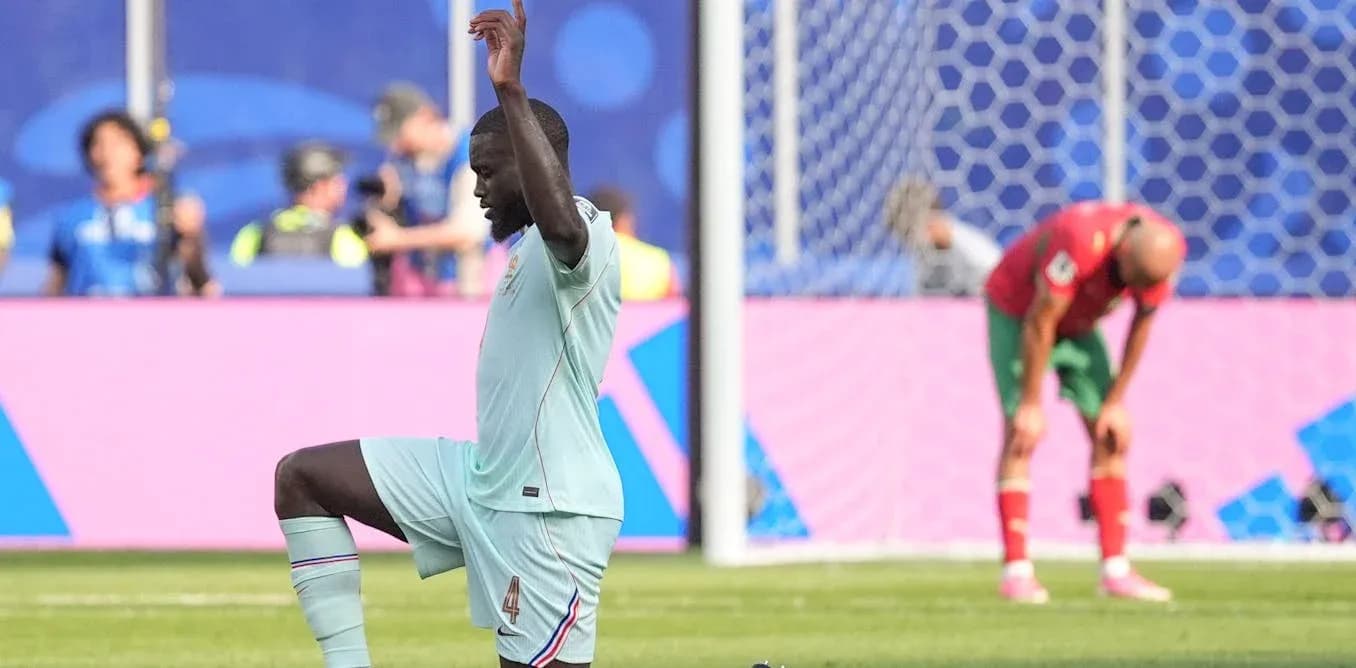
As the 2026 World Cup reached semi-final week, one number underlined the scale of that mental workload. France centre-back Dayot Upamecano led the tournament with 12 interceptions. Twelve times he had judged a pass early, committed his body, and arrived first.
That tally is not just a defensive stat. It is a record of how often an elite defender must process chaos at high speed during a major tournament. Every interception begins with a question: can I get there?
The answer is never simple.
Cape Verde and the underdog’s weapon
Cape Verde, making their World Cup debut, turned interceptions into a survival tool. Against Euro 2024 winners Spain in their Group H opener, they cut out 15 passes and held on for a 0-0 draw. Across four matches they averaged about 13 interceptions, scrapping their way out of the group before finally falling 3-2 after extra time to defending champions Argentina in the round of 32.
Those numbers do not prove that interceptions made their tournament. They can just as easily reveal a team forced to defend for long stretches. But they do show how disrupting passing lanes can unsettle superior opponents and open up counter-attacks before those opponents can reset.
Cut out the pass, and the game briefly flips. The hunter becomes the hunted.
What the brain sees, what the body dares
To understand how fatigue distorts this skill, you have to strip the interception down to its parts.
First comes prediction. A defender must forecast where the ball will travel and whether they can reach it first. Research on anticipation in sport shows that skilled players blend their knowledge of the situation with visual cues from opponents. A passer’s posture, their approach to the ball, the angle of the hips — all of it hints at where the ball is going.
Once the ball leaves the foot, speed becomes everything. In one experimental study with well-trained amateur footballers, players backed away from interceptions as passes grew faster. When they did go, their success rate dropped. The ball was simply moving too quickly.
Distance shapes the decision as well. Work on senior male futsal players found that how far the defender stood from the ball at the start strongly influenced whether an interception was possible. Yet even after committing, players kept adjusting their speed against the ball’s path until the move ended. An interception is not a single leap of faith. It is an unfolding chase, constantly updated.
Experience sharpens those judgments, but never makes them perfect. In a football-specific study comparing expert and less-expert athletes, both groups initially overestimated what they could intercept. With practice and direct feedback, their self-assessments improved. Players learned to match their ambitions to their actual physical reach.
That delicate calibration is exactly what fatigue threatens.
When tired minds misjudge tired legs
Mental fatigue is not about heavy legs. It is about dulled edges: tired concentration, slower recognition, clouded choices.
In one study of 20 professional male footballers, players first completed a demanding 30-minute mental task. When they then took part in a training match, their passing decisions suffered. Another study with well-trained male players showed that mental fatigue cut both the speed and accuracy of football-specific decisions.
Those experiments did not test interceptions directly, but the overlap is obvious. To intercept, a player must pick out key visual information, judge speed and distance, predict the next moment and choose a response under pressure. Blunt any of those tools and the defender either goes too late or not at all.
Physical fatigue adds another twist. A pass that was reachable in the 15th minute might be beyond reach in the 85th at the same speed. Research with 24 trained male players showed that acute physical fatigue reduced how far and how intensely they moved. It also altered aspects of their positioning and team play.
A related study drew a striking contrast. Players with stronger decision-making skills managed to hold their positioning and effectiveness under acute physical fatigue, partly by deliberately moving at a slower pace. Those with weaker decision-making profiles kept up more of their physical output, but their positioning and defensive play deteriorated.
The lesson is harsh but clear: the smartest defenders adapt their movement to their shrinking capacity. They keep reading the game honestly, not as they wish their body felt, but as it actually is.
The duel with disguise
Of course, the opponent is not standing still in this equation. They are trying to cloud it.
Research on deception in competitive sport describes how players disguise their intentions. A passer may shape their body towards one teammate, drawing the defender into that lane, before sliding the ball elsewhere. By the time the real direction becomes obvious, the defender has already shifted weight the wrong way.
Wait longer, and you see more. But you give the ball more time to travel. Move early, and you might get there first. You also leave yourself wide open to feints and disguise.
This is the constant tension for a defender: commit, or hold? Anticipate, or react?
Training the calculation, not just the legs
The science points towards clear implications for training and load management.
Sessions that drill interceptions cannot be sterile patterns against mannequins. Research on realistic practice design argues that training must preserve the key information and actions of real competition. That means moving opponents, varied pass speeds, changing starting distances, and deliberate use of deception.
Coaches also have to pay attention to the state players are in when they make these choices. Fatigue does not just slow the legs; in some situations it alters the decision itself. Tracking distance covered and sprint numbers might miss a more important drop-off: a defender’s ability to judge when to go.
The goal is not to churn out defenders who chase every ball. The best know which passes they can realistically cut out and keep updating that judgment as the move develops.
By the time Upamecano stretches out a boot and kills a move, we see only the final touch. Hidden behind it is a rapid, demanding calculation — one that becomes harder with every minute, every sprint, every mental demand of a World Cup. And in the games that decide tournaments, the margin between glory and exposure can be no more than that single, exhausted step into the passing lane.