.svg&w=384&q=75 "Naijagoal logo")
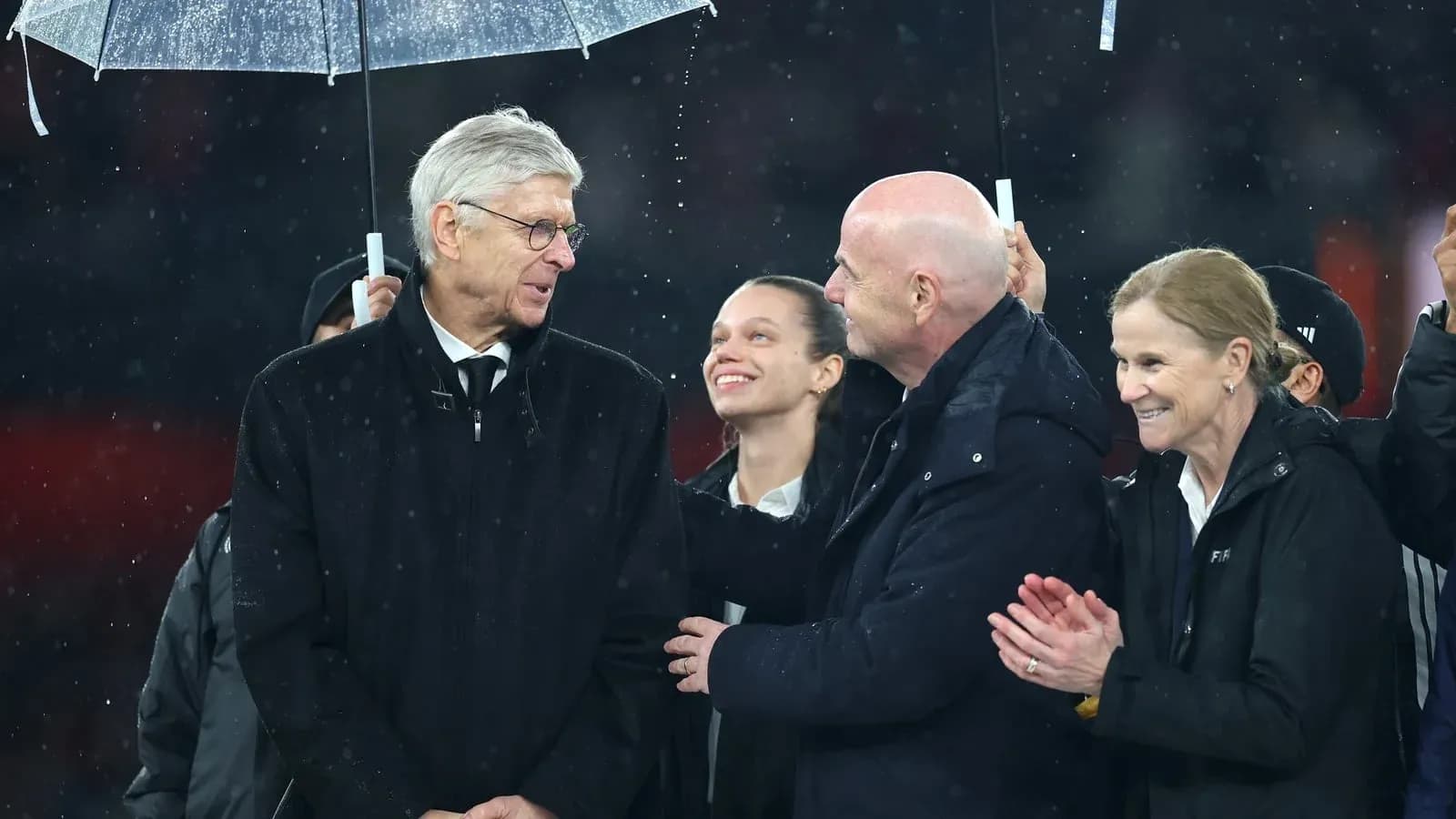

Arsene Wenger Calls FIFA Investment Plan 'Mistake'
Arsene Wenger has broken his silence on the storm around FIFA’s abandoned World Cup investment scheme, calling Gianni Infantino’s decision to pull the plug “absolutely necessary and beyond question”.
The former Arsenal manager, now FIFA’s chief of global football development, issued a carefully worded but unmistakably firm statement on Tuesday, a week after news first broke of Infantino’s plan to create a new vehicle, FIFA Forward Enterprise (FFE), and sell a 20 per cent stake to private equity.
The proposal triggered an immediate backlash. Three continental confederations rejected the idea outright, with UEFA pushing hardest, even raising the prospect of boycotting the World Cup and other FIFA competitions if the project went ahead. The pressure told. Infantino backed down.
Wenger has now made clear where he stands.
He stopped short of following Infantino’s senior adviser Carlos Cordeiro in walking away from the organisation, yet left no doubt that he opposed the FFE concept and the direction it hinted at for world football’s governing body.
“The recent events at FIFA deserve some clarity from my side,” Wenger said. He began by setting out his role, perhaps to underline the distance between his day‑to‑day work and the controversial scheme.
“At FIFA, I am the Chief of Global Football Development,” he explained. “Together with my team, I oversee the data analysis of the game, the FIFA online training centre, the development of youth education through 60 academies across 60 countries where they are most needed, and youth competitions around the world. In addition, I am a technical adviser to IFAB.”
Then came the key line. Wenger stated he “was not involved in this strategic plan and first became aware of the project through media reports”.
That admission lands heavily. A figure of Wenger’s stature, occupying a senior technical role, learning about a fundamental commercial shift from the press rather than from inside FIFA itself, points to how tightly the FFE plan was held at the top.
Once he had drawn that boundary, Wenger moved to the heart of the matter.
“The decision to withdraw the project was absolutely necessary and beyond question,” he said, “because I firmly believe in an independent FIFA that serves our game with commitment, transparency, and integrity.”
Those three words – commitment, transparency, integrity – cut straight to the criticism levelled at the FFE plan. Selling a slice of a World Cup company to private investors raised fears of outside influence over the sport’s biggest tournament and long‑term control of its revenues. UEFA’s threat to boycott underlined how close the game came to a full‑blown civil war.
Wenger’s statement does not attack Infantino by name, nor does it dwell on the politics. It does something more subtle: it plants a flag. His work, he stresses, lies in the football itself – data, coaching, youth academies in 60 countries, youth competitions worldwide – and in advising IFAB on the laws of the game. The business manoeuvre around FFE sat outside that sphere, and he wants that separation to be crystal clear.
He remains in post, but his intervention adds another authoritative voice to those who saw the FFE project as a step too far. In a week when the balance between football’s governance and its commercial ambitions has been tested again, Wenger has nailed his colours to a familiar mast: FIFA, he insists, must serve the game, not the other way around.