.svg&w=384&q=75 "Naijagoal logo")

Arsenal vs PSG: UEFA Champions League Final Showdown
At Puskas Arena in Budapest, Paris Saint Germain and Arsenal meet in the UEFA Champions League Final, a one-off, title-defining match. In the league phase, Arsenal arrive as the competition’s benchmark side, top of the table with 24 points from 8 wins in 8 games (23 goals for, 4 against), while Paris Saint Germain come in as dangerous challengers, ranked 11th with 14 points from 4 wins, 2 draws and 2 losses (21 goals for, 11 against). This final will ultimately define the narrative of their entire 2025 Champions League campaign: Arsenal aiming to convert league-phase dominance into a crown, PSG looking to turn a strong but less consistent run into the ultimate prize.
Head-to-Head Tactical Summary
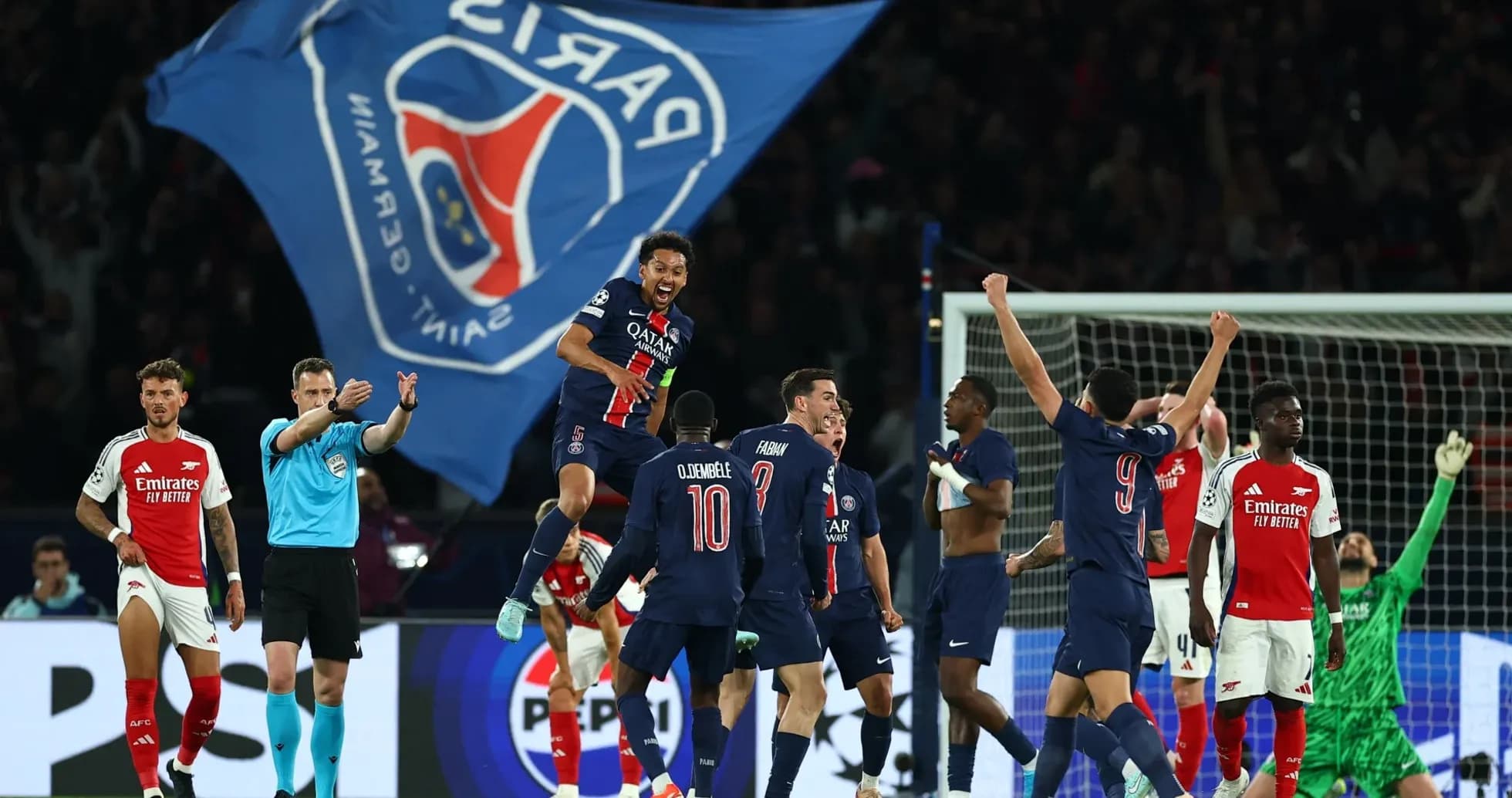
The recent head-to-head pattern is finely balanced and tactically rich. In 2025, the sides met twice in the UEFA Champions League semi-finals. On 7 May 2025 at Parc des Princes in Paris, Paris Saint Germain beat Arsenal 2-1, having led 1-0 at half-time. A week earlier, on 29 April 2025 at Emirates Stadium in London, PSG had already shown their capacity to control away legs with a 1-0 win, leading 1-0 at the break and preserving that margin.
Earlier in the 2024 Champions League league stage, on 1 October 2024 at Emirates Stadium, Arsenal defeated PSG 2-0, building a 2-0 half-time lead and then managing the game. Before that, on 28 July 2018 at The National Stadium in Singapore in the International Champions Cup, Arsenal produced a 5-1 win over PSG, having been 1-0 ahead at half-time. Going further back, on 23 November 2016 at Emirates Stadium in the Champions League group stage, the teams drew 2-2 after a 1-1 half-time score. Overall, Arsenal have delivered some high-margin wins at neutral and home venues, while PSG’s more recent competitive edge has come through narrow, controlled victories in knockout ties.
Global Season Picture
- League Phase Performance: In the league phase, Paris Saint Germain’s profile is that of a high-variance contender: 4 wins, 2 draws and 2 losses from 8 games, with 21 goals for and 11 against, giving them 14 points and 11th place. Arsenal, by contrast, have been relentlessly efficient: 8 wins from 8 matches, 23 goals scored and just 4 conceded, collecting 24 points and leading the table.
- Season Metrics: Scope detection shows team statistics totals (PSG 16 games, Arsenal 14) are only slightly above league-phase games (8 each), so this is effectively a league-only dataset and should be treated as In the league phase. In the league phase, PSG have scored 44 goals in 16 matches (2.8 per game) and conceded 22 (1.4 per game), reflecting a very aggressive attack and a defense that allows chances. Arsenal have 29 goals in 14 matches (2.1 per game) and have conceded only 6 (0.4 per game), indicating a controlled, compact structure with strong game management. Card data underlines PSG’s volatility, with a concentration of yellow cards in the 76–90 minute range (6 yellows, 42.86%), hinting at late-game stress, while Arsenal’s bookings are more spread, peaking between 61–75 minutes (7 yellows, 31.82%), consistent with tactical fouls to protect leads.
- Form Trajectory: In the league phase, PSG’s form string “DLDWL” points to inconsistency: only 2 wins in their last 5, with 2 losses and 1 draw, suggesting a side capable of high peaks but without sustained control. Arsenal’s “WWWWW” is a perfect run of 5 straight wins, reinforcing the image of a team arriving in the final at maximum confidence and rhythm, with both performance and results trending upward.
Tactical Efficiency
In the league phase, PSG’s attacking output of 2.8 goals per game versus 1.4 conceded paints them as a high-risk, high-reward side: they create and convert at an elite rate but leave space and volume of chances at the other end. Arsenal’s 2.1 goals scored and 0.4 conceded per game describe a far more controlled efficiency: slightly lower raw scoring volume, but underpinned by a defense that rarely allows clear opportunities and maintains clean sheets (9 in 14 games).
Without explicit numeric attack/defense indices from the comparison block, the relative efficiency can be inferred structurally. PSG’s profile suggests an attack index tilted towards explosiveness, with their biggest away win at 2-7 and multiple games with 3+ goals scored, but a defense index that is more vulnerable, reflected in 1.8 goals conceded per home game and only 5 clean sheets in 16 matches. Arsenal’s underlying metrics point to a balanced but superior overall index: their attack is slightly less explosive in single-game highs but extremely reliable, while their defensive index is elite, with just 6 goals conceded in 14 and no losses recorded.
In a one-off final, this translates tactically into a clash between PSG’s vertical, high-scoring model and Arsenal’s control-first approach. If the game opens up, PSG’s attacking numbers give them real upside; if it stays within Arsenal’s preferred rhythm, their defensive efficiency and clean-sheet habit tilt the probabilistic edge in their favour.
The Verdict: Seasonal Impact
This final is season-defining for both clubs. For Arsenal, victory would complete a near-perfect Champions League year: top of the league phase with maximum points and then champions, validating their defensive structure and game management as the standard for Europe in 2025. It would also reinforce their status as a top seed in future campaigns and set a benchmark for continuity with an unbeaten league-phase record and a flawless knockout conversion.
For Paris Saint Germain, winning here would transform a solid but not dominant league phase (11th place, 14 points) into a historic triumph. It would show that their high-ceiling attacking model can peak at exactly the right time, offsetting earlier inconsistency. A loss, however, would underline the gap between their explosive moments and Arsenal’s sustained efficiency, framing their campaign as one of strong potential that fell short against the most complete side in the competition.
Looking forward, the result will heavily influence the strategic narratives. An Arsenal win encourages further investment in continuity, defensive solidity and marginal gains, confirming that control and stability can outperform volatility at the highest level. A PSG win would incentivize doubling down on attacking talent and game-breaking profiles, proving that, in a knockout environment, ceiling can trump consistency. Either way, this final will be the defining reference point for how both clubs build and benchmark their Champions League projects in 2026.