.svg&w=384&q=75 "Naijagoal logo")

Arsenal's Ambitious Journey: Chasing History Against Brighton
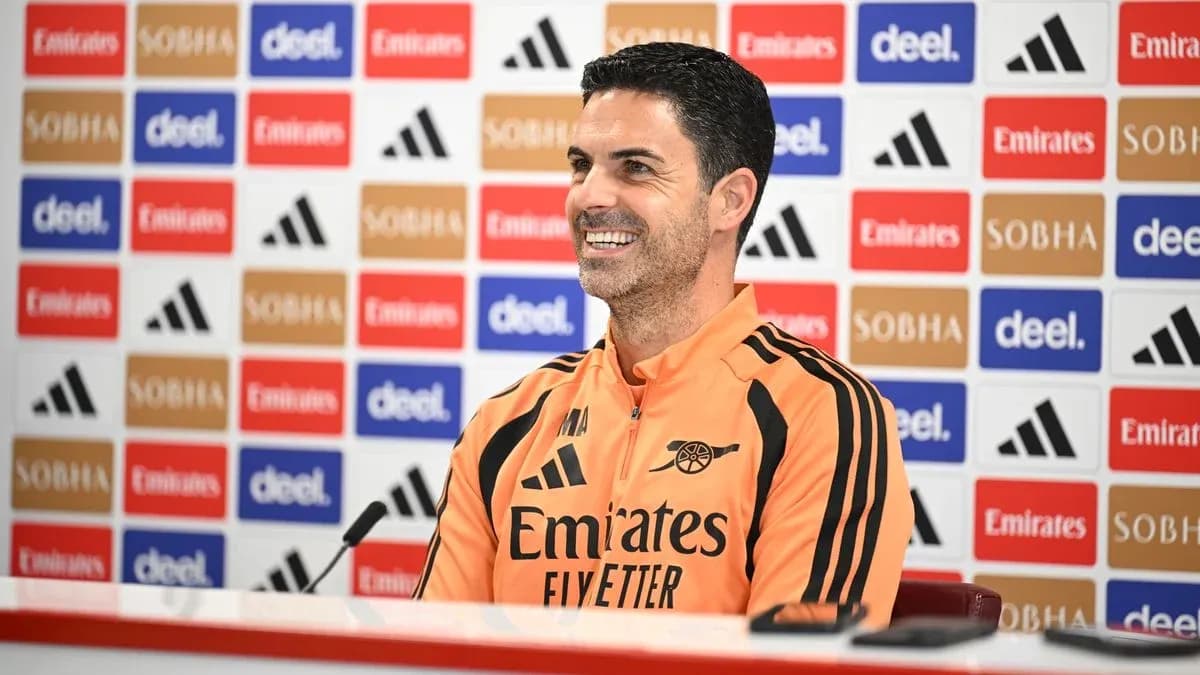
Mikel Arteta walked into the room looking relaxed, but the questions waiting for him were anything but soft. Brighton away, an eight-game winning start on the line, referee rows still simmering, contract talk, young talent, veterans, and a goalkeeper being talked up as the best in the world. It was all on the table.
Fitness boost before Brighton
First, the injuries. Arsenal’s head coach could hardly have sounded more upbeat.
- Ben White? “All good.”
- Jurrien Timber, Cristhian Mosquera, Piero Hincapie? Also in the frame.
Arteta confirmed they all have another session to come but spoke of them as players “willing to be part of it,” with the mood around the squad clearly positive heading into the Amex. This will be Arsenal’s fourth straight away game, and the manager likes what he’s seen in the grind.
“The team has responded so well,” he said. “Playing with such dominance, it doesn’t really matter if we play at home or away; we want to be the same team.”
Three away wins are already in the bag. Brighton are the last hurdle before the international break.
Referees, influence and the Sunderland fallout
The inevitable comparison came. Jamie Carragher has likened Arteta’s growing influence to Sir Alex Ferguson’s, suggesting the Arsenal boss is now in a position to shape refereeing narratives.
Arteta batted that aside.
He insisted he is not trying to become some all-powerful figure over officials, only to “defend my club” and answer questions “in the most direct way and fair way.” He admitted he will make mistakes but stressed his aim is to be as fair as possible.
The Sunderland controversy still lingers in the background, with Arsenal having spoken to Pro Ref. On that, he was tight-lipped.
“This is a conversation that will remain private as usual,” he said. Manchester United have already received an apology for a separate incident, but Arteta pushed the focus away from apologies and towards clarity.
“It’s not about the apology, it’s just agreeing that the decision should have been different or not,” he said. If views differ, the key for him is to “try to improve and move forward together.”
Respect for Brighton and De Zerbi’s successor
Arteta was reminded of comments from Fabian — Brighton’s manager at the time of their March meeting — who had criticised Arsenal’s style and time management before later apologising.
The Spaniard refused to stir anything up.
He spoke instead of “huge respect” for Fabian and Brighton as a club, calling what they have done “remarkable” and predicting “a beautiful game to watch” at the Amex.
Eight on the spin and a fast start
Beat Brighton and Arsenal will have eight wins from eight in all competitions this season, a start the club say they have not matched since 1903.
Arteta was not interested in the romance of the statistic.
“We’ve got a really tough opponent tomorrow so we’re going to have to earn the right to win the game,” he said. The mindset, though, is clear: the players are going there to extend the run, not protect it.
He later reflected on the broader start: seven wins already, achieved in the awkward period straight after a World Cup, when no one quite knew how players would respond.
“We know how complicated it is to win a football match at this level,” he said. “To win seven, it tells the story.” He pointed to attitude and application, admitted Arsenal “had a bit of luck as well,” and then cut it off: “We want to make another one for sure tomorrow.”
Talk of another Invincibles season? He brushed that aside. Brighton, and only Brighton, is on his plate.
Contract calm
Arteta’s own future was never going to be ignored. Club, manager, supporters — everyone seems aligned on a new deal. The question is when.
“I think we are all very much aligned,” he said. “Whenever the time is right, we’ll get that done. There is nothing to be concerned about.”
He refused to play the timing game, even when reminded that his last extension was announced during an international break.
“I don’t know if the time will be the same or different,” he replied. What mattered to him was shared “ambition and will.” Once there is time, he expects it to be “resourced.”
A longer international break – blessing or burden?
This Brighton match is the last before the new, extended international window. It changes the rhythm of the early season, potentially allowing clubs to build more momentum before the first stoppage.
Arteta will reserve judgement.
“Let’s see, it’s something that we’ll have to experience,” he said. Some national teams are staying local, some are flying around the world for more than two weeks. The key, he stressed, will be communication: “They understand where our players are, what we expect, what they expect as well. And work together, that’s the best way always.”
Asked whether the longer gap might actually help club sides maintain momentum, he again pointed to the variety of national-team schedules. “We have to wait and see how this develops,” he said.
Leadership on the pitch: Gabriel, Salmon and the split-second that matters
One moment from the cup tie stood out: Gabriel racing over to Marli Salmon after the youngster’s error, lifting him instantly.
For Arteta, that kind of instinct can’t be manufactured.
“You cannot cause that. You have it, or you don’t, because it’s a split second,” he said. He “absolutely loved it” because “we’ve all been there.”
The effect on a 16-year-old? Huge. That one gesture, Arteta believes, helped Salmon “go again and deliver in the next action” and revealed the “bond, that connection within the team.”
Bruno Guimaraes and midfield flexibility
Arteta was also asked about Bruno Guimaraes’ role, specifically whether he sees him as a left-sided midfielder given his predominantly right-sided work at Newcastle.
The answer was simple: versatility.
“He can play on the left, on the right, in the middle, he can rotate from there,” Arteta said. Bruno’s dynamism means it will come down to what Arsenal need “on the day,” how he links with other midfielders, and what the opponent is doing.
David Raya’s rise and his impact on Arsenal
The journey of David Raya, from non-league to the Premier League and now a goalkeeper being talked about as the best in the world and a Golden Glove contender, drew a smile from Arteta.
“That’s a great story,” he said, holding it up as a pathway for any kid dreaming of the top. Modern football is so interconnected that “you might be playing a game, somebody scouts you, and you can end up in two or three years’ time playing at the highest level.”
Raya’s mentality, Arteta believes, has been decisive. The Spaniard has “tremendous quality” but has had to overcome “a lot of difficulties and a lot of challenges.” Even when he reached Arsenal, “it wasn’t easy at the beginning.” He had to “dig in and improve himself” with the help of coaches — Iñaki singled out for “amazing work” — and his teammates.
Now, Arteta says, “he has the right to be one of the best.”
Is he the manager’s best signing, pound for pound? Arteta wouldn’t bite.
“I don’t know, he’s been a tremendous signing. There’s no question about that,” he said. Whether he’s the best is “just an opinion,” but what matters is that “he has elevated the team, the club to a different level” — and now Arsenal must “maintain that level.”
Viktor’s fight for rhythm
Viktor will face one of his former clubs this weekend, and questions came about his form and confidence.
Arteta doesn’t see a player struggling mentally, but he recognises the obvious: minutes have been limited in the Premier League. A strong display in Napoli last week offers a platform.
“I think that’s about moments as well,” Arteta said. The task now is to “give him all the support and confidence that he needs” because the staff know “the capacity that he has to score goals and what he can give to the team.”
The adaptation process, he stressed, is ongoing — and not just for Viktor.
“The team is doing certain different things this season as well,” he said. It’s a “constant evolution, player and team,” and his job is to “find those connections and that level of confidence for the player to give his best for the team.”
He knows what can flip a striker’s season.
“Especially for a striker, you know what, they need minutes and they need goals. That’s what really boosts the energy of them,” he said. Brighton away offers another chance.
Building the future: youth recruitment and retention
Beyond the first team, Arsenal have been busy reshaping the youth structure. Per has moved on, Pascal has come in, and the club have invested in prospects such as Victor in January and Andria Bartishvili more recently.
Arteta made it clear this is a club-wide strategy.
“If we want to constantly maintain this level and have the pathway already in-house… they need to be one of the best in the world at recruiting,” he said. That means in England and abroad, finding “the best talent that we possibly can” to sustain Arsenal’s standards.
It is not simple. Over his near seven years at the club, some young players — he name-checked Chido, Ayden and Nduka — have moved on. Others, like Max Dowman and Marli Salmon, have been tied down to new deals.
“That is challenging because there are a lot of parties there,” he said. The system “is not easy,” and at key moments “big decisions have to be made” by players, agents and families, not just the club. Arsenal will “try to, for sure, to keep the best talent in-house.”
Max Dowman kicking the door down
Max Dowman’s performance at Ipswich Town — two goals and a statement display — has sharpened the conversation about his role.
When asked whether the youngster is knocking on his door demanding more minutes, Arteta’s answer was pointed.
“That’s the best way to knock on the door: to do it on the pitch, not in the office,” he said. When a player “delivers constantly on the pitch every single day in training,” the manager runs out of arguments. Teammates start demanding that player be picked.
“What Max did the other day, alongside all the players… that they haven’t played that many minutes, it was really impressive.”
Dowman’s development isn’t just technical. Being around the first team has changed him as a person.
“When you see how those players behave daily, the level of attention they put to any detail, the way they look after themselves, the standard that they set,” Arteta said, it raises a youngster’s level. It “educates you in a way that becomes a normality,” and once that standard is normal, “you will hit another level.” That, he believes, is where Max is now.
Eze, Tzolis and the left-wing puzzle
With Martinelli and Trossard gone, the left wing has been reshaped. All of Eze’s minutes this season have come there, and Arteta likes what he brings.
“He’s always played there,” he said. The “biggest moments” and “highlights of his career” have come from that side. Eze can drift into different spaces, but that left channel is where he has consistently produced match-winning moments for previous clubs.
He shares that role with Tzolis. So what makes an Eze game versus a Tzolis game?
Form. The opponent. The relationships within that unit. “There are a lot of factors,” Arteta said. It’s a tactical call, not a fixed hierarchy.
Ezri Konsa and an instant partnership
Ezri Konsa’s impact has been swift. Thrown into a physical battle against Sunderland’s Brobbey, he impressed alongside Gabriel.
Arteta had heard “great things” about Konsa before he arrived. Seeing him every day has underlined “the magnitude of the player that we signed. Not only the player, but the person.”
He highlighted the way Konsa connects with people, the easy bond with Gabriel. “When you see those two in the corridors talking, the way they interact with each other,” Arteta said, “it seems like they’ve been here for a long, long, long time together.”
That matters, because he sees their partnership as “extremely important on the field.” Konsa’s attributes and quality, he added, “really make us better.”
Arsenal head to Brighton chasing a piece of history, juggling fitness boosts, contract calm, youth ambition and the weight of expectation. They have seven wins already, a goalkeeper touching the elite, young talents demanding more, and a manager who insists he is only just getting started.
The question now is simple: can this team turn a blistering start into something that truly changes the shape of their season?