.svg&w=384&q=75 "Naijagoal logo")

Argentina vs Egypt: World Cup Quarterfinals Showdown
Two left-footed geniuses. Two exhausted teams. One ticket to the World Cup quarterfinals.
On Tuesday in Atlanta, the tournament’s reigning kings meet its long-suffering nearly-men as Argentina face Egypt at Mercedes-Benz Stadium, a last-16 tie framed by fatigue, tension and the looming silhouettes of Lionel Messi and Mohamed Salah.
A champion jolted awake
Argentina arrive with a win on paper and a warning in the legs.
Their 3-2 extra-time escape against World Cup debutants Cape Verde on Friday stripped away the illusion of cruise control. What had looked like a serene title defence through the group stage suddenly cracked, the holders pushed to the brink by a side that fired 16 shots at them and refused to bow until Diony Borges turned into his own net in the 111th minute.
That own goal kept Argentina alive. It also exposed them.
Messi, who has carried this campaign on his back at 38, admitted afterwards he was tired and frustrated by Argentina’s failure to press high. That detail matters. This team is still built around his genius, still leans on his left foot when the plan frays. Seven of Argentina’s 11 goals so far have come from him, a remarkable burden at this stage of his career, even if one more is counted as an own goal in the team tally.
For the first time this tournament, Lionel Scaloni looked like a coach with more questions than answers. Was Cape Verde just an awkward night? Or a blueprint for how to drag the champions into deep water?
Bodies creaking, decisions looming
The schedule has offered no mercy. Both sides are running on fumes.
Argentina’s issues are not just tactical. They are physical, visible, and potentially decisive.
Left-back Facundo Medina left the Cape Verde match with severe cramp, Enzo Fernández also seized up, and Nicolás González limped through an ankle problem after all substitutions had been used. The next day’s recovery session underlined the strain: Nahuel Molina, Fernández and Medina were all unable to complete it, with Medina’s problem later played down as cramp but González emerging as the bigger doubt amid reports of an ankle sprain.
Scaloni does at least have options at left-back, with Nicolás Tagliafico ready if Medina cannot start. Elsewhere, the choices are less straightforward. How much risk can he take with players who looked spent only days ago? How many minutes can he realistically squeeze out of Messi, who has already been asked to do almost everything?
The defending champions know the stakes. They also know their history.
Across all World Cups, Argentina have turned extra time into a familiar hunting ground. Twelve matches have gone beyond 90 minutes; they have survived 10 of them, four without needing a shootout and six through penalties. When games stretch into the dark, they rarely blink first.
But there is a cost to living on the edge, and this tournament is starting to send the bill.
Egypt smell opportunity
Egypt will have watched Cape Verde’s fearless performance with sharp interest.
The Pharaohs have waited 92 years to see their national team in a World Cup last 16 again. They did not come this far to play the role of respectful guests. Their route here has been just as draining: 120 minutes against Australia, a 1-1 draw, and then a 4-2 win on penalties that finally broke the curse of the group-stage exit.
Their identity under pressure is clear. Compact, disciplined, hard to drag out of shape. They will likely sit in, absorb, then spring forward through Salah and Omar Marmoush whenever space appears. Against an Argentina side still searching for its pressing intensity, that counter-attacking threat becomes more than a tactical wrinkle; it becomes a genuine weapon.
The question, again, is fitness.
Salah entered the Australia match nursing a hamstring concern. At times he looked like a man managing his body as much as the game, reluctant to open up fully in another draining 120-minute contest. Egypt need his acceleration, his ability to turn a half-chance into a defining moment. They also need him on the pitch, not in the treatment room.
If he is anywhere close to fully fit, this tie tilts from daunting to dangerous for Argentina.
Messi, Salah and a thin margin
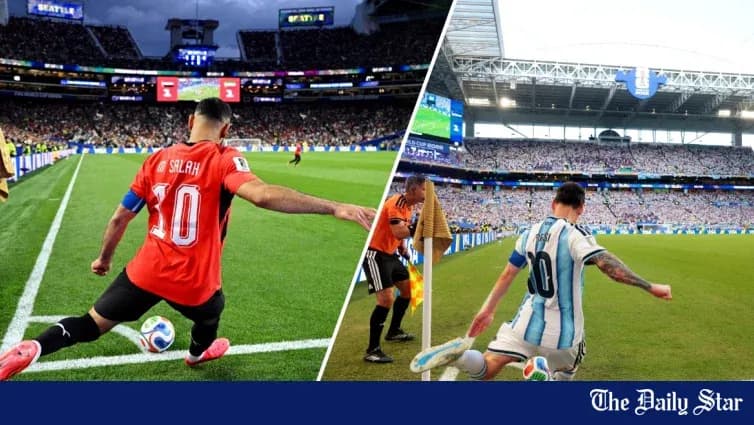
Strip away the subplots and this match still comes back to two left feet that have defined an era.
Messi, at 38, chasing one more deep run in the colours that finally crowned him. Salah, 32, carrying the hopes of a nation that has dominated Africa but never cracked the World Cup’s inner circle. Both arrive a little bruised, both a little short of peak sharpness, yet both capable of deciding everything with a single touch.
Argentina will try to reassert control, to turn this back into the kind of match they dominated in the group stage. Egypt will try to drag them into another fight, to test those tired legs and that fragile press, to see if Cape Verde’s courage was not an anomaly but a roadmap.
Somewhere inside Mercedes-Benz Stadium, between cramp and courage, between tired minds and tired muscles, one of these teams will find just enough.
The prize is clear: Switzerland or Colombia in Kansas City on July 11, and a place among the last eight.
For Messi and Salah, for champions and challengers, the margin now is razor-thin.