.svg&w=384&q=75 "Naijagoal logo")

Anglian Combination Postpones Season Due to Rock-Hard Pitches
The Anglian Combination was supposed to be lacing up for another season next weekend. Instead, one of England’s biggest amateur leagues has been brought to a standstill by something no fixture secretary can control: the sky.
After an urgent board meeting on Friday, the 85-club competition, spread across Norfolk and Suffolk, took the rare step of postponing the start of its 2026/27 season. The new kick-off date is now 29 August. The reason is brutally simple. The pitches are “rock hard” and players are getting hurt.
For weeks, grounds that usually give a little under a sliding tackle have felt closer to car parks than football fields. Pre-season friendlies have been cancelled across the region, and the games that did go ahead have come at a cost, with what the league described as “many injuries” on the baked surfaces.
That mounting casualty list left the league’s board with little room for sentiment. In a statement sent to clubs, players and officials, chair Dale Brown laid out the thinking. Player welfare comes first.
“The rationale behind this decision is to protect the welfare of players, officials and all associated with the match day, in what has been the driest and hottest July since records began in 1836,” Brown said. “Most of our league clubs pitches are grass and the ground conditions are extremely dry and pitches rock hard.”
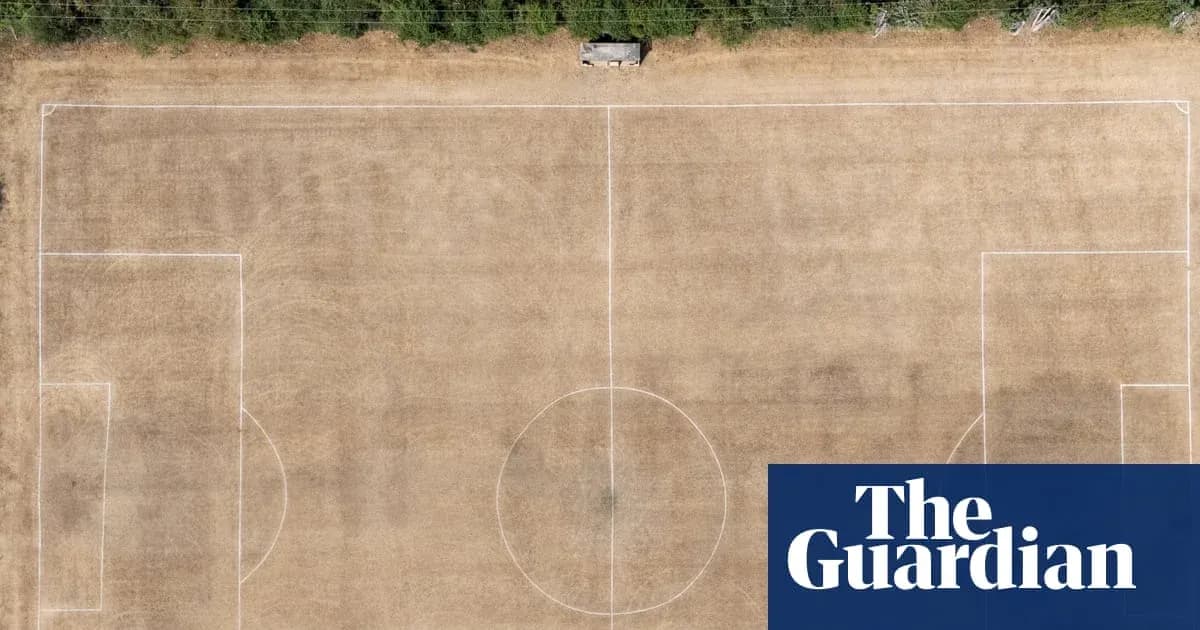
The language was blunt because the situation is. Much of England and Wales is visibly scorched after a sequence of record-breaking heatwaves and historically low rainfall. The ground in many areas is as unforgiving as concrete. In East Anglia, where the Anglian Combination lives and breathes on village greens and community fields, that has turned routine summer preparation into a safety risk.
Brown did not pretend the call was universally popular. “This was a very difficult decision to reach and one that will not please all clubs,” he admitted. For managers already juggling holidays, pitch bookings and player availability, another reshuffle of the calendar is an unwelcome headache. But the alternative was to send players out on surfaces that simply do not give.
Current Weather Conditions
The backdrop is stark. Record temperatures hit in May and June. July went down as the driest since records began. A formal drought has already been declared across half of England, and water companies have moved to protect dwindling supplies. Anglian Water, which covers Norfolk and Suffolk, has enforced a hosepipe ban since 11 July, tightening the screw on anyone trying to keep grass alive.
The divide is visible from the air. Aerial photographs have shown parks and community sports fields bleached brown, stripped of almost every hint of green. The exceptions stand out: golf clubs, some sports facilities and private schools, whose exemptions from hosepipe bans have stirred debate while grassroots volunteers watch their pitches crack.
Looking Ahead
The weather is not done yet. The Met Office is predicting another heatwave next week, with temperatures expected to push up to 36C in parts of East Anglia and south-east England by Thursday. Humidity may rise, but meaningful rain is nowhere in sight. For ground staff armed with nothing more than a fork, a hose they cannot use and a prayer for clouds, there is little they can do.
Nationally, the scale of the disruption is hard to quantify. The FA does not keep central records on how many leagues have delayed their seasons because of the drought, leaving decisions to individual competitions and county FAs. The Anglian Combination has gone public, but it is unlikely to be alone in wrestling with the same problem.
For now, players in Norfolk and Suffolk must wait. Boots will stay in the hallway a little longer, match balls will remain in the kit shed, and the first roar of the new campaign will be pushed back by four weeks.
When the whistle finally blows on 29 August, the grass underfoot will tell its own story about how much the game at this level depends on something as simple, and as fragile, as rain.