.svg&w=384&q=75 "Naijagoal logo")
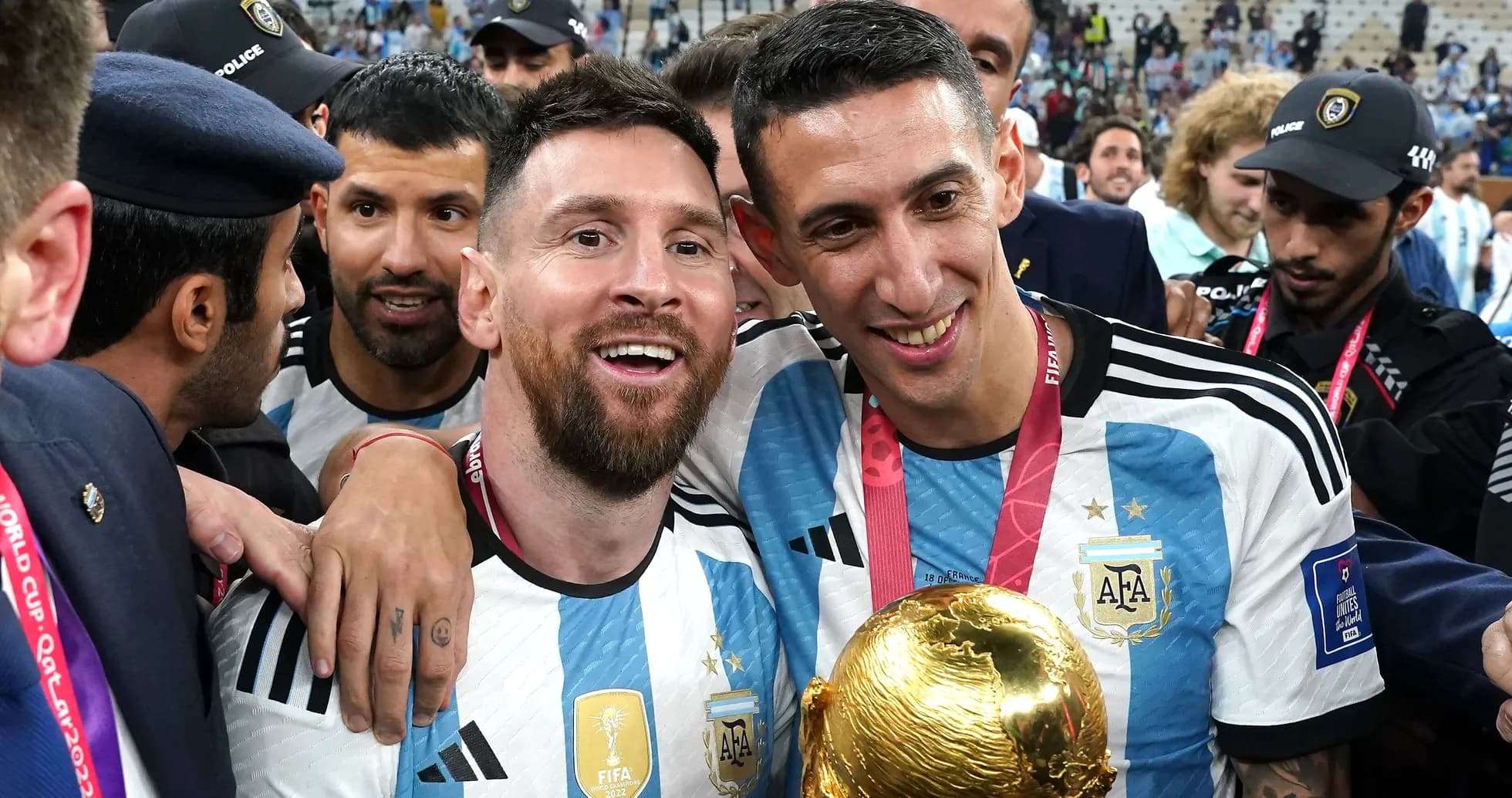

Ángel Di María Defends Lionel Messi's Future in Football
Ángel Di María has never been one for half-measures. Not on the pitch, and certainly not when he talks about Lionel Messi.
Days after Argentina’s agonising end to their 2026 World Cup journey, the veteran winger drew a firm line under any suggestion that Messi’s story at the top level is over. For Di María, it is simple: Messi plays until Messi decides otherwise.
Speaking in the aftermath of Rosario Central’s 2-1 defeat to Belgrano, Di María barely needed the question to finish before he launched into his defence of his long-time teammate.
“Leo has to keep going as long as he wants,” he said. “I think he can continue for many more years. At 39, he's shown that he's one of the best and that he can continue to be one of the best in history. He has no ceiling, there's nothing more for him.”
The words cut through the noise that has followed Argentina since the World Cup final. Leandro Paredes had already revealed that Messi viewed that showpiece as his farewell to the international stage, a revelation that hit a country still riding the emotional high and low of another deep run. The narrative of a goodbye began to form. Di María is not ready to accept that as a full stop.
For him, Messi remains the one who dictates the terms of his own exit. Age, expectation, even the weight of a nation’s hopes – all secondary to the will of a player who has spent two decades bending football to his imagination.
Scaloni at the heart of a golden era
Di María’s message did not stop with Messi. His gaze quickly shifted to the man on the touchline who has quietly become just as central to Argentina’s modern identity: Lionel Scaloni.
“Scaloni is the leader of the national team, I hope he stays for everyone's sake,” Di María insisted. “He's developing a good generation of young players who are coming through now, and every little bit helps. I hope he stays; it's his decision. Scaloni, better than anyone, knows what he wants, but obviously, as an Argentine, I'd like him to continue.”
The plea carries weight. Scaloni has overseen a golden era for the Albiceleste, stitching together a side that delivered four major trophies: the World Cup, two Copa Americas and the Finalissima. Under him, Argentina stopped chasing ghosts and started building legacies.
Di María knows better than most what that transformation cost and what it gave. He was there for the near-misses and the heartbreaks. He was also there when the dam finally broke and the titles started to flow.
That is why he frames Scaloni not as a mere coach, but as the anchor for a new wave of Argentine talent, the bridge between the old guard and the kids now breaking into the senior squad. Remove that anchor, and the transition becomes far more fragile.
A generation that changed everything
Asked to look back on the journey rather than just the final stumble, Di María’s voice shifted from defiant to reflective. This is a player who has lived the full arc of Argentina’s modern footballing saga, from the frustrations of earlier years to the ecstasy of recent triumphs.
“They deserve more than just applause for everything they've achieved and have continued to achieve,” he said of his teammates. “Beating England was the culmination of all that. For me, the World Cup ended there, and we gave the country its greatest joy, and that's the most beautiful thing for everyone.”
In that line, you can hear the weight of a career. For Di María, that win over England stands as a defining emotional peak, a moment when years of toil, criticism and expectation finally crystallised into something pure. Whatever came after, he suggests, could not change what had already been given to the people back home.
The current squad, in his eyes, no longer fights for validation. They have already secured their place in football’s pantheon. Every trophy, every iconic night, has etched them into history.
Living every kick from afar
Di María also lifted the curtain on what it felt like to watch this World Cup from a different vantage point, no longer at the centre of the storm but still emotionally tethered to every minute.
“I suffered through every match, but in the end they drew on their inner strength and that's what led to victories,” he admitted. “Finals are finals; sometimes you win, sometimes you don't. This time it wasn't our turn, but I think the lads did the national team proud.”
There is no attempt to dress up the pain of defeat. He knows what it is to win the biggest games and to lose them. He also knows that, in Argentina, finals are never just football matches. They are national events, emotional trials, a mirror held up to a country’s sense of itself.
Yet his conclusion is unwavering: pride, not regret. Even in defeat, he sees a group that honoured the shirt.
Between the lines of Di María’s words lies the real question now facing Argentina: can this era stretch a little longer, with Messi still weaving his magic and Scaloni still guiding the next wave, or has the story already reached its natural turning point?
For Di María, at least, the answer is clear. Messi still has more to give. Scaloni still has more to build. The only decisions that matter now belong to them.