.svg&w=384&q=75 "Naijagoal logo")

Andoni Iraola's Liverpool Pre-Season Tour: Lessons Learned
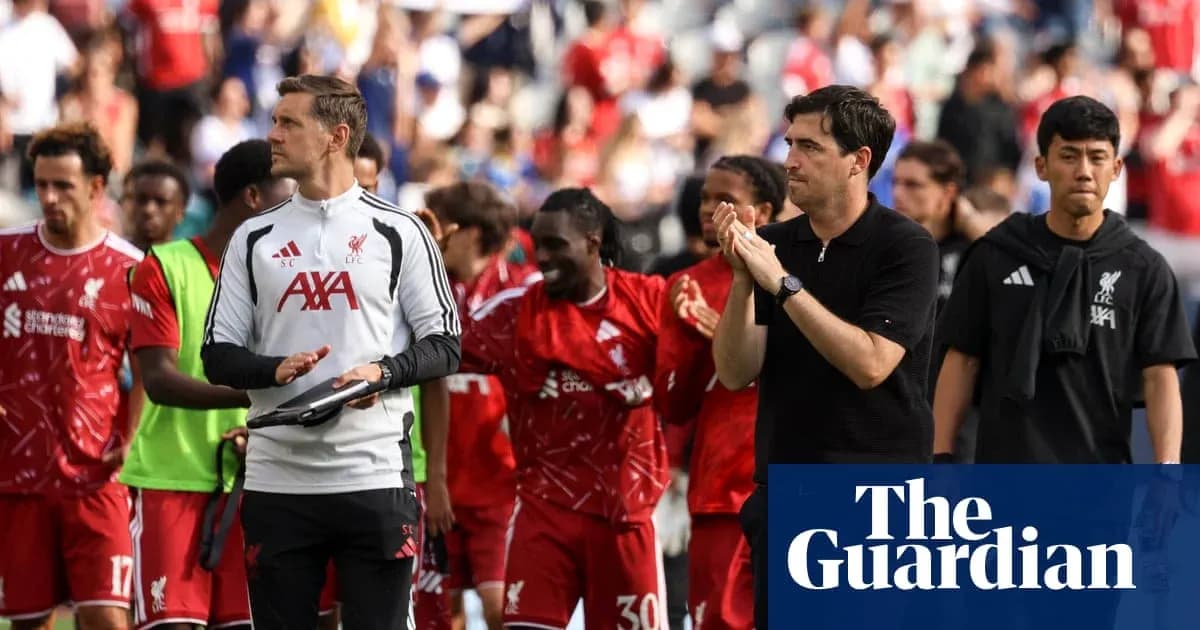
Andoni Iraola’s first pre-season tour as Liverpool head coach ended with a defeat, a long flight and a reminder of how much work lies ahead. Wins over Sunderland in Nashville and Wrexham in New York had offered encouragement. Leeds’ 4-2 victory in Chicago supplied the jolt.
Across three games, the outline of Iraola’s Liverpool came into view: aggressive, front-foot, demanding. The reality is that this version is still months, not weeks, away.
A bold idea, a tight deadline
For 45 minutes against Leeds, Liverpool looked like a side already buying into their new manager’s ideas. The press bit hard. The tempo jumped. With the senior names on the pitch, Iraola’s high-intensity blueprint briefly felt natural rather than forced.
Then came the second half.
Set-piece frailty resurfaced. Concentration slipped. Old problems – the ones that haunted last season – walked straight back through the door once the changes came. For Iraola, it was both a warning and a useful piece of evidence. The style he wants is clear. The squad’s ability to sustain it is not.
The clock is not his friend. Liverpool’s new head coach has not yet coached Virgil van Dijk, Cody Gakpo, Alisson, Alexis Mac Allister or new signing Víctor Muñoz. He has not even met them in person. That happens this week at the AXA Training Centre, days after a draining trip back from Chicago and with Mac Allister still away after his World Cup exertions.
There are fewer than three weeks before Liverpool open their Premier League campaign at Newcastle. Only a double-header against Como at Anfield remains on the friendly schedule. Iraola did not pretend the transformation will be instant. He admitted he cannot simply walk in on day one and expect perfection. The gap between his ideal and what he has in front of him was laid bare in the US.
A squad that still needs help
In truth, this tour never gave Iraola a full deck to play with. For much of it, eight first-team players were missing on post-World Cup breaks and six more were out injured. Joe Gomez joined that latter group after another ill-timed setback in the States.
With 14 senior options unavailable, Liverpool’s adaptation to Iraola’s methods was always going to lag. Even when everyone returns, the holes are obvious.
Mohamed Salah’s departure was confirmed in March, with talks to end his contract early starting even before that. Five months on, there is still no replacement. On the right flank, Liverpool are gambling with time and hoping the market bends their way.
Conor Bradley’s serious knee injury has left the right-back position exposed. Internally, the club is excited by Jérémy Jacquet and Giovanni Leoni – the latter emerging from ACL rehab looking like a different physical presence entirely – and 18-year-olds Ifeanyi Ndukwe and Mor Talla Ndiaye impressed across the Atlantic. The problem is not talent. It is experience, and in Ndukwe’s case, eligibility. Post-Brexit work permit rules will keep him out of competitive action this season.
Gomez’s injury history means he has to be treated as a bonus, not a pillar. Counting him as one of four dependable central defenders is wishful thinking. Iraola spoke intriguingly about wanting wingers who can operate on both flanks and the tactical advantages of switching them mid-game. That flexibility is appealing. But unless Liverpool move decisively, the right side of their team may become a running debate, even if they succeed in prising Bradley Barcola from Paris Saint-Germain.
For a new head coach trying to imprint a demanding style, the message from this tour is blunt: he needs more backing, and he needs it quickly.
Nyoni steps out of the shadows
If the squad’s shortcomings were clear, so was one of the solutions already in-house.
Amid the enforced reliance on youth, Nyoni made himself impossible to ignore. Others caught the eye – Ndukwe and Talla Ndiaye, Lewis Koumas, Kieran Morrison, Luke Chambers – but no youngster shifted their first-team status quite like the 19-year-old midfielder.
Nyoni and Rio Ngumoha were regulars around Arne Slot’s squad last season. Ngumoha turned that proximity into 19 Premier League appearances, five of them starts. Nyoni had to settle for six cameos from the bench. In the US, he looked determined to close that gap.
He took to Iraola’s instructions immediately: receive on the half-turn, look forward early, take risks in the right zones. He did it under pressure. He did it by drifting into space with smart, economical movement. His pass in the buildup to Florian Wirtz’s goal against Leeds was the standout moment – an incisive, perfectly weighted ball that matched the ambition of Iraola’s system.
After that game, Nyoni admitted he knew he had to improve this summer. On this evidence, he has. He returns to Merseyside not as a hopeful extra, but as a midfielder firmly in his new manager’s plans.
Jones at a crossroads
While one academy product surged, another stalled.
Curtis Jones arrived on tour with a year left on his contract and growing interest from Italian champions Inter. This was a chance to convince a new head coach he should be central to the project. He did not take it.
Where Nyoni and Dominik Szoboszlai looked comfortable with Iraola’s demands for central midfielders – intensity off the ball, verticality on it – Jones struggled. His second-half showing against Leeds underlined the problem: the tempo of his game lagged behind the system being built around him.
Then came the captain’s armband incident against Wrexham. When Szoboszlai was substituted, Jones expected the armband. It went instead to Kostas Tsimikas, the reserve left-back who spent last season on loan at Roma. Jones’ petulant reaction did him no favours.
The pattern repeated. When Gomez went off in the opener against Sunderland, Tsimikas again received the armband. Twice, the boyhood Liverpool fan and one of the more senior tourists watched a loanee left-back be preferred as on-field leader.
Publicly, everyone laughed it off. Jones, Szoboszlai and Tsimikas made light of it in the days after the Wrexham game, and social media noise exaggerated the row. Yet the optics cut against what Iraola has been preaching. During a sit-down in Chicago, the new head coach stressed the importance of the collective. Jones’ reaction looked out of step with that message.
With a year left on his deal and a new manager making early value judgments, this felt less like a storm in a teacup and more like a signpost.
Szoboszlai takes centre stage
If one senior midfielder’s stock dipped, another’s soared.
In the absence of Salah, Andy Robertson, Van Dijk and Alisson, Dominik Szoboszlai became the face of Liverpool’s tour. Everywhere the team went across the US, the Hungary captain drew the loudest roars. Every introduction, every touch, every strike carried the weight of expectation.
He handled it with ease.
Fresh from signing a new five-year contract, Szoboszlai trained like a standard-bearer. With a young and patched-up squad around him, his leadership mattered as much as his quality. He set the tone in sessions, demanded standards, and embraced the responsibility that came with being last season’s standout player.
For Iraola, that presence is priceless. With Salah and Robertson gone, vice-captaincy roles are up for grabs. Szoboszlai looks an obvious candidate, not just because of his contract length or status, but because he has already started behaving like the heartbeat of the dressing room.
The tour ended with defeat in Chicago and a long list of questions. Iraola flies back to Liverpool knowing his idea works in flashes, that his squad is incomplete, and that some of his younger players are ready to accelerate their careers.
Pre-season is over. The margin for experimentation is shrinking. The real test now is whether the club moves as decisively off the pitch as Iraola wants his team to play on it.