.svg&w=384&q=75 "Naijagoal logo")

Carlo Ancelotti on Neymar and Brazil's Future
Carlo Ancelotti did not dodge the Neymar question. He walked straight into it.
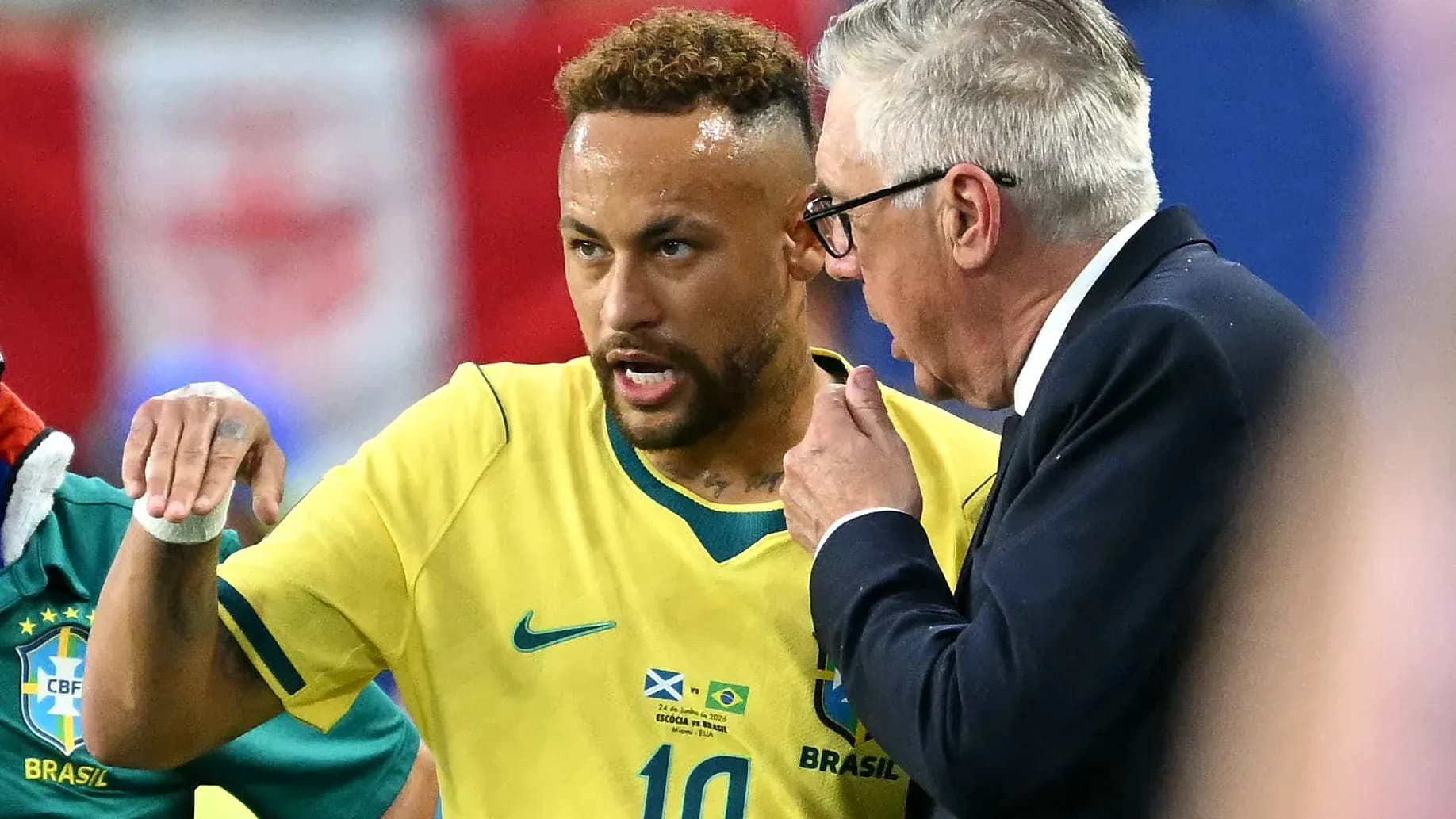
The Italian coach, now the man charged with reshaping Brazil, laid out the contrast as plainly as he could: Neymar the professional, present and committed; Neymar the athlete, short of what a World Cup demands.
He pointed first to the context. A grade 2 calf strain had already pushed Brazil’s number 10 to the margins, ruling him out of the opening group games against Morocco and Haiti. Match fitness never really caught up. The player who once bent tournaments to his will arrived, this time, chasing his own body.
"I think he didn’t contribute on a technical level as it was hoped he could, because he couldn’t," Ancelotti told ESPN. That line matters. It wasn’t about desire. It was about capacity. "But, in terms of attitude, it was a very positive attitude. I have a lot of affection for him, I thanked him for his attitude, for his behavior, and I think it was the right decision to include him on the 26-man roster."
Behind the scenes, Neymar impressed his coach. Leadership in the dressing room. Professionalism in training. No public sulking, no visible fractures in the group. For a player so often framed as a lightning rod, that mattered to Ancelotti.
Yet the praise came with a sting.
"The only thing that bothered me is that Neymar could have prepared himself better during that lead-up period," Ancelotti added. "He could have been ready for game one instead of game four. That was the only disappointing part."
That is the pivot point. Ancelotti, a serial winner, has little patience for wasted margins. In his eyes, Brazil did not just lose minutes of their best player; they lost the chance to build a tournament around him from the first whistle. By the time Neymar was available, the rhythm had already moved on.
Now, the rhythm of Brazilian football is about to change with it.
With his long-time talisman stepping away from the international stage, Ancelotti is preparing what amounts to a full-scale rebuild ahead of the 2030 World Cup. This is not a tweak. It is a philosophical reset: away from the icons who defined the 2010s, toward a generation that must carry the next decade.
"I think that players like Neymar, who already commented yesterday, and with all due respect to his decision. I believe that in history, one generation ends and another has to come, and it has to be better than the last one," the former Real Madrid boss said.
That is the standard being set. Not equal. Better.
And Neymar will not be the only casualty of time. The coach made it clear that the changing of the guard will not stop at the number 10 shirt. Asked about the futures of Casemiro, Danilo and Alex Sandro, Ancelotti didn’t reach for clichés about experience or dressing-room value. He leaned into reality.
"I think so. It is a period that is coming to an end," he admitted. "Obviously, we have to thank all of them, and I have a lot of affection for all of them. But I think the idea that a player over 30 is done means that we have to think about the future.... Some of these players will be there, obviously. Marquinhos, for example. Alisson, we’ll see."
There it is: gratitude, then the guillotine of elite sport.
Casemiro, the heartbeat of a generation. Danilo and Alex Sandro, dependable lieutenants across cycles. All now standing at the edge of international football’s exit door, their roles shrinking as Brazil’s timeline stretches toward 2030.
Ancelotti’s message cuts both ways. Age alone will not decide everything — Marquinhos is already pencilled in, Alisson remains under consideration — but the axis has tilted. The team will no longer be built around what these veterans were. It will be built around what the next wave can become.
For Brazil, a nation that clung to the aura of its stars for so long, the question is no longer whether this generation deserved more. The question, under Ancelotti, is whether the next one will be ruthless enough, fit enough, and ready early enough to deliver what the last could not.