.svg&w=384&q=75 "Naijagoal logo")

Žilina’s Tactical Adjustments Secure 2-1 Victory Over Hajduk Split
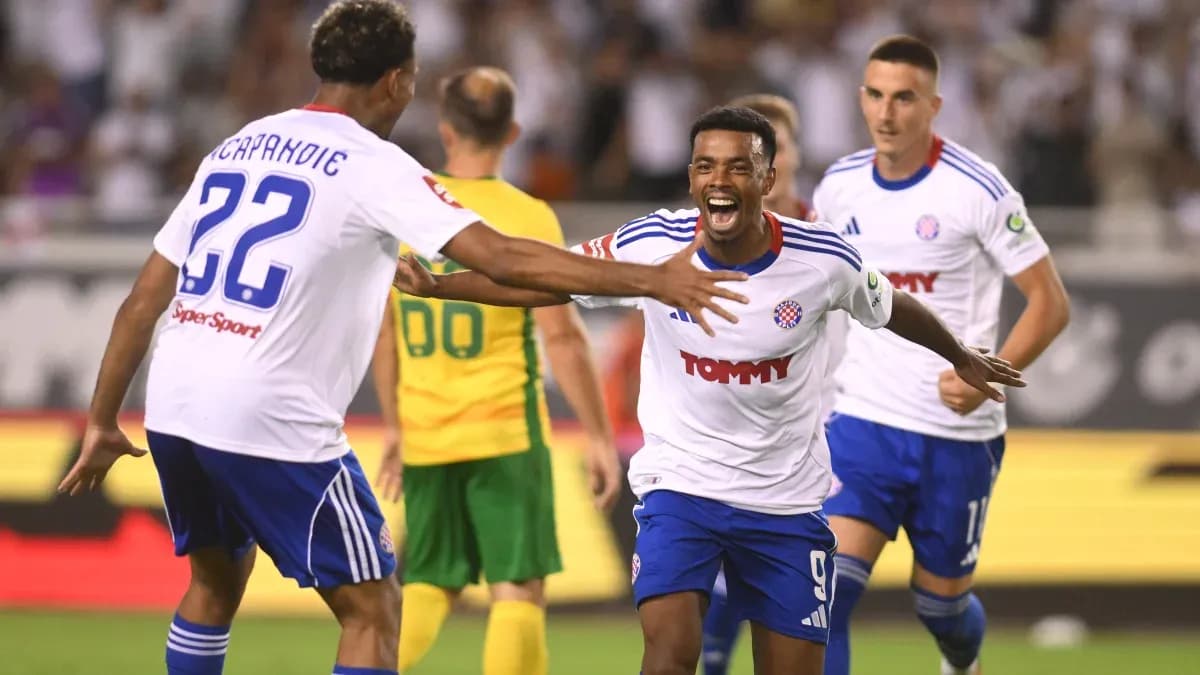
Žilina’s 2-1 comeback over HNK Hajduk Split at Štadión pod Dubňom in the UEFA Europa League 1st Qualifying Round was built almost entirely on structural and in-game tactical adjustments rather than statistical dominance, because the available data offers only disciplinary numbers. With both sides finishing with two yellow cards and no reds, the match was decided by how each coach manipulated shape and personnel around key moments, especially after half-time, when Žilina overturned a 0-1 deficit and forced the decisive own goal at 90'.
HNK Hajduk Split's Formation
HNK Hajduk Split started from a clear 4-2-3-1 under Gonzalo Garcia, with T. Silic in goal, a back four of M. Acapandie, M. Skelin, Alec Van Hoorenbeeck and Šimun Hrgović, a double pivot of R. Pukstas and A. Pajaziti, and an attacking band of R. Brajkovic, N. Skoko and D. Melnjak behind lone forward M. Sego. This structure gave them early control of width and allowed the full-backs, especially Hrgović on the right, to step high and combine with the advanced midfielders. The opening goal at 45' reflected that pattern: Hrgović provided the assist and Van Hoorenbeeck arrived from the defensive line to finish, underlining how Hajduk’s back four were encouraged to attack the box on late runs.
Out of possession, Hajduk’s 4-2-3-1 behaved more like a 4-4-1-1, with Skoko dropping alongside Brajkovic and Melnjak to form a flat midfield line, while Sego stayed higher to press Žilina’s central centre-back. The two cautions for Hrgović (21', “Foul”) and Van Hoorenbeeck (30', “Foul”) show that this aggressive defensive posture came at a cost: both full-backs were repeatedly exposed in wide duels and forced into contact-heavy defending to stop transitions.
Žilina's Formation
Žilina, coached by Pavol Stano, lined up in a 3-4-3, with J. Badzgon in goal behind a back three of T. Paliscak, J. Minarik and A. Narimanidze. The wing-backs T. Hranica and K. Bari, supported inside by X. Adang and M. Kacer, were tasked with stretching Hajduk’s 4-2-3-1 horizontally. Up front, F. Kosa and P. Ilko flanked central forward M. Roginic. In the first half, however, this 3-4-3 often flattened into a 5-4-1 under pressure, with Hranica and Bari pinned deep by Hajduk’s advanced wide players. That allowed Hajduk to control the half-spaces and led to the late first-half breakthrough, which VAR confirmed at 45+3' for the away side.
Tactical Adjustments
The match’s tactical hinge came immediately after the interval. At 46', Stano replaced right-sided centre-back T. Paliscak with M. Okal: M. Okal (IN) came on for T. Paliscak (OUT). This change effectively refreshed the right side of the back three and, more importantly, allowed Žilina to push their wing-backs higher with greater security behind them. With the back line stabilised, Žilina could commit more numbers into the second line and connect faster into the front three.
The equaliser at 52' showcased the improved verticality. M. Roginic finished for 1-1 after a combination involving F. Kosa, whose assist from the right channel exploited the space behind Hajduk’s advanced full-backs. The goal was checked and confirmed by VAR at 54', underlining how fine the margins were in Žilina’s more aggressive second-half approach. Structurally, Žilina’s 3-4-3 now looked more like a 3-2-5 in possession, with both wing-backs and one of the central midfielders joining the front line.
Stano then used a sequence of substitutions to sustain intensity and adjust roles in midfield and attack. At 66', M. Kacer (OUT) made way for F. Bzdyl (IN), refreshing central energy, while F. Kosa (OUT) was replaced by M. Fasko (IN) to provide a different profile on the flank. Later, at 72', P. Ilko (OUT) was swapped for S. Datko (IN), further altering the composition of the front line. Finally, at 82', X. Adang (OUT) was replaced by A. Florea (IN), adding a fresh midfielder after Adang had been booked at 67' for “Persistent fouling”. These moves indicate a deliberate attempt to keep the central block aggressive and mobile without risking a red card from further infractions.
Hajduk's Response
Hajduk responded with their own adjustments but struggled to regain the initiative. At 64', N. Skoko (OUT) was replaced by D. de Almeida (IN), a like-for-like change aimed at injecting new legs into the attacking midfield band. At 75', Garcia made a double change: Šimun Hrgović (OUT) for A. Sanyang (IN) at right-back, and R. Brajkovic (OUT) for A. Guram (IN), reshaping the right side and trying to stabilise a flank that had become vulnerable after the break. The final offensive switch at 84' saw central forward M. Sego (OUT) replaced by M. Livaja (IN), a move designed to introduce a more experienced focal point for late attacks.
Despite these adjustments, Hajduk’s structure became increasingly stretched as they chased a winner. Žilina’s late pressure culminated in the decisive moment at 90', when D. Melnjak turned the ball into his own net for 2-1 to Žilina. The own goal, credited to the home team, was the direct outcome of sustained territorial pressure and repeated deliveries into the box against a back line that had undergone multiple changes and was under constant stress.
Discipline's Role
Discipline played a subtle but important tactical role. Hajduk’s two first-half yellows to their full-backs constrained their ability to defend aggressively in wide areas after the break. For Žilina, the bookings came later: X. Adang at 67' for “Persistent fouling”, and Andrei Florea at 90+2' for “Foul”. Adang’s caution likely influenced Stano’s decision to withdraw him at 82', preventing a potential numerical disadvantage and preserving the team’s capacity to press in midfield during the closing phase.
From a statistical standpoint, the only hard numbers available are disciplinary: both Žilina and HNK Hajduk Split finished with two yellow cards and no reds. With no recorded data for possession, shots, passes, xG or goalkeeper saves, the evaluation of control and chance creation must rely on event sequencing and tactical logic rather than raw metrics. The scoreline evolution — 0-1 at half-time, 2-1 at full time — combined with the pattern of substitutions and the late own goal suggests that Žilina grew into the game physically and territorially, while Hajduk’s early structural superiority faded as their full-backs were booked, their wide players substituted, and their defensive line reconfigured.
Conclusion
In summary, Žilina’s 3-4-3, initially reactive and deep, was progressively tilted into an aggressive, wing-back-driven system through targeted substitutions and risk-taking after the interval. Hajduk’s 4-2-3-1, which had been effective at exploiting half-spaces and full-back overlaps in the first half, gradually lost compactness and control. Without comprehensive statistical data, the tactical story is nonetheless clear: Žilina won the structural battle in the second half, forcing errors and ultimately the decisive own goal, while managing their disciplinary exposure more effectively in the game’s critical final third.