.svg&w=384&q=75 "Naijagoal logo")

VAR's Catastrophic Error in Manchester Derby: A Deep Dive
“Quick, quick, quick, quick! Go, go, go, go, go!”
The soundtrack to the Manchester derby’s decisive moment was not the roar of the Etihad, but the frantic voice of VAR Matt Donohue, racing through a review that should have defined the game with clarity. Instead, it has come to define something else entirely: one of the most catastrophic VAR errors the Premier League has seen.
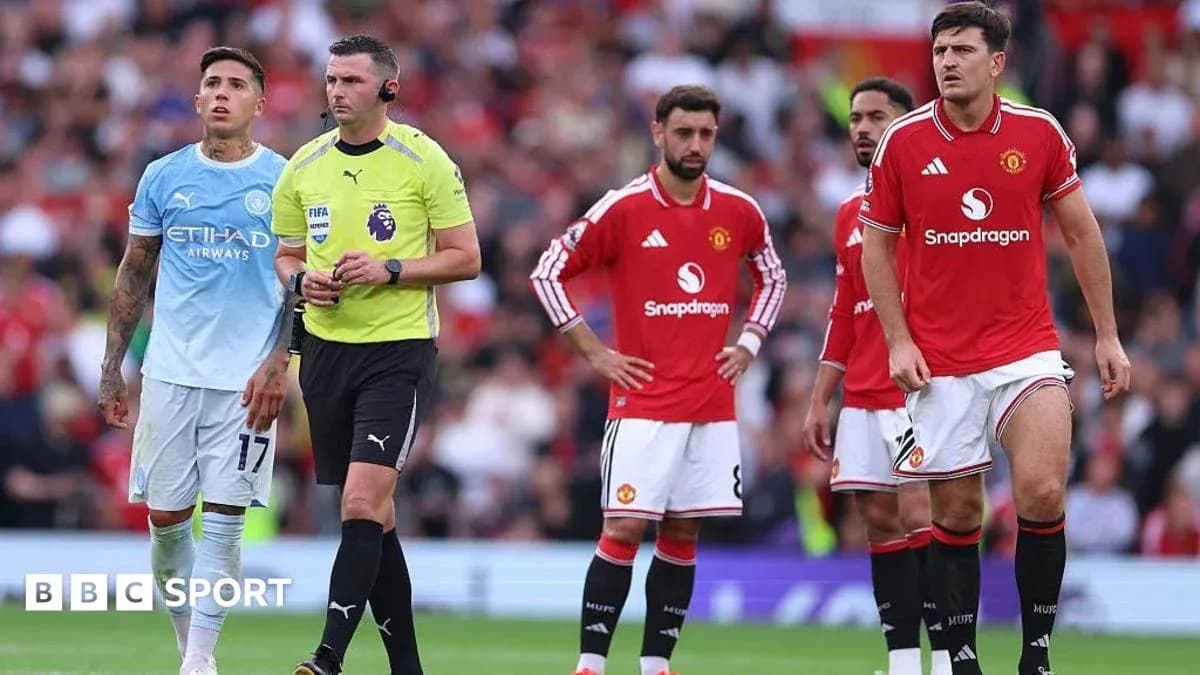
Erling Haaland’s winner stood. Manchester City 1-0 Manchester United. But Enzo Fernandez, three yards offside before attempting to head the ball, somehow passed unseen.
Not by the crowd. Not by the cameras. Just by the people paid to see everything.
A rush that went badly wrong
Donohue’s urgency crackled through the audio.
“Let’s go, let’s go, let’s go, let’s go!”
This wasn’t the calm, clinical check the technology was sold on. It sounded panicked. Rushed. Chaotic. The exact opposite of how a video official is supposed to operate in the biggest fixture of the domestic season.
The Premier League has spent this campaign chasing a promise: quicker VAR, fewer delays, less frustration. “More efficient application of VAR to reduce delays” is written into its football principles for the season.
The message has been relentless. Fans complain. Pundits hammer home the point. Phone-ins rage about stoppages. A stakeholders’ survey – managers, coaches, supporters – came back with one clear demand: speed up the decisions.
That pressure seeps into the booth. It doesn’t excuse what happened.
The mistake before the mistake
Strip away the noise and one thing becomes clear: the most serious failure happened before Donohue even started rushing the attacking phase.
On the first replay of Josko Gvardiol’s cross, Donohue told the replay operator to freeze the frame at the moment of contact. He jumped straight into the semi-automated offside system from there.
That is not how it is supposed to work.
The VAR team should first have watched the entire sequence: the cross, the movement in the box, Fernandez’s position, Haaland’s finish. Only then do they drill down into frames and lines. That wider picture would have made Fernandez’s offside position and involvement impossible to miss.
Instead, they sliced the incident into pieces too quickly. By the time they examined the attacking phase, Donohue and his assistant VAR, Blake Antrobus, were locked on to a single question: did Fernandez touch the ball? If he did, it would reset the phase and put Haaland offside.
Everything else – including Fernandez’s own offside position – drifted out of view.
The goal was cleared. Check complete. Game decided.
Where was the safety net?
Donohue has absorbed most of the backlash, but Antrobus’ role – or absence of it – is just as important.
The AVAR is there as the safety net, the second set of eyes, the person who spots what the main VAR has missed. Antrobus’ entire contribution to the review amounted to a brief “no, yeah” on the question of a Fernandez touch, one second before Donohue confirmed the goal.
No challenge. No pause. No insistence on rewinding to see the full picture inside the area.
The support VAR, based in the operations room next to the match hub at Stockley Park, can also step in on protocol. They knew what was unfolding. They stayed silent.
Even after the ball hit the net, the situation was not beyond rescue. Under protocol, the process could still have been corrected in the window between the goal and the restart. It never was.
When an error of this magnitude survives every layer of protection, something has gone badly wrong in the system, not just in one man’s judgment.
The cost of chasing seconds
The irony? The numbers say VAR is getting quicker.
Average delays – including the referee’s stadium announcement – have dropped from 46 seconds per game last season to 36 this time around. On paper, that looks like progress.
But the only other accepted VAR mistake this season, the failure to award Arsenal a penalty at Aston Villa, also came from an incident cleared too quickly. A pattern starts to emerge.
Speed is not supposed to mean skipping steps. On Sunday, it did.
The obsession with time has already left scars. There has been just one truly long VAR delay this season: over four minutes to rule out a Dan Ballard goal for a subjective offside against Kevin Danso in Brentford v Sunderland. Antrobus was AVAR that day as well, and the criticism for the delay was fierce.
Did that experience sit in the back of his mind during the derby? Only he knows. But when hesitation is punished as harshly as delay, officials find themselves trapped in a no-win scenario.
Specialists under fire
This is not a story of an untrained official thrown into deep water. Donohue is, by the Premier League’s own definition, a VAR specialist.
Three seasons ago, Pro Ref invited referees to apply to become dedicated video officials. Candidates went through aptitude testing, then intensive training. Around 15 reached the final stages; 10 have since taken charge of Premier League matches from the booth.
Donohue is one of them. Sunday was his 65th game as VAR. His progress has been such that he is now on the international list, working on Uefa club competition qualifiers over the summer.
He has made mistakes. Almost all VARs have. Only Nick Hopton and Neil Davies, both from the same accelerated programme, have avoided a clear error over the past two seasons.
The idea that simply appointing full-time VARs will clean everything up has already been tested. Lee Mason and Mike Dean, the only full-time VARs brought in after retiring from on-field duties, were both dismissed by Howard Webb within months of his arrival, after a string of high-profile errors.
Even in Spain, where La Liga and the second division use officials who only operate as VARs and never referee on the pitch, the controversies roll on. At the start of last season, the VAR there missed a goalscorer standing offside when the ball was played. Different country, same headlines.
Specialists help. They don’t make the technology infallible.
A football problem, not just a VAR problem
Pro Ref has poured training, money and manpower into VAR to make it both slick and accurate. When a decision like Haaland’s goal slips through the net, all that investment feels suddenly fragile.
City boss Enzo Maresca, the beneficiary of the gaffe, offered a touch of sympathy.
“To make a decision in 10, 20 seconds is not easy for them,” he said. “Sometimes they make mistakes. I make mistakes, players make mistakes. It’s part of our job.”
That is true. Human error will never leave the game. The question is how much the sport itself has contributed to this particular failure.
The derby wasn’t the first big call to take time. West Ham’s stoppage-time equaliser at Arsenal last season took more than four minutes to rule out. The decision was painful to wait for, but it was right.
Nobody liked the delay. Nobody argued with the outcome.
Now the pendulum has swung. The push for speed has become an obsession, one that risks undermining the very credibility VAR was meant to bring.
This isn’t just a story about one panicked voice in a booth at Stockley Park. It’s a warning about what happens when a sport that demands perfection from its officials also demands they deliver it in half the time.