.svg&w=384&q=75 "Naijagoal logo")

U.S. Men's National Team Advances in World Cup Without Pulisic
SEATTLE — No Christian Pulisic. No problem, at least for now.
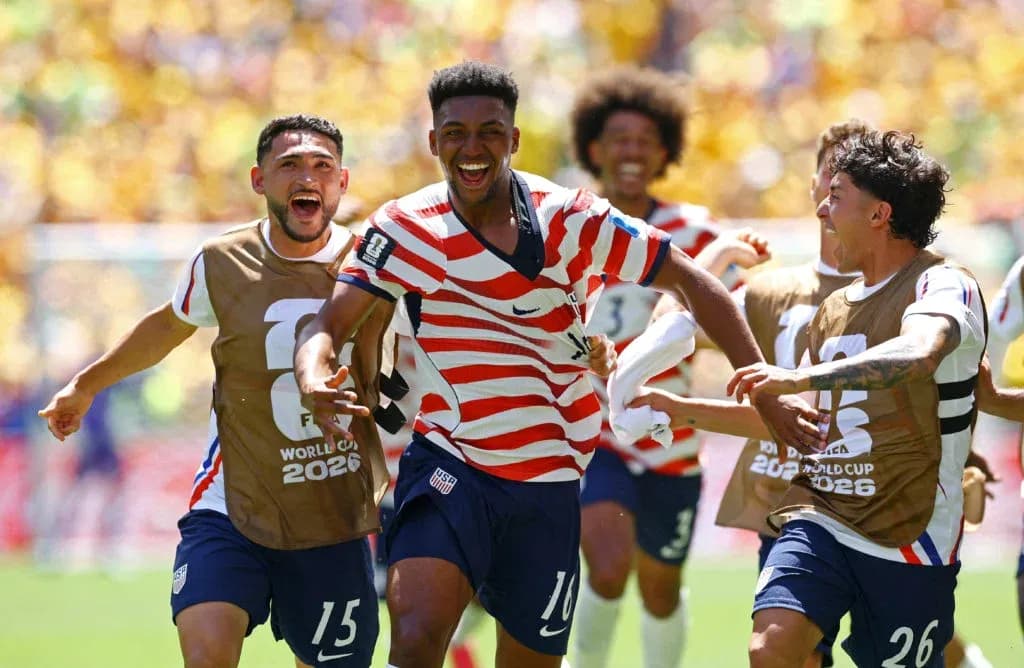
On a cool Friday night in the Pacific Northwest, the U.S. men’s national team booked its place in the World Cup knockout rounds with a controlled 2-0 win over Australia, doing it the hard way — and doing it early. Two games, six points, and a ticket through with a match to spare. That’s a sentence rarely written about this team on this stage.
Life without Pulisic
The storyline before kickoff was simple: no Pulisic, no proven replacement. The AC Milan forward, owner of 33 goals in 87 international appearances, watched from the sidelines with a calf injury, leaving a sizeable hole in the attack and a question hanging over the evening.
The answer arrived in waves of red, white, and blue runs down the flanks.
Folarin Balogun, fresh off his brace in the 4-1 win over Paraguay on June 12, set the tone almost immediately. In the 11th minute, he tore down the left sideline, driving at Australia’s back line with the kind of conviction that forces defenders into bad decisions. His low centering ball toward Ricardo Pepi never reached its intended target. Instead, it clipped defender Cameron Burgess and skipped past the goalkeeper for an own-goal.
Not pretty. Absolutely vital.
The U.S. had its lead, and with it, the freedom to dictate the night.
Freeman’s moment
If the opener was scruffy, the second had a touch of destiny about it.
Alex Freeman, the youngest player in the squad at 21 and the son of Super Bowl champion Antonio Freeman, stepped into the spotlight just before halftime. The U.S. had been probing, pushing Australia deeper, forcing mistakes and set pieces. The pressure finally told in the 43rd minute.
From a dead ball situation, Sergiño Dest’s effort pinballed inside the box. The shot took a deflection, hanging in the air for a heartbeat. Freeman attacked it, rising above the crowd to plant a firm header into the net. His first World Cup goal, confirmed after a brief video review, doubled the lead and changed the feel of the entire tournament for this team.
In that instant, the narrative shifted: from “How will they cope without Pulisic?” to “How high is this group’s ceiling?”
History, rewritten on home soil
The U.S. has been here before as World Cup hosts, but not like this. In 1994, the Americans slipped into the knockouts as one of the best third-place teams, clinging on rather than charging through. They then ran into Brazil in the round of 16 and bowed out to the eventual champions.
This time, qualification came with authority. Two games, two wins, a clean sheet against Australia, and a sense of depth that has often been talked about but rarely proven on a stage this large.
Balogun again looked dangerous. Pepi, starting in Pulisic’s place, occupied defenders and opened lanes. Dest’s involvement in the second goal underlined how much attacking thrust now comes from the fullback positions. And Freeman, still at the start of his international story, delivered the kind of moment that can define a tournament for a young player.
The U.S. didn’t just survive without its star. It imposed itself.
The knockout rounds will ask harder questions, as they always do. Pulisic’s fitness will dominate the days ahead. But after a night like this in Seattle, one thing is clear: this is no longer a team that needs everything perfect to progress. It’s a squad deep enough, and confident enough, to keep pushing — with or without its biggest name.