.svg&w=384&q=75 "Naijagoal logo")

Turki Al-Sheikh's Bid for Derby County: A Defining Test for English Football
English football’s new independent regulator has barely found its feet. Already, it faces a moment that will define exactly what – and who – it is for.
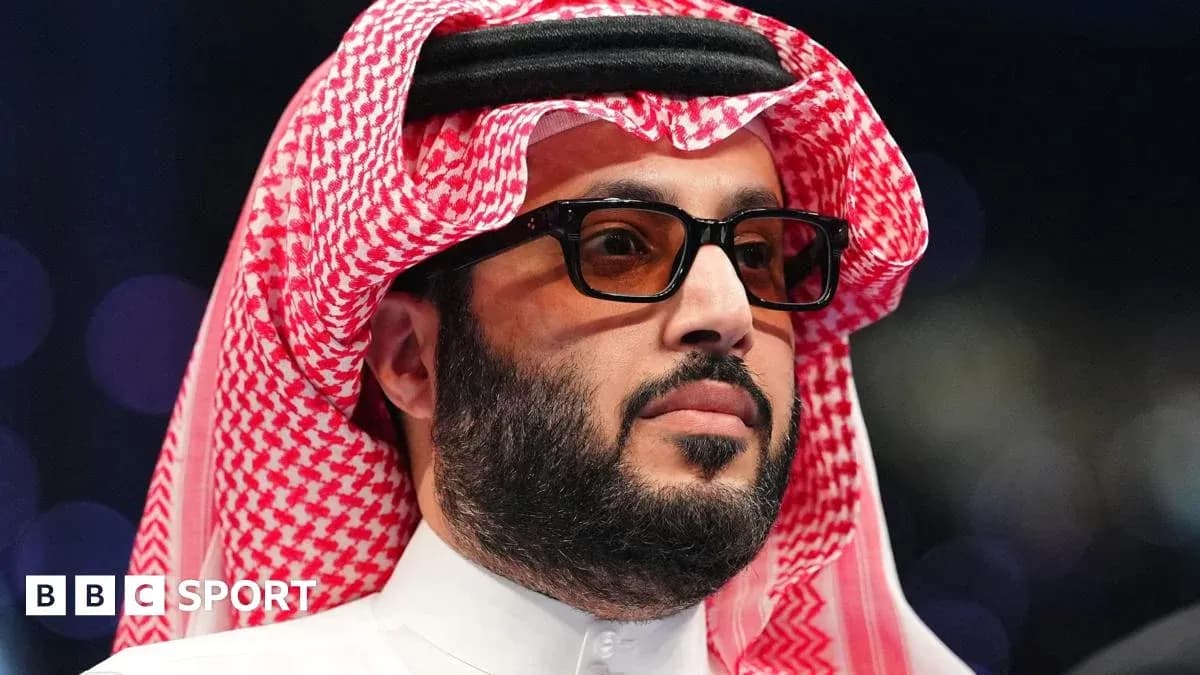
Turki Al-Sheikh, one of the most powerful figures in Saudi sport and entertainment, wants in at Derby County. Not a full takeover, but a stake in a club that has clawed its way back from the brink and is once again dreaming of the Premier League.
On paper, it is the kind of proposal that has transformed clubs elsewhere: serious money, heavyweight connections, global ambition. In reality, it is a collision of football, politics and morality that leaves almost no one sitting comfortably.
A test of the new guard
Al-Sheikh is not just another wealthy investor. At 44, he chairs Saudi Arabia’s General Entertainment Authority and moves in the tight inner circle of the country’s de facto ruler, Mohammed bin Salman. He has previously owned clubs in Spain and Egypt and now exerts huge influence in world boxing, orchestrating the sport’s recent era of lavish, Saudi-staged mega-events.
To get anywhere near Pride Park, he must first pass English football’s new gatekeeper: the Independent Football Regulator (IFR), created last year to protect the game’s integrity and long-term health.
The IFR has taken over the owners’, directors’ and senior executives’ test for Championship clubs, a role previously held by the English Football League. This is its first major examination in the spotlight.
Amnesty International has already framed it in stark terms.
“This is a defining test for English football's new independent regulator,” said Felix Jakens, head of campaigns at Amnesty International UK. “Will it allow a senior representative of a government directly implicated in mass human rights violations to take control of one of the country's oldest football clubs? The regulator must ask these questions and answer them transparently.”
The question is not theoretical. Saudi Arabia’s human rights record – from the use of the death penalty to the treatment of women and LGBT people – has drawn sustained condemnation. Amnesty says 356 people were executed in the country last year, a record figure.
For campaigners, this is not a private deal with a distant businessman. “Al-Sheikh is not a private businessman. He is the chairman of Saudi Arabia's General Entertainment Authority,” Jakens stressed.
Saudi footprint grows
Newcastle United already sit under the umbrella of Saudi Arabia’s Public Investment Fund. Amnesty warned that any stake for Al-Sheikh at Derby “would mark a significant expansion of Saudi Arabia's footprint in English football.”
That raises another thorny issue: multi-club influence.
The Premier League’s owners’ and directors’ test explicitly forbids any individual or entity from directly or indirectly determining the management of more than one English league club. While Derby operate in the Championship, the potential for future conflicts – on transfers, loans, competitive integrity – will not be ignored, especially with Al-Sheikh’s “existing links” to the Newcastle power structure.
For now, though, silence. The IFR, the EFL and Derby County have all declined to comment on Al-Sheikh’s interest. So have his representatives. The deal, and the debate, hover in the air.
A club still rebuilding
Derby County know better than most how fragile a football club can be.
Dragged through administration and near oblivion, they were rescued in the summer of 2022 by local property developer David Clowes. He stabilised the club, got it moving again, and then made clear that to truly compete he would need help.
Clowes has been open to new investment since 2024 and has said he could consider selling upwards of 80% of his share in the club. For a historic side marooned outside the Premier League for almost two decades, the prospect of a billionaire backer is seductive.
No surprise, then, that the fanbase is split almost down the middle.
“There is no skirting around how the fanbase will be divided,” Rams supporter Nick Webster told BBC Radio Derby’s Sportscene at Six. “Many are excited by the billions that potentially could be invested, and then there are the human rights and all the other issues that are going on. Then there will be people in the middle, and it will make a lot of people uncomfortable.”
The divide is not abstract. It runs through households, friendship groups, matchday conversations. What price a promotion push? What cost a clean conscience?
The lure of ambition
Some Derby fans see the dilemma clearly and still feel the pull of what Al-Sheikh could bring.
Sam Jones, a Rams supporter and boxing manager who has worked with Al-Sheikh, admitted he was “excited straight away” when he heard of the Saudi powerbroker’s interest. To him, Derby’s possible future is written in what Al-Sheikh has already done for boxing.
Jones pointed to the extraordinary show staged at the Pyramids of Giza in May, headlined by Oleksandr Usyk’s world title fight with Rico Verhoeven and featuring his own fighter Jack Catterall on the undercard.
“In my 10 years in boxing I've been to some very mad places, and my fighter Jack has just won a world title [WBA 'regular' welterweight belt] on the foot of the pyramids,” Jones told BBC Radio Derby. “Before Jack's ring walk, about half an hour before, there was a bit of a sandstorm. It was completely crazy. But to have that type of vision for boxing, to put on a show there, you've got to have serious ambition.”
That ambition is what some Derby fans are clinging to. The idea that the man who turned boxing into a global travelling circus of blockbuster nights could inject the same scale, the same swagger, into a club that has been stuck in the grind of the EFL.
“And if Turki Al-Sheikh does take over the club or invest heavily in the club, whatever he's doing, and he puts in a quarter of the effort that he has done with boxing, making all the biggest fights come true, then Derby County fans need to be very excited,” Jones said.
Between romance and reality
Al-Sheikh’s name has circled English football before. He has previously held takeover talks at Bristol City and explored interest in Southampton and Millwall. None of those moves came off. Derby is the latest, and perhaps the most politically charged, destination in his sights.
The timing matters. English football is trying to prove it can regulate itself with more backbone, more independence, more moral clarity than in the past. The IFR was designed to be the bulwark – against reckless ownership, against financial ruin, against the sense that the game is simply for sale to the highest bidder.
Now, one of the world’s most controversial power brokers wants to buy into one of England’s oldest clubs.
For Derby, the stakes are sporting, financial, emotional. For the regulator, they are existential.
Does English football open the door and embrace the money, the show, the global reach – or does it draw a line that might finally say something about what kind of game this is meant to be?