.svg&w=384&q=75 "Naijagoal logo")

Socceroos Advance but Forward Concerns Persist
The Socceroos are through, but the alarm bells are ringing.
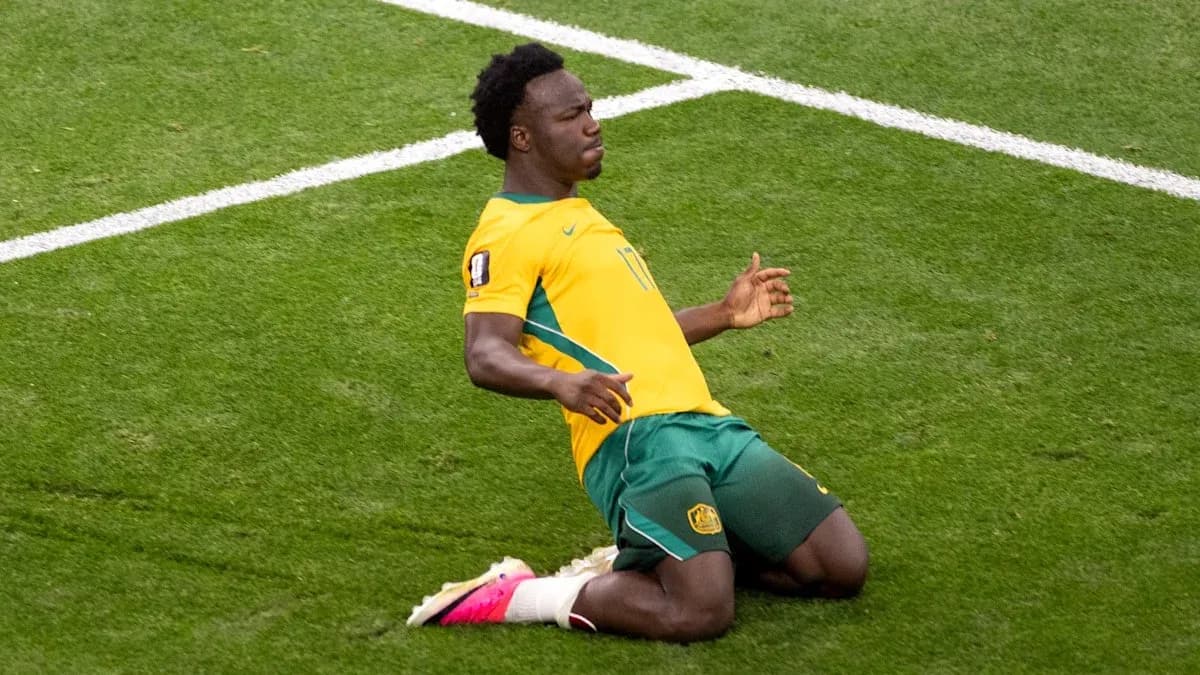
A goalless draw with Paraguay was enough to book Australia’s place in the round of 32 at the FIFA World Cup, a result built on grit, discipline and the emergence of an unlikely star: Jordan Bos. Yet as the final whistle went, two former internationals were left worrying about what that said about everyone in front of him.
Bos shines, questions grow
This was supposed to be the night the forwards took control. Instead, it was a 21-year-old fullback-turned-winger who looked the most dangerous in green and gold.
Jacob Italiano’s late injury reshaped Tony Popovic’s plans. The coach pushed Bos into the vacancy on the right, with Aziz Behich sliding across to the left. It was the sort of tactical tweak that had hovered over the build-up, a selection puzzle many fans wanted answered.
Popovic’s gamble worked. Bos ran relentlessly, stretched Paraguay’s back line and gave Australia a rare outlet in a match starved of clear chances.
That, for Scott McDonald and Robbie Slater, was precisely the problem.
“Up front is a bit of a worry when we’re looking at Jordy Bos as one of the most threatening (for Australia),” Slater said on Stan Sport’s Added Time, the praise for the youngster wrapped in concern for the attack.
McDonald nodded along. On nights like this, he argued, the spotlight should fall on Mo Toure or Nestory Irankunda, not the right-sided defender doing everything he can to drag the team forward.
No.9 conundrum
Instead, Toure watched from the bench and Irankunda, more at home as a winger, was asked to lead the line as Australia’s No.9.
For McDonald, that experiment has a clear ceiling.
“There is a problem in terms of the No.9. Not bringing (Mo) Toure on instead of Tete Yengi tells me today that there’s no trust there,” he said. The implication was brutal. If you are the striker left unused, what does that do to your belief?
“Does he go and start him (Toure) out of the blue in the next game? You just can’t tell with Tony. But as a striker, being Toure, I don’t like that. That doesn’t fill me with confidence that my coach trusts me.”
The picture up front was bleak. Irankunda, 20, battled for scraps, isolated and often outnumbered by a fierce, physical Paraguayan back three.
“No matter who we put up there, it’s a thankless task up there,” McDonald said. “Look at Nestory (on Friday), he had very little and was living off scraps.
“But also when he plays up top, we don’t have a box outlet. Jordy Bos playing on the right-hand side was brilliant and it gave us that outlet.”
Irankunda out of position
McDonald didn’t hide his admiration for Irankunda’s talent, but he never believed the youngster would look truly comfortable as a No.9 or even a No.10 at this level.
The role demands something different.
“Look, he’s gotta hold it up a little bit better,” McDonald continued. “I think at times he struggled because it’s not his natural game.”
The problem wasn’t just Irankunda. Paraguay’s structure squeezed the life out of him. Their back three closed the channels he loves, forcing him into traffic and denying him the space to drift wide and explode.
“If there are some players getting closer to you, then what are you meant to do?” McDonald asked, sympathetic but firm. Irankunda wants to roam, to find those wider areas, to drift into pockets where he can face defenders and drive at them. Paraguay simply shut the door.
“They were aware of his threat also, with three taking care of him. But he probably sometimes needs to be more in central positions and wait for things to happen.”
That, for McDonald, is the lesson. The best strikers in the world simplify the chaos.
“As we see the best strikers in the world – like Erling Haaland – they’re not interested any more. They just get into the right areas and allow others and trust others to do the dirty work then get on the end of things.”
“That’s not naturally probably where (Irankunda) thinks. He wants to be the guy creating that and doing things, getting on the edge of the box and having shots. So if you’re gonna play that role, you just need to play it a little bit more smarter and be a bit more patient.”
The old-school No.9 test
McDonald spoke from experience. His career was built in and around that penalty area, often playing off a bigger, more physical partner.
“I didn’t like it either,” he admitted of the modern lone-forward grind. “I mean, for the majority of my career it was always you played off the big man or whatever.”
Then came the line that cut to the heart of Australia’s long-running search for a true centre-forward.
“But I’ve always said it, if you can head it, you’ve got a better chance of being a No.9 for the Socceroos. It’s as simple as that.”
Australia march on, their place in the knockouts secure, their defensive structure holding firm, their unexpected gem shining on the flank. But until someone in a No.9 shirt starts matching Jordy Bos for impact, this World Cup campaign will carry a nagging question: who is going to score the goals when it really matters?