.svg&w=384&q=75 "Naijagoal logo")
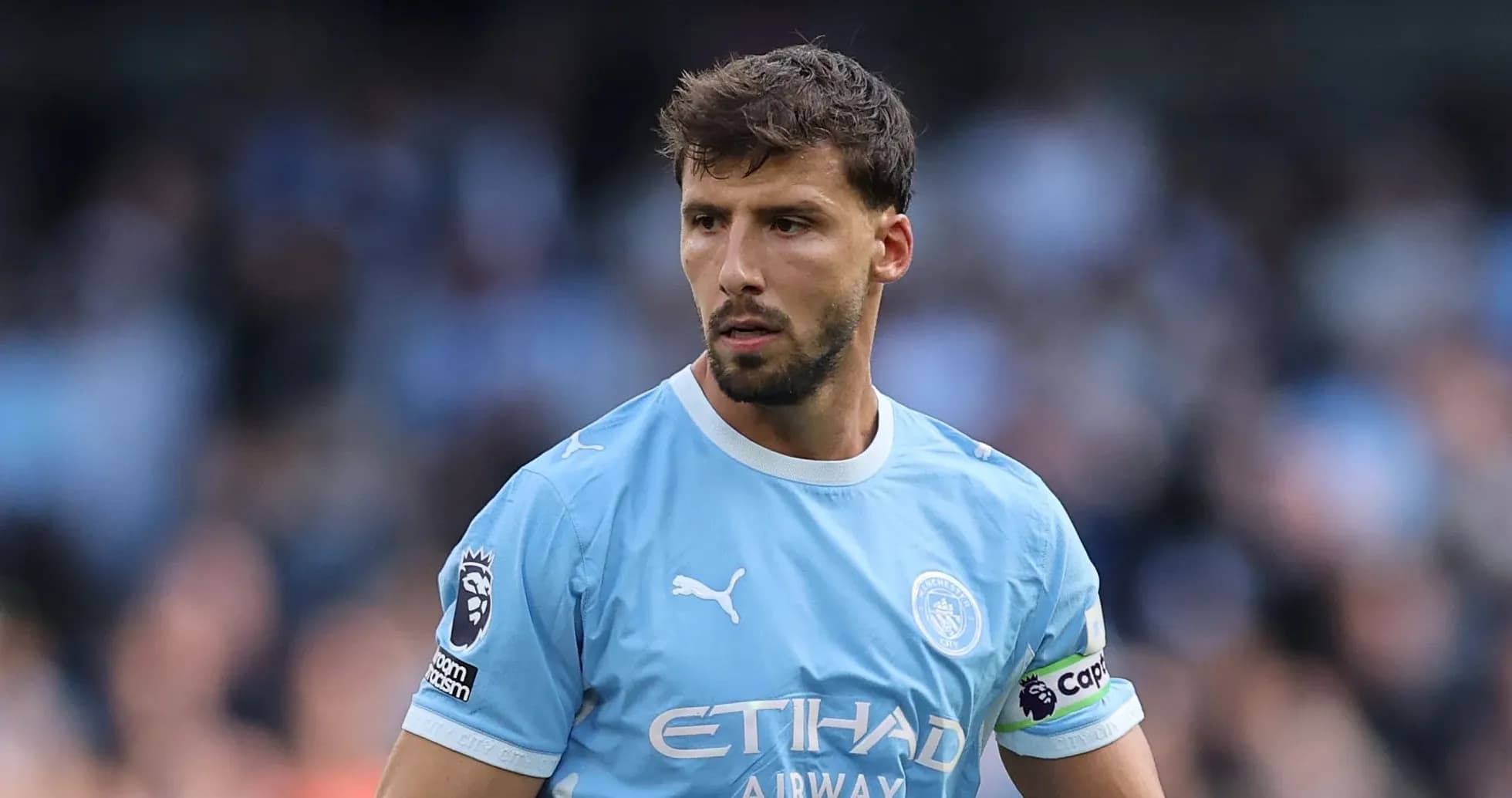

Rúben Dias: From Lieutenant to Leader in Manchester City's Transformation
The Etihad has seen summers of change before, but nothing quite like this.
Pep Guardiola is gone after a decade that rewrote Manchester City’s history. Rodri, Bernardo Silva, John Stones – pillars of that era – have followed him out. In their place, a record £458 million has been thrown at a rebuild for Enzo Maresca, with Enzo Fernandez, Elliot Anderson and Ayyoub Bouaddi headlining a new-look squad.
Through all of it, one figure has quietly shifted from rising star to standard-bearer: Rúben Dias.
From lieutenant to leader
At 29, Dias suddenly finds himself as one of the elder voices in a dressing room that has been almost completely reworked. More than 250 appearances, four Premier League titles, a Champions League, and now a contract that runs until 2029 – he is no longer just a cornerstone of the defence. He is the bridge between eras.
His role, he insists, hasn’t changed in essence.
“In terms of the role I have, it goes down to trying to be the best version of yourself, and in terms of that, nothing has changed,” he told BBC Sport. The cast around him may look different, but the demands do not. “So many people have left and so many winners have left, and now new people have joined with a lot of ambition and people that are desperate to win and that is also what makes the club keep on going.”
The departures cut deep on a personal level. These were friends, not just teammates. Yet Dias speaks about it with a clear-eyed acceptance that underlines why City see him as a long-term anchor.
“It’s the circle of life, you can call it and it is just how things are,” he said. “I’m appreciative of the memories I have with all the ones that left and I’m excited about the memories I’m going to make with the ones that have just arrived.”
Maresca’s City, familiar but different
The biggest change, of course, sits in the dugout.
Guardiola’s exit could easily have triggered a jarring reset. Instead, City have turned to a familiar mind in Maresca, whose previous spell as an assistant at the club has softened what might have been a brutal transition. The early evidence is emphatic: four wins from four across the Premier League and Champions League.
Dias is convinced that continuity behind the scenes has mattered as much as any signing.
He talks about the detail in Maresca’s work, and how quickly it has clicked. “There’s obviously many things from training session to some details about the way we press, details about the way we defend and that make all of these Enzo’s idea. I feel like everything is making a lot of sense.”
That last line is telling. For a squad that has lost so many of its reference points, clarity is everything.
“Everyone is buying into the idea. Everyone’s excited about it and there is a lot of joy in training, which is massively important,” Dias added. Joy is not a word often associated with a summer of upheaval. Yet it fits the mood he describes: a group stripped of some of its legends, but not of its hunger.
A veteran’s fire
Dias does not hide from the reality of his own timeline. “I am 29, I am going to be 30 next year,” he said, before quickly pivoting to what still drives him. “But I am excited about all of this and all the things with the club, the new manager, new players, the new challenge, guys that I was so close with leaving.”
He has already won almost everything there is to win at club level. That can dull an edge. With Dias, it seems to have sharpened it.
“I am still very ambitious,” he said. “I took the decision of being at this level because I feel like I have won so much but maybe the thing that would be my biggest reward would be to be here so many years playing at this level and having the consistency of being ambitious for so long.”
That last ambition is not about a single season or a single trophy. It is about building a career that stretches across cycles, managers and teammates, while the standards stay the same.
City’s spending spree and Maresca’s smooth start have dominated the headlines, but behind the noise, the club’s future leans heavily on players who understand what it took to reach the summit in the first place. In a dressing room full of new faces and fresh voices, Dias now carries that memory – and the responsibility to prove that City’s dominance was never just about one coach, or one generation of players.
The question that hangs over this new project is simple: can that culture outlast its creators? Dias is staking the prime years of his career on the answer.