.svg&w=384&q=75 "Naijagoal logo")
AS Roma Dominates Fiorentina 4–0 in Serie A Showdown
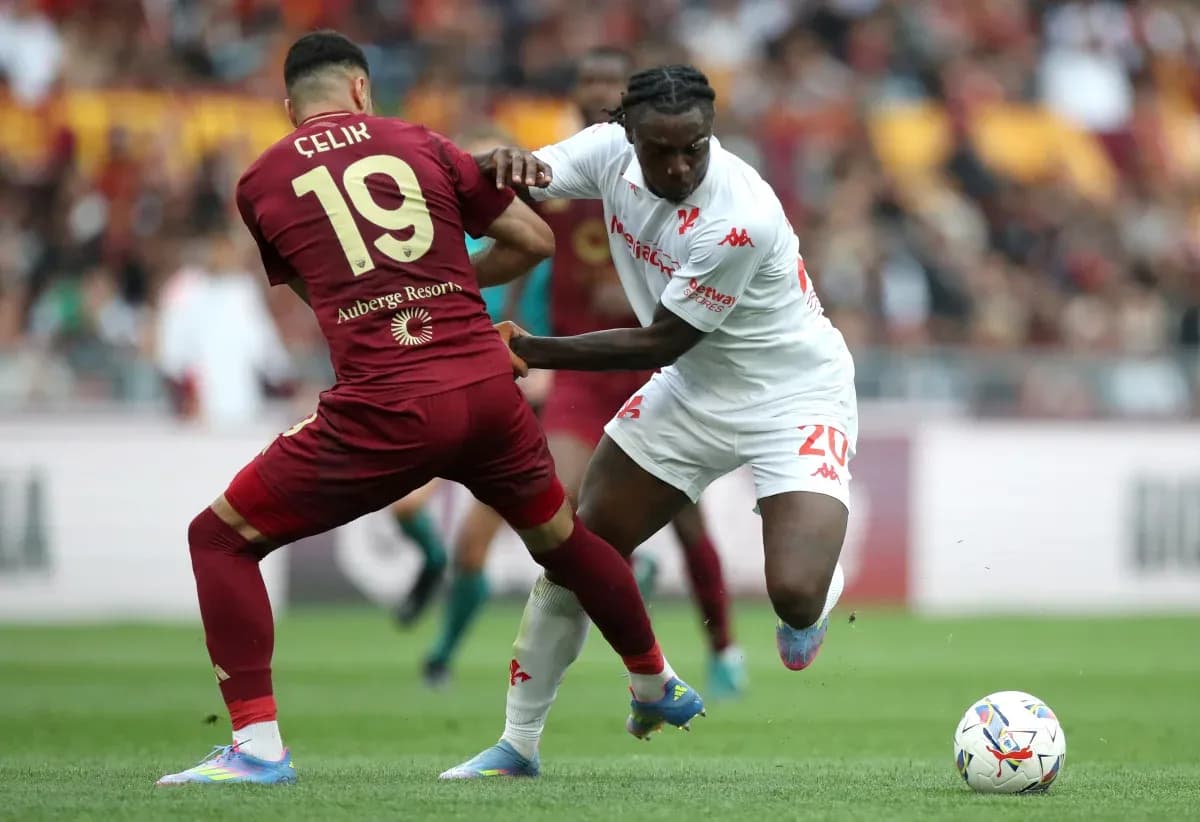
AS Roma dismantled Fiorentina 4–0 at Stadio Olimpico in a one-sided Serie A Round 35 contest, decided by structural superiority as much as by individual quality. With a 3-4-2-1 against Fiorentina’s 4-3-3, Roma imposed territorial control from the opening minutes, racing to a 3–0 lead by half-time and never allowing the visitors a route back. The expected goals gap (2.14 vs 0.16) and shot volume (14 vs 4) underlined a match in which Roma’s pressing, rest-defense and wing occupation were all clearly superior. Fiorentina’s adjustments at the break could not disrupt Roma’s rhythm, and the hosts added a fourth to complete a dominant performance.
Scoring Sequence
Roma’s scoring sequence began at 13', when G. Mancini attacked the near post from a set or second-phase delivery and finished, assisted by N. Pisilli. The pattern already reflected Roma’s intent: centre-backs stepping aggressively into dangerous zones. Four minutes later at 17', Wesley Franca doubled the lead, this time supplied by fellow defender M. Hermoso, who advanced from the back line to create overloads on the left before finding Franca in a finishing position.
Fiorentina’s first disciplinary mark came at 25', with Marin Pongračić booked for a foul, symptomatic of a back line repeatedly exposed by Roma’s rotations between the lines. At 34', Hermoso turned scorer, finishing after a feed from M. Kone, who had drifted into a half-space pocket to pull Fiorentina’s midfield out of shape. That goal effectively killed the contest before the interval, with the half-time score 3–0 to Roma.
Second Half Changes
Fiorentina reacted with a triple change at 46'. R. Braschi (IN) came on for J. Harrison (OUT), F. Parisi (IN) replaced A. Gudmundsson (OUT), and P. Comuzzo (IN) came on for M. Pongracic (OUT), signalling a desire for more defensive security and fresh wide energy. Roma’s first card arrived at 48', when Mario Hermoso was booked for a foul, a rare instance of Roma’s back line being forced into a reactive action. The fourth goal came at 58', N. Pisilli finishing clinically after a layoff or through ball from D. Malen, who had been stretching the Fiorentina back line with depth runs.
Roma’s first substitution followed at 64', with S. El Shaarawy (IN) coming on for M. Kone (OUT), adding vertical threat and transition speed to an already dominant side. Fiorentina’s frustration surfaced again at 66', when Fabiano Parisi was booked for argument, reflecting the psychological shift as Roma continued to control tempo. Roma then refreshed their attacking and defensive structures at 72': P. Dybala (IN) replaced M. Soule (OUT), and D. Ghilardi (IN) came on for G. Mancini (OUT), preserving intensity without losing shape.
Fiorentina’s final push came with a double change at 75', J. Fazzini (IN) for N. Fagioli (OUT) and G. Fabbian (IN) for M. Brescianini (OUT), but it yielded little change in the flow. Roma closed their bench at 83' with J. Ziolkowski (IN) for M. Hermoso (OUT) and R. Vaz (IN) for D. Malen (OUT), maintaining defensive stability and fresh legs up front. The last disciplinary note arrived at 90+2', when Stephan El Shaarawy received a yellow card for a foul, rounding off a match with two yellows per side and no reds.
Tactical Overview
Tactically, Roma’s 3-4-2-1 was the decisive framework. With M. Svilar behind a back three of G. Mancini, E. Ndicka and M. Hermoso, Roma built with numerical superiority against Fiorentina’s first pressing line of three. The wing-backs, Z. Celik on the right and Wesley Franca on the left, pinned Fiorentina’s full-backs deep, preventing them from stepping into midfield to help. Central midfielders N. Pisilli and M. Kone (later S. El Shaarawy in a more advanced role) created constant triangles with the two support forwards, M. Soule and B. Cristante, behind D. Malen.
Roma’s possession share of 61% and 599 total passes at 91% accuracy show a side comfortable circulating the ball until gaps appeared. The key was verticality at the right moments: Pisilli and Kone broke lines with forward runs and passes, while Malen’s movement dragged centre-backs away from their zones. This is reflected in the scoring: a centre-back (Mancini), a wing-back (Wesley Franca), another centre-back (Hermoso) and a central midfielder (Pisilli) all on the scoresheet, a textbook example of systemic goal distribution.
Defensive Performance
Defensively, Roma’s rest-defense was secure. With only 4 shots conceded (1 on target), Svilar was asked to make just 1 save. The negative goals prevented figure (-0.74) suggests Fiorentina’s lone clear chance was not particularly well handled statistically by the model, but in practical terms Roma’s Defensive Index on the day was excellent: Fiorentina managed only 3 shots inside the box and 1 from outside, and were forced into wide, low-probability situations. The back three stepped out aggressively on Fiorentina’s central midfielders, while Celik and Wesley Franca dropped quickly to form a back five when out of possession.
Fiorentina’s 4-3-3 never found stable access to Roma’s build-up. D. de Gea was under constant pressure, facing 7 shots on goal and making 3 saves. The visitors’ 39% possession and 373 passes at 84% accuracy indicate they could circulate in safer zones but were repeatedly blocked from progressing centrally. Their xG of 0.16 underlines a lack of penetration; A. Gudmundsson and M. Solomon were largely isolated, and J. Harrison’s early withdrawal at 46' confirmed the failure of the initial attacking plan.
Statistical Verdict
From a statistical verdict, Roma’s 4–0 win slightly overperformed their xG of 2.14, but not to an extreme degree; the finishing was efficient rather than lucky. Fiorentina’s 0.16 xG supports the clean sheet as fully deserved. Roma’s Overall Form in this match reads as high-control, high-efficiency football: more shots (14 vs 4), more shots on target (7 vs 1), more corners (4 vs 5 conceded but from a position of control), and a balanced foul count (12 vs 10), with discipline maintained despite late-game changes. Both teams finished with 2 yellow cards and no reds, but only Roma consistently translated their structure into chances and goals, confirming a tactical performance firmly aligned with the underlying numbers.