.svg&w=384&q=75 "Naijagoal logo")
Cagliari's Defeat to Udinese: A Tactical Analysis
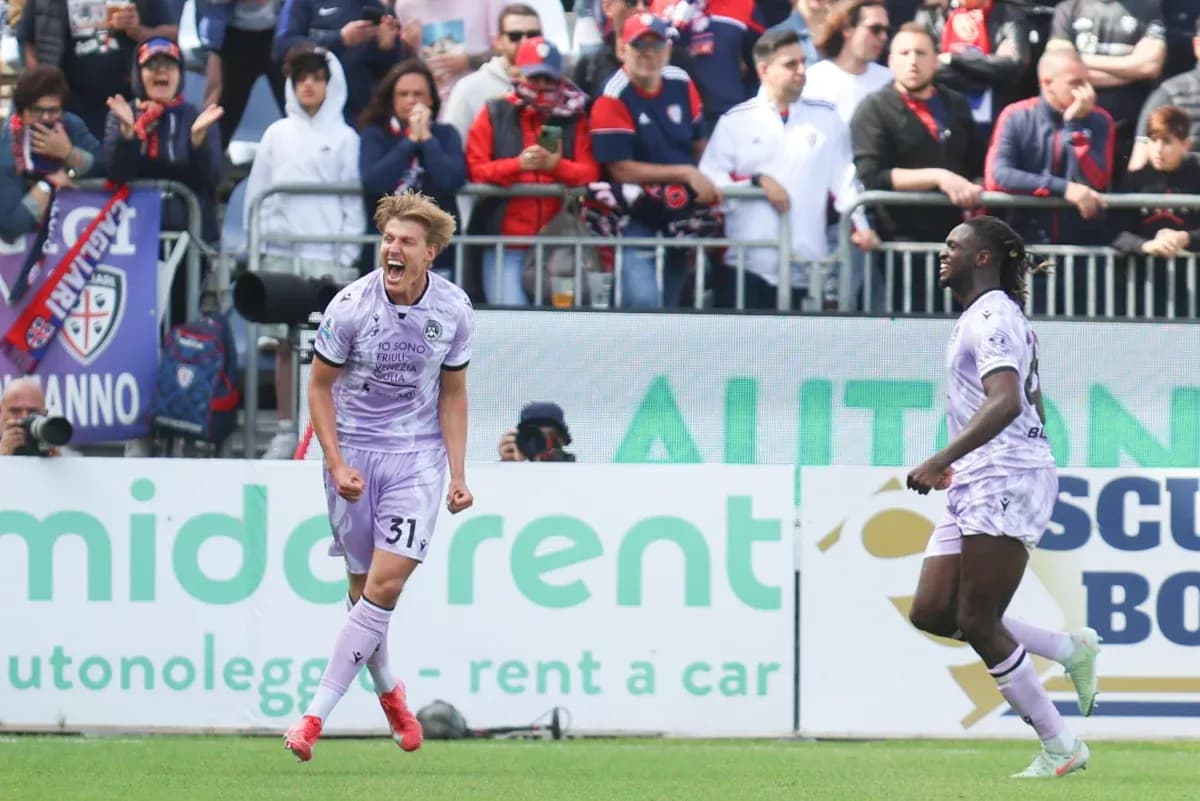
Cagliari’s 2–0 home defeat to Udinese at the Unipol Domus was a study in contrasting efficiency. In a Serie A Round 36 fixture where Fabio Pisacane’s side controlled territory and tempo for long spells, Kosta Runjaic’s visitors absorbed pressure in a compact 3-5-2 and struck decisively in transition. Cagliari generated more volume and possession, but Udinese’s superior shot quality, vertical runs from midfield, and ruthlessly executed counters decided a match that remained goalless until the 56th minute before being killed off in second-half stoppage time.
The disciplinary and key-event sequence underpinned the tactical story. At 34', a VAR intervention cancelled a Cagliari penalty initially awarded for an incident involving Michel Adopo, removing what could have been a turning point for the hosts. The first card arrived at 44':
- 44' Kingsley Ehizibue (Udinese) — Off the ball foul
Cagliari’s only booking came early in the second half:
- 53' Zé Pedro (Cagliari) — Foul
As Udinese began to lean into their counter-attacking plan, fresh legs were introduced at 55', with L. Miller (IN) coming on for J. Piotrowski (OUT) and N. Bertola (IN) for B. Mlacic (OUT), reinforcing central stability and defensive depth. The breakthrough followed almost immediately: at 56', A. Buksa finished a transition move for Udinese, assisted by H. Kamara, exploiting space behind Cagliari’s advanced wing-backs.
Pisacane responded at 62', shifting his wing dynamics: G. Zappa (IN) came on for M. Palestra (OUT), and I. Sulemana (IN) replaced J. Pedro (OUT), signalling a move towards more midfield energy and wider attacking lanes. Udinese then rotated their front line to keep the counter threat live: at 65', K. Davis (IN) came on for A. Buksa (OUT). Cagliari’s chase intensified with A. Albarracin (IN) for M. Folorunsho (OUT) at 73', but Udinese doubled down on fresh running and defensive work at 78', introducing I. Gueye (IN) for N. Zaniolo (OUT) and J. Arizala (IN) for K. Ehizibue (OUT).
Cagliari’s late push saw A. Belotti (IN) for M. Adopo (OUT) and Y. Trepy (IN) for A. Obert (OUT) at 88', effectively morphing the 5-3-2 into a more aggressive, striker-heavy shape. Tension rose in added time, reflected in Udinese’s second booking:
- 90+2' Keinan Davis (Udinese) — Argument
Yet, just before that, Udinese had already sealed the result: at 90', I. Gueye scored the second, assisted by K. Davis, another transition strike that punished Cagliari’s stretched rest-defense.
Tactical Analysis
Tactically, Cagliari’s 5-3-2 under Fabio Pisacane was built on high possession and territorial dominance. With 63% of the ball, 537 total passes and an 86% accuracy rate, they controlled circulation. The back five, anchored by E. Caprile in goal and a line of M. Palestra, Zé Pedro, A. Dossena, J. Rodriguez and A. Obert, pushed high to compress the pitch. The midfield trio of M. Adopo, G. Gaetano and M. Folorunsho sought to create overloads between Udinese’s lines, while S. Esposito and P. Mendy offered depth and link play.
However, the structure had a recurring flaw: when the wing-backs advanced, Cagliari’s rest-defense often became a flat three that struggled against direct runs from Udinese’s forwards and wide midfielders. The shot profile tells the story: Cagliari produced 22 total shots (5 on target, 11 off, 6 blocked), but many came from crowded zones or suboptimal angles, reflected in an xG of 1.41. Their box occupation (15 shots inside the area) was high, but Udinese’s compact 3-5-2—T. Kristensen, O. Solet and initially B. Mlacic as the back three—protected the central corridor and forced speculative attempts.
Udinese’s plan under Kosta Runjaic was clear: concede possession, compress space centrally, and break with precision. With only 37% possession and 331 passes at 76% accuracy, they were not interested in long settled spells. Instead, their 3-5-2 relied on a disciplined block, with H. Kamara and Kingsley Ehizibue providing width and transition outlets, and J. Karlstrom and J. Piotrowski (later L. Miller) screening in front of the back three. A. Atta’s positioning between lines helped link to the front pair of N. Zaniolo and A. Buksa.
The efficiency edge is visible in the numbers: 9 total shots, but 6 on target and an xG of 2.17. Udinese’s chances were fewer but clearly better. Both goals followed the same pattern: regain, rapid vertical progression, and exploiting Cagliari’s high line. For the opener, Kamara’s assist to Buksa came from a quick transition into the space vacated by advanced Cagliari defenders. For the second, I. Gueye—introduced at 78'—capitalised on Cagliari’s late-game structural risk, finishing a move set up by K. Davis, another substitute. Runjaic’s bench management directly influenced the scoreboard.
In goal, E. Caprile registered 4 saves, reflecting Udinese’s high-quality, on-target attempts. His counterpart, M. Okoye, made 3 saves but benefited from Cagliari’s wastefulness and the defensive line’s ability to block and force shots off target. Both keepers posted a goals prevented figure of 0.82, suggesting that finishing quality and defensive positioning, rather than extraordinary goalkeeping, primarily shaped the 2–0 scoreline.
Statistically, the verdict is stark: Cagliari’s Overall Form in this match—high possession, 22 shots, 8 corners, and just 10 fouls—indicates control without incision. Udinese, with 13 fouls and 2 yellow cards to Cagliari’s single booking, played on the edge in duels but remained structurally sound. The Defensive Index tilts towards Udinese: conceding 1.41 xG under sustained pressure while creating 2.17 xG on just 9 shots points to a side that defended compactly, transitioned clinically, and maximised the impact of substitutions. Cagliari’s inability to convert volume into goals, combined with vulnerabilities in transition, ultimately defined a defeat that, on pure territory, felt harsher than the numbers but was fully justified by shot quality and tactical execution.