.svg&w=384&q=75 "Naijagoal logo")
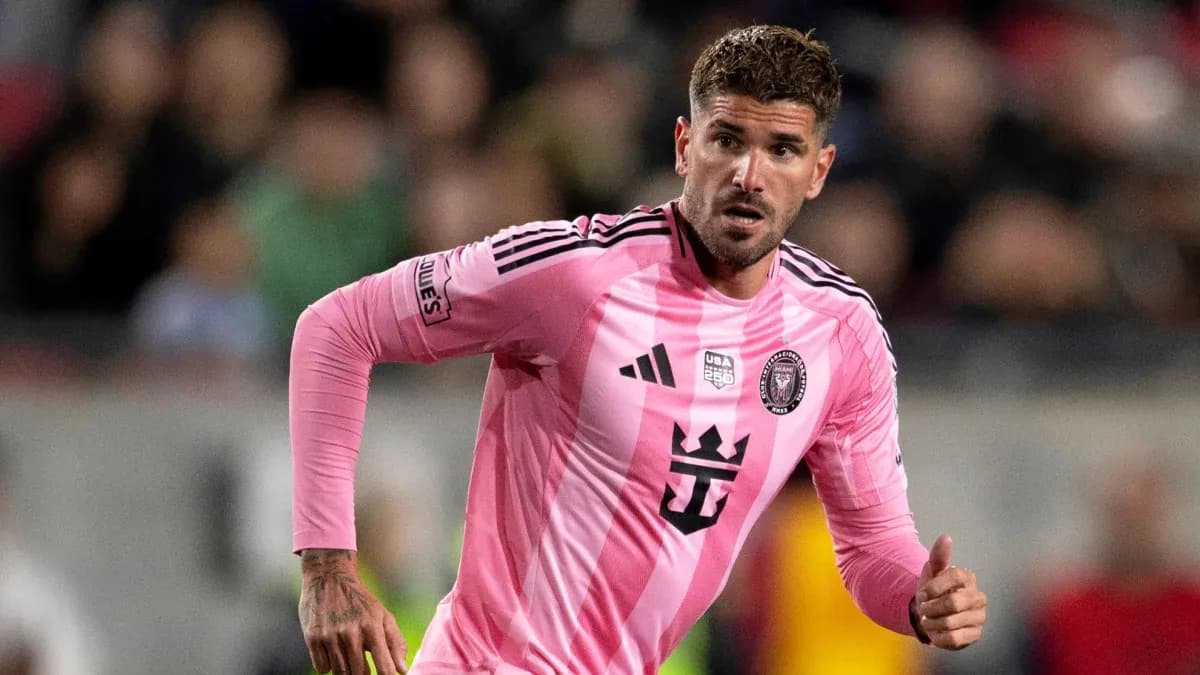

Rodrigo De Paul: From Racing to a $25 Million Fortune in MLS
Rodrigo De Paul has never hidden what he is. In the 90th minute of a tense 1-1 draw between Inter Miami and the Chicago Fire, the whole league saw it again.
A routine flashpoint between Robert Lewandowski and Ian Fray — a tangle, a shove, another shove back — suddenly escalated. De Paul sprinted into the frame, straight at the Polish striker, chest out, eyes locked. There was no hesitation, no calculation. He was there to protect his teammate, and everyone in the stadium knew it.
That raw, visceral reaction said as much about his personality as any interview ever could. It also threw fresh light on the journey that turned him from a scrappy kid at Racing Club into one of the highest‑paid players in MLS.
From Racing to a $25 million fortune
De Paul’s career has been built the hard way, step by step, over more than a decade across four countries. Celebrity Net Worth estimates his fortune at around $25 million — not an official balance sheet, but a snapshot of what 11 years of salaries, bonuses and endorsement deals in Argentina, Spain, Italy and the United States can do for a player who never stops running.
The clearest window into his current earning power sits in Miami. Figures published by the MLS Players Association list De Paul on a base salary of $7.57 million, with approximately $9.69 million in guaranteed annual compensation for 2026. In a league that increasingly attracts global stars, that number matters. It makes him the third‑highest‑paid player in MLS, behind only Lionel Messi and Son Heung-min.
He did not arrive at that level overnight. His path was long and, at times, winding.
He came through at Racing Club, broke into the first team, and earned his move to Europe with Valencia. It did not all click in Spain. His real rebirth came in Italy, where five seasons with Udinese turned him into one of Serie A’s most complete midfielders. Atlético Madrid then stepped in, paying around €35 million to sign him in 2021.
Four years later, Inter Miami moved to bring him into Messi’s orbit again, spending roughly €14.5 million to secure him permanently. Those transfer fees went to the clubs, not directly into De Paul’s bank account, but the pattern is clear: each deal, each rising figure, strengthened his market value and his leverage at the negotiating table.
Capology estimates that De Paul has earned close to $29.9 million in gross base salary across his career, not counting bonuses, image rights or commercial deals. The real number, once everything is included, is higher — how much higher, nobody outside his inner circle truly knows.
The money you can’t quite measure
On top of club wages, De Paul’s role with Argentina has brought both glory and more income, even if the exact numbers remain locked away.
FIFA awarded the Argentine federation $42 million for winning the 2022 World Cup. The governing body never revealed how that money was divided among the squad. The same goes for the bonuses tied to Argentina’s Copa América triumphs in 2021 and 2024. No verified figures exist, which makes any attempt to count those dollars guesswork.
What is clear is the value of what he did on the pitch. While Lewandowski has stacked up Champions League medals, Bundesliga titles and scoring charts without ever lifting a major trophy for Poland, De Paul built a different kind of legacy.
He became the relentless midfielder at Messi’s side. Two Copa América titles. The 2022 World Cup. A player defined by his willingness to run, tackle, argue, and shield the stars around him. The scene against Chicago — charging at Lewandowski after a teammate was shoved — fit perfectly with that identity.
Family, ink and life after Europe
Behind the footballer and the finances sits a family story that Argentina knows almost as well as his playing résumé.
De Paul is the youngest of three sons born to Mónica Ferrarotti and Roberto De Paul. He has two children, Francesca and Bautista, from his former relationship with Camila Homs. At times, his private life has filled just as many headlines back home as his performances for club and country.
His European chapter lasted around 11 years, from his move to Valencia in 2014 to his departure from Atlético Madrid to join Inter Miami in 2025. Those years shaped him as a player and as a public figure. Away from the pitch, he grew into a visible personality: fashion-conscious, heavily tattooed, always camera-ready.
One piece of ink stands above the rest. On his neck, De Paul carries the date of Argentina’s 2022 World Cup triumph — a permanent stamp of the night that changed his career, his status and, ultimately, his earning power.
Now he is in Miami, on a huge contract, in a league still growing into its global ambitions, throwing himself into late-game confrontations to defend teammates. The money, the trophies, the tattoos all tell part of the story.
The rest is written in moments like that clash with Lewandowski — the kind that show why clubs keep paying for a midfielder who refuses to stand aside.