.svg&w=384&q=75 "Naijagoal logo")

Real Sociedad vs Atletico Madrid: A Tactical Dissection of the 3–0 Defeat
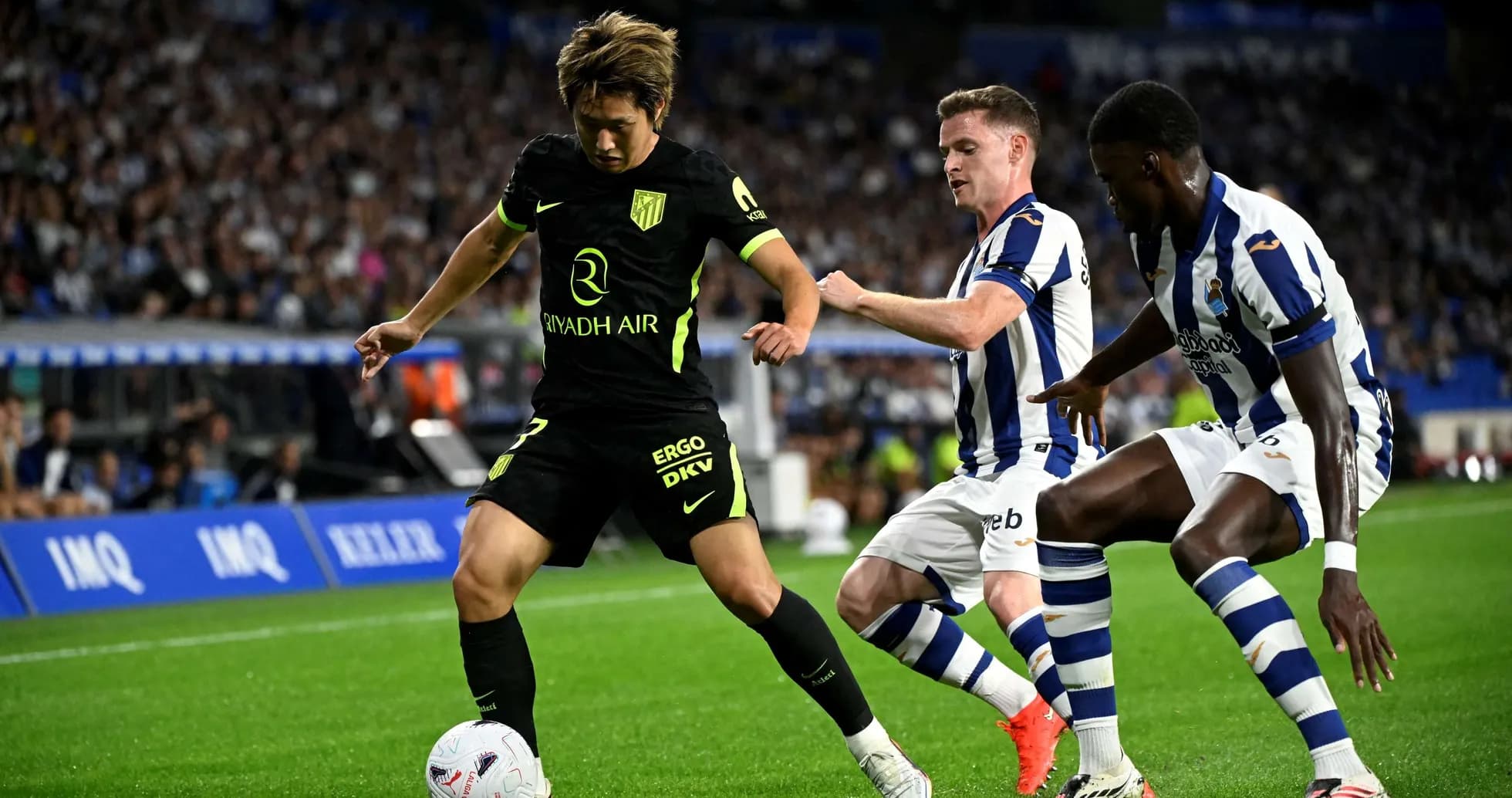
Under the Basque night sky at Reale Arena, this was supposed to be a measuring-stick evening for Real Sociedad. Instead, it became a brutal reminder of the gap that still exists to the league’s elite, as Atletico Madrid arrived with a new tactical skin and left with a 3–0 win that felt as controlled as it was ruthless.
I. The Big Picture – Two Paths Crossing
Heading into this game, Real Sociedad were 12th in La Liga with 7 points from 6 matches, their overall goal difference already a worrying -5 (6 scored, 11 conceded). At home they had been cautious to a fault: 1 win, 1 draw, 1 defeat, only 2 goals scored and 4 conceded, averaging just 0.7 goals for and 1.3 against per home match. The Reale Arena, usually a fortress, had felt more like a laboratory for a side still searching for balance.
Atletico Madrid arrived as a more convincing unit. Fifth in the table with 10 points from 5 matches, they had scored 10 and conceded 6 overall, a positive goal difference of 4 built on a consistent attacking output of 2.0 goals per match both at home and on their travels. Away from home they had already won twice in three outings, with 6 scored and 4 conceded, and an away defensive average of just 1.3 goals against.
This fixture, in the early stretch of the Regular Season - 5, pitted a Real Sociedad side still calibrating a 4-2-3-1 under P. Matarazzo against a shape-shifting Atletico under D. Simeone, who opted for a 3-4-2-1 that looked as modern as it was menacing.
II. Tactical Voids – Absences and Fault Lines
Real Sociedad entered the night with structural absences in key defensive zones. Jon Martín, one of La Liga’s most notable red-card recipients this season, was suspended after his dismissal; his profile – 366 minutes of solid distribution and 8 tackles – had been an important part of building from the back. I. Zubeldia and A. Odriozola were also unavailable, leaving Matarazzo to lean on Luken Beitia and M. Sarr as the central defensive axis, flanked by Sergio Gómez and J. Aramburu.
The double pivot of Y. Herrera and Carlos Soler was designed to offer bite and progression, but it carried risk. Herrera, already top of the league’s yellow-card charts with 3 bookings and 8 fouls committed, embodies Real Sociedad’s disciplinary edge. The team’s season-long card profile shows yellow peaks spread through the middle phases of matches – 21.43% of yellows in each of the 16–30, 46–60, and 61–75 minute windows – and a red-card spike between 61–75 minutes at 100%. This is a side that tends to fray as the tempo rises after half-time.
Atletico’s own disciplinary record is more controlled but not spotless. Their yellows cluster between 31–45 and 46–60 minutes (22.22% in each window), and they carry a late-game red risk, with a sending-off in the 76–90 bracket. Robin Le Normand, who has already seen red this season and conceded a penalty, started on the bench, a reminder of the combustible edge Simeone can call upon.
Injury-wise, Atletico were without J. Alvarez, P. Barrios and A. Sorloth, trimming their rotation but not the spine. The starting XI still carried both control and incision.
III. Key Matchups – Hunter vs Shield, Engine vs Enforcer
The most intriguing subplot came in the “Hunter vs Shield” duel: Atletico’s attacking unit, powered by league top-scorer candidate Álex Baena and the relentless G. Simeone, against a Real Sociedad defence that had conceded 11 goals overall and 7 on their travels, but even at home had already allowed 4 in just 3 matches.
Baena arrived with 3 goals and 1 assist in 298 minutes, averaging a shot volume and creative output that marks him as a high-impact second-line threat: 8 shots, 4 on target, 10 key passes, and a pass accuracy of 84%. Operating in one of the two pockets behind A. Lookman, Baena’s role was to find the seams between Herrera/Soler and the back four, exploiting Real Sociedad’s tendency to lose duels in transition.
Alongside him, G. Simeone brought a different profile: 2 goals, 1 assist, 52 duels contested and 27 won. Stationed nominally as a right-sided midfielder in the 3-4-2-1, he functioned as an aggressive shuttler – part wing-back, part forward – tasked with pinning Sergio Gómez and dragging Sarr or Beitia into wide channels. His 11 tackles and 2 blocked shots this season underline how he doubles as both hunter and auxiliary shield.
On the other side, Real Sociedad’s offensive hopes rested heavily on Luka Sučić and Mikel Oyarzabal. Sučić, with 2 goals from midfield and 13 shots (5 on target), is their most vertical threat between the lines, while Oyarzabal’s 2 assists and 6 key passes make him the connector. But they were running into a defensive structure anchored by Dávid Hancko, one of the league’s standout defenders so far: 361 completed passes at 90% accuracy, 5 tackles, 3 successful blocks, 8 interceptions and 21 duels won from 30. Hancko’s calm on the ball and aggression without it allowed Atletico to hold a high line and compress the space that Sučić and Oyarzabal needed.
In the engine room, Marcos Llorente and M. Hjulmand squared off against Herrera and Soler. Herrera’s 51 duels and 9 tackles this season show his appetite for the fight, but his 3 yellow cards and presence on both the yellow and red disciplinary lists also made him a potential liability against Atletico’s swirling rotations. Llorente’s capacity to break lines with and without the ball tilted that duel in Atletico’s favour, especially once Real Sociedad were forced to chase.
IV. Statistical Prognosis – Control, Punishment, and the 3–0 Reality
The numbers painted a worrying pre-match picture for the hosts. Overall, Real Sociedad were averaging just 1.0 goals for and 1.8 against per match, with only 1 clean sheet and 3 matches in which they failed to score. Atletico, by contrast, came in with 2.0 goals scored and 1.2 conceded on average, 2 clean sheets, and only one blank in front of goal.
Overlay that with the disciplinary timing: Real Sociedad’s tendency to collect cards and even reds in the middle third of the second half intersected neatly with Atletico’s habit of sustaining pressure through the 31–75 minute band, where their yellow-card distribution (22.22% between 31–45 and 46–60, plus 11.11% between 61–75) reflects a team that plays on the edge but in control.
The 3–0 full-time scoreline felt like the logical extension of those trends. Atletico’s 3-4-2-1 maximised their strengths: Jan Oblak’s authority behind a back three led by Hancko, wing activity from Marc Pubill and Álex Grimaldo to stretch Real Sociedad’s back four, and dual creators Baena and Lee Kang-In feeding Lookman. Real Sociedad’s 4-2-3-1, by contrast, never quite solved the spacing between their double pivot and their centre-backs, and without Martín or Zubeldia, the back line lacked both experience and bite.
Following this result, Real Sociedad’s defensive concerns deepen and their already fragile home aura takes another dent. Atletico Madrid, meanwhile, reinforce their identity as a side that can now marry Simeone’s traditional defensive steel with a more expansive, multi-layered attack – a combination that, on nights like this in San Sebastian, looks brutally efficient.