.svg&w=384&q=75 "Naijagoal logo")

Atlético Madrid vs Real Madrid: A Tactical Derby Triumph
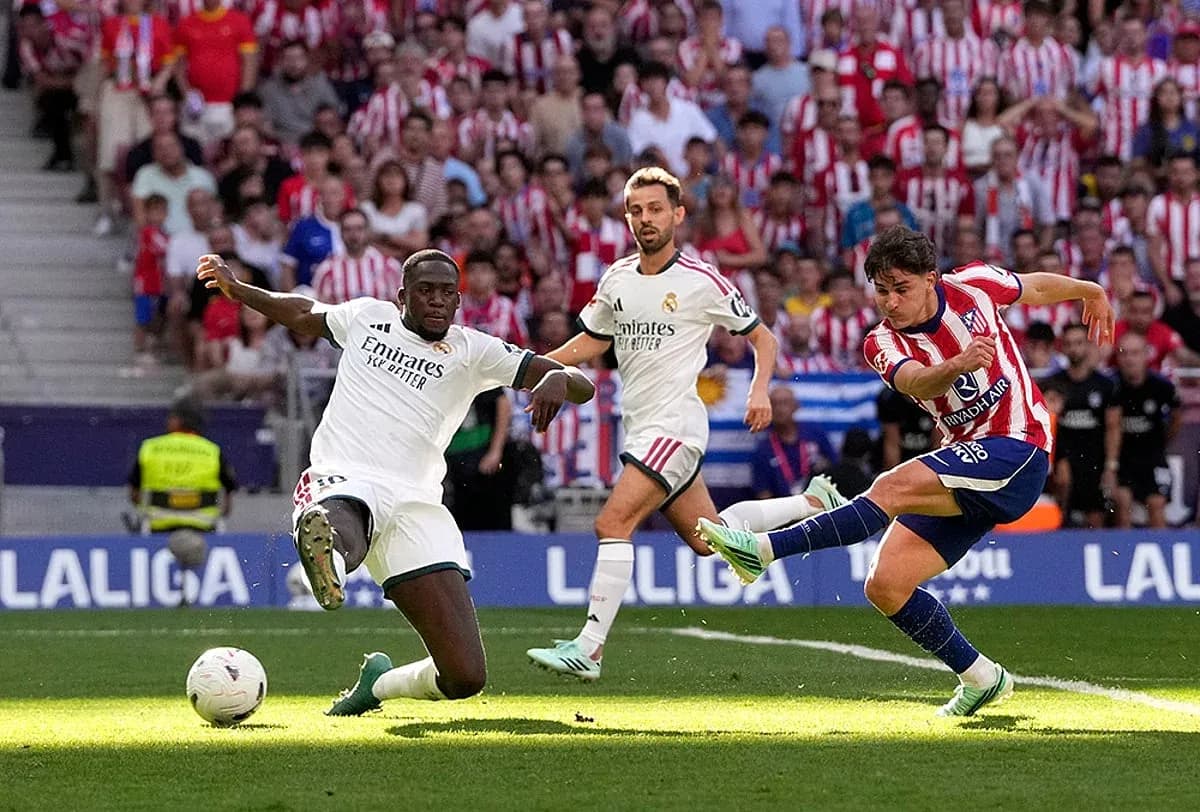
Under the Riyadh Air Metropolitano lights, this was an Atlético Madrid performance that felt both familiar and subtly reimagined. A 2–1 win over Real Madrid in La Liga’s “Regular Season - 7” did more than tilt a derby; it underlined why Atlético sit 2nd with 16 points and a goal difference of 9, and why this version of Diego Simeone’s side is as much about control and craft as it is about chaos and bite.
I. The Big Picture – Two Identities Collide
Heading into this game, Atlético’s season profile was clear: at home they had played 4 league matches, winning 3 and drawing 1, scoring 10 and conceding 3. An average of 2.5 home goals for and 0.8 against painted the Metropolitano as a fortress with a sharper attacking edge than in many past iterations.
Real Madrid arrived 4th in the table with 15 points and a goal difference of 10. Their overall record across 7 matches – 5 wins and 2 defeats, 18 goals for and 8 against – showed a side that could overwhelm opponents, particularly at home, where they averaged 4.0 goals. Away, however, the picture was more human: 4 matches, 2 wins and 2 defeats, with 6 goals scored and 6 conceded, an away average of 1.5 goals for and 1.5 against.
The formations told their own story. Atlético set up in a 4‑4‑2, but not the flat, purely reactive version of old. J. Oblak anchored a back four of Marc Pubill, C. Romero, D. Hancko and Álex Grimaldo. In front, a midfield line of G. Simeone, Marcos Llorente, J. Cardoso and Álex Baena supported a mobile front pair of Lee Kang‑In and J. David. This was a side built to spring quickly but also to pass through pressure.
Real Madrid’s 4‑2‑3‑1 under José Mourinho was predictably star‑studded: T. Courtois behind a defence of D. Dumfries, I. Konaté, D. Huijsen and Marc Cucurella; a double pivot of F. Valverde and A. Tchouaméni; an attacking trio of A. Güler, J. Bellingham and Vinícius Júnior behind Kylian Mbappé. It was a shape designed to dominate the ball and punish transitions.
II. Tactical Voids – Absences and Discipline
Both sides entered with notable absentees that shaped the match’s texture. Atlético were without P. Barrios and A. Sorloth, both ruled out with muscle injuries. Barrios’ absence removed a press‑resistant option in midfield, increasing the onus on Cardoso and Baena to link phases. Sorloth’s physical presence would have offered a more direct reference point; instead, Simeone leaned into mobility and combination play with Lee and David.
Real Madrid’s missing trio was even more structural: Eder Militao (hamstring), F. Mendy (hip) and Rodrygo (knee) all sidelined. Without Militao and Mendy, Mourinho had to lean on the relatively young D. Huijsen and the more attacking profile of Cucurella at left‑back. That back line, while technically strong, lacked some of the pure defensive security and recovery pace Militao brings, especially in open‑field duels.
Season‑long disciplinary trends also framed the risk profiles. Atlético’s yellow cards skewed heavily toward the 31–45 minute window, with 30.77% of their cautions arriving just before half‑time, and another 23.08% between 46–60 minutes. Their only red card of the campaign had come late, in the 76–90 minute range. Real Madrid, by contrast, showed a spread of yellows, with 25.00% between 46–60 and another 25.00% between 61–75, and a single red card arriving between 46–60. D. Huijsen himself carried that red in his seasonal profile, while I. Konaté’s 3 yellow cards in 6 appearances underlined his role as the last‑ditch firefighter.
In a derby where emotional temperature rises around the interval and into the hour mark, these patterns mattered: they hinted at periods when both sides might be vulnerable to losing control.
III. Key Matchups – Hunters and Shields
The headline duel was obvious: Kylian Mbappé as the hunter against an Atlético defence that had conceded just 7 goals in total across 7 league matches, averaging 1.0 against overall and only 0.8 at home. Mbappé entered this fixture as La Liga’s most ruthless finisher: 7 goals and 2 assists in 7 appearances, a 7.96 average rating, 32 shots with 22 on target, and 39 dribbles attempted with 23 successful. He had also won and taken responsibility from the spot, scoring 1 penalty but missing 1 – a reminder that even his ruthlessness has human edges.
Against him stood a back line calibrated for duels and positioning rather than raw speed. D. Hancko’s reading of the game and C. Romero’s aggression were supported by Grimaldo’s intelligence on the left and Pubill’s energy on the right. Behind them, Oblak’s command of the box remained central to Atlético’s low concession rate.
If Mbappé was Real Madrid’s spear, J. Bellingham was the engine and compass. With 3 goals, 2 assists, 17 key passes and a 90% pass accuracy, Bellingham’s ability to arrive late in the box and dictate tempo between the lines made him the quintessential “engine room” presence. He had also won 51 of 83 duels and completed 19 of 28 dribbles, making him a constant problem in crowded central zones.
Opposite him, Atlético’s answer was collective rather than individual. J. Cardoso’s screening, Baena’s work rate and Llorente’s two‑way running formed a triangle built to compress Bellingham’s space. Baena, with 4 goals, 1 assist and 14 key passes, was not just a shuttler but Atlético’s own creative nerve, capable of turning Madrid’s press against them. G. Simeone, with 2 goals, 2 assists and 15 tackles, embodied the hybrid role: part winger, part second striker, part auxiliary full‑back.
On the flanks, Vinícius Júnior’s duel with Pubill and Romero was another pressure point. Vinícius came into the game with 1 goal, 3 assists, 23 fouls drawn and 29 dribbles attempted, 12 successful. His capacity to destabilise wide zones was balanced by his own disciplinary tightrope – 2 yellow cards already this season.
Up front for Atlético, J. David’s efficiency loomed large despite a smaller sample size: 3 goals and 1 assist in just 160 minutes, with 6 shots on target from 10 attempts and 6 key passes. His movement between Konaté and Huijsen, especially attacking the channels behind Cucurella and Dumfries, was always likely to be decisive. With Konaté already on 3 yellow cards this season and prone to committing fouls (8 so far), David’s sharp changes of direction and combination play with Lee threatened to pull Real’s central defenders into uncomfortable, card‑risking decisions.
IV. Statistical Verdict – Why Atlético’s Plan Prevailed
From a season‑long statistical lens, this result felt like the logical expression of each side’s tendencies. Atlético’s overall scoring average of 2.3 goals per match and their defensive average of 1.0 conceded aligned almost perfectly with a 2–1 home win. Real Madrid’s away profile – 1.5 goals scored and 1.5 conceded on their travels – also fits the pattern of a narrow, high‑stakes contest rather than an away rout.
Real’s penalty record this season, with 2 taken and only 1 scored, the other missed, hinted at small inefficiencies in key moments. In a match of fine margins, those details matter. Atlético, by contrast, had been flawless from the spot this campaign, scoring both of their 2 penalties.
Defensively, Real’s away average of 1.5 goals conceded per match suggested that even with Courtois in goal and a technically gifted back four, they were not impermeable when forced to defend running back toward their own box. Atlético’s front unit, with David’s clinical edge, Baena’s late arrivals and G. Simeone’s relentless pressing, exploited precisely that vulnerability.
In midfield, Bellingham, Valverde and Tchouaméni carried the technical superiority, but Atlético’s structure diluted their impact. Cardoso’s positional discipline and Llorente’s capacity to surge past Madrid’s double pivot turned transitions into weapons. Each time Madrid committed numbers forward, they risked exposing Konaté and Huijsen to direct runs, a scenario made more delicate by Konaté’s disciplinary profile and Huijsen’s prior red card this season.
In the end, the 2–1 scoreline was not just a derby triumph; it was a crystallisation of two tactical identities. Atlético, with their blend of old‑school defensive rigour and a new‑look attacking fluidity, maximised home advantage and season‑long trends. Real Madrid, brilliant in bursts but less secure away from the Bernabéu, met an opponent perfectly calibrated to absorb their stars’ threat and punish their structural cracks.