.svg&w=384&q=75 "Naijagoal logo")
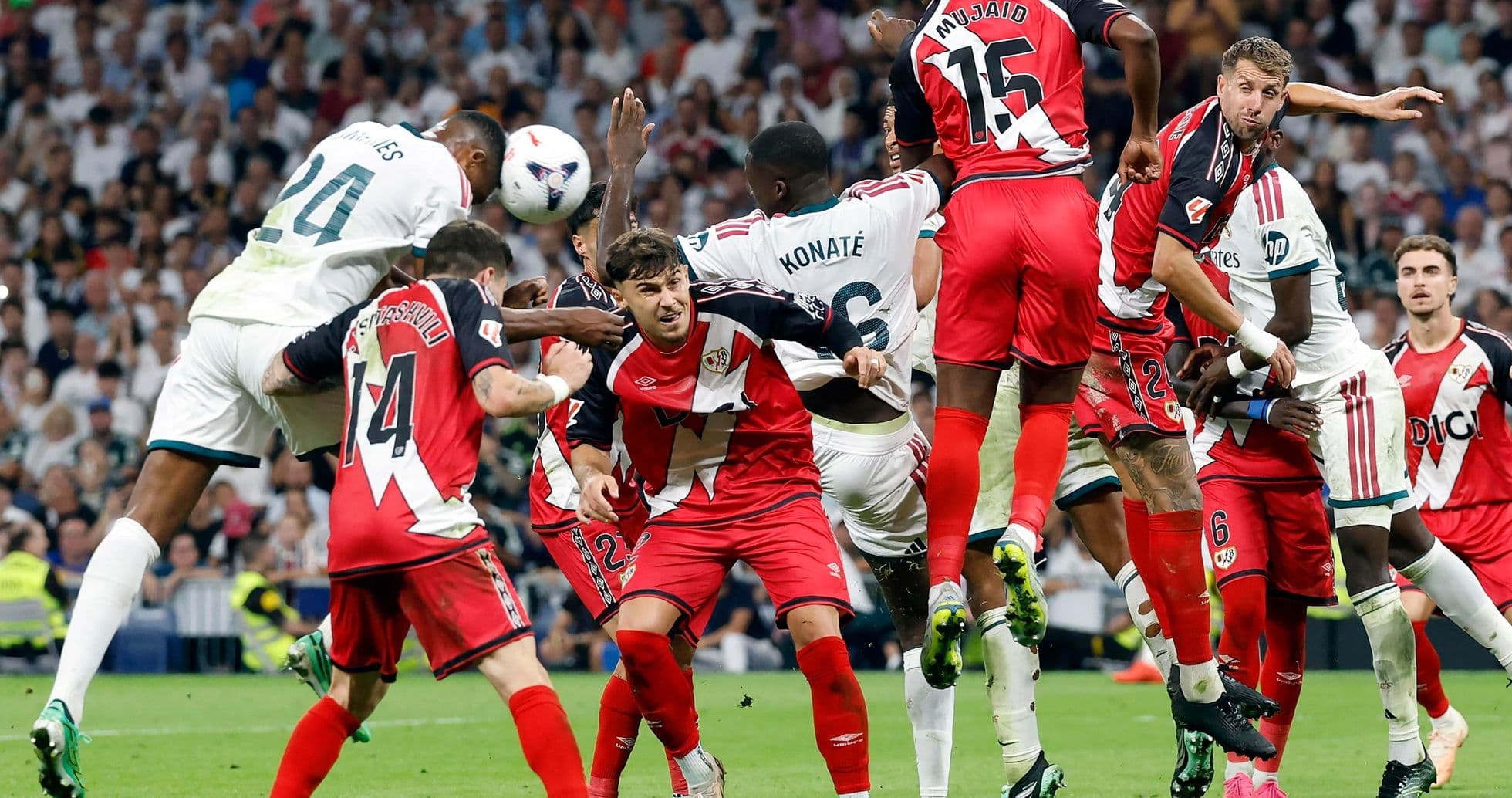

Real Madrid Dominates Rayo Vallecano in 4-1 Victory
Under the lights of the Bernabéu, this was Real Madrid at full attacking tilt, a 4-1 dismantling of Rayo Vallecano that underlined why the league table already has a familiar look. Following this result, Real Madrid sit 2nd in La Liga with 12 points from 5 matches, their overall goal difference a commanding +10 from 14 goals scored and 4 conceded. Rayo, by contrast, remain in 16th with 4 points, their overall goal difference a worrying -6 after 8 goals scored and 14 allowed.
I. The Big Picture – Systems and Seasonal DNA
Both sides lined up in a 4-2-3-1, but the shared shape masked very different identities.
Real Madrid’s season profile had already been clear: at home they are devastating. Heading into this game they averaged 4.0 goals scored at home and only 0.7 conceded, winning all 3 home matches. The Bernabéu has become an attacking laboratory, and José Mourinho leaned into that, starting Kylian Mbappé up front with a three of Vinícius Júnior, Jude Bellingham and Y. Diomande behind him, supported by a double pivot of F. Valverde and Bernardo Silva.
Rayo Vallecano arrived as a side in flux. On their travels they had lost all 3 away games, scoring 4 but conceding 11, an away average of 1.3 goals for and 3.7 against. Beñat San José has alternated between several systems this season, but here he trusted the 4-2-3-1 that has been his most-used structure, with Sergio Camello leading the line, Unai López and Pedro Díaz in central areas, and Álvaro García offering width.
The scoreline – 3-0 at half-time, 4-1 at full-time – reflected the structural gulf between a settled, ruthless home side and an away team still searching for defensive stability.
II. Tactical Voids – Absences and Discipline
Both squads were notably stretched in key zones.
Real Madrid were without Eder Militao (hamstring), F. Mendy (hip) and Rodrygo (knee). The absence of Militao and Mendy forced a reconfiguration of the back line: I. Konaté and A. Rüdiger formed the central pairing, with D. Dumfries on the right and Álvaro Fernández on the left. This back four, protected by Valverde and Bernardo Silva, allowed Madrid to maintain a high line and aggressive rest-defense, trusting Konaté and Rüdiger’s athleticism to manage transitions.
Rayo’s list of absentees was longer and more destabilising. A. Batalla, Luiz Felipe, R. Nteka, I. Palazon and J. Vertrouwd were all missing through injury, while Fran Pérez and Jorge de Frutos were suspended after red cards. That stripped San José of both defensive depth and attacking variety. Without Fran Pérez and de Frutos, Rayo lacked two of their more combative and direct wide options, placing even more creative and transitional burden on Álvaro García and G. Tsitaishvili.
Disciplinary trends framed the risk for Rayo. Across the season, 40.00% of their yellow cards have arrived between 61-75 minutes and 30.00% between 76-90, with 50.00% of their red cards in the 76-90 window. This is a side that tends to fray late. Real Madrid, by contrast, spread their yellow cards more evenly, with 25.00% in 46-60, 25.00% in 61-75 and another 25.00% between 91-105 minutes, suggesting controlled aggression rather than chaos.
III. Key Matchups – Hunter vs Shield, and the Engine Room
Hunter vs Shield: Mbappé and Camello vs fragile defences
Heading into this game, Real Madrid’s overall attacking numbers were elite: 2.8 goals per match in total, with Mbappé as the spearhead. Mbappé came in with 6 league goals and 1 assist in 5 appearances, an 8.14 rating, 29 shots (21 on target) and 20 successful dribbles from 31 attempts. He is both volume shooter and high-efficiency dribbler, and his presence amplifies the creative output of Bellingham and Vinícius.
Rayo’s overall defensive record was ill-suited to contain him: 14 goals conceded in 5 matches, an overall average of 2.8 per game, and 11 of those shipped away from home. Their worst away defeat so far, 5-2, foreshadowed exactly the sort of high-line punishment Mbappé thrives on. The duel between Mbappé and the central pairing of F. Lejeune and P. Ciss was always likely to decide the tone; with Madrid three up by the interval, the hunter clearly won.
At the other end, Sergio Camello arrived as La Liga’s top scorer with 6 goals and 1 assist in 5 matches, converting 10 of 11 shots on target and drawing 11 fouls. He is Rayo’s reference point in every phase: pressing trigger, outlet on the break, and penalty-box finisher. His challenge was to find space against a Real defence that, overall, had conceded just 4 goals in 5 matches, with only 2 allowed at home. Konaté and Rüdiger were able to crowd him, and with Rayo’s creative cast depleted, Camello’s threat was largely isolated.
Engine Room: Bellingham and Bernardo vs Unai López and Pedro Díaz
The midfield battle was the true tactical hinge. Jude Bellingham entered with 3 goals and 2 assists, 12 key passes and a 91% passing accuracy. He is Madrid’s tempo-setter and late-arriving runner in the box, and in this 4-2-3-1 he operated between the lines, constantly probing the half-spaces around Rayo’s double pivot.
Behind him, Bernardo Silva and Valverde formed a hybrid engine: Bernardo as the metronome, Valverde as the vertical carrier. This trio’s passing security – Bellingham at 91% accuracy, Bernardo’s usual low-risk distribution, Valverde’s capacity to break lines – allowed Madrid to sustain waves of pressure.
For Rayo, Unai López is both playmaker and enforcer. He came into the match with 3 assists, 12 key passes, 11 tackles and 4 blocks, a profile that blends creativity with defensive work. But the structural demand on him and Pedro Díaz was enormous: screen Mbappé’s dropping movements, track Bellingham, and still launch transitions. Under constant pressure, López’s influence was inevitably diluted, and Rayo struggled to connect their first and second lines.
IV. Statistical Prognosis – xG Logic Without xG Numbers
Even without explicit xG data, the season metrics sketch a clear probabilistic picture.
Real Madrid’s home average of 4.0 goals scored and 0.7 conceded, combined with Rayo’s away average of 1.3 scored and 3.7 conceded, pointed towards a multi-goal home win. Madrid’s penalty profile added a note of volatility: they had been awarded 2 penalties overall, scoring 1 and missing 1, so they are far from automatic from the spot. But with such volume of box entries, the likelihood of high-quality chances was always significant.
Rayo’s inability to keep a clean sheet anywhere – 0 clean sheets overall – and their tendency to concede heavily on their travels suggested that even a strong individual performance from Camello would not be enough to tilt the balance.
Following this result, the narrative is reinforced rather than rewritten. Real Madrid look every inch a Champions League-level juggernaut domestically, their 4-2-3-1 humming around Mbappé, Bellingham and Vinícius. Rayo Vallecano, meanwhile, remain a dangerous but unbalanced side: capable of scoring, led by a prolific Camello and a creative Unai López, yet undermined by a porous away defence and a long list of absentees that strips them of margin for error.