.svg&w=384&q=75 "Naijagoal logo")

Pochettino’s USMNT Wins Group Despite Defeat to Turkiye
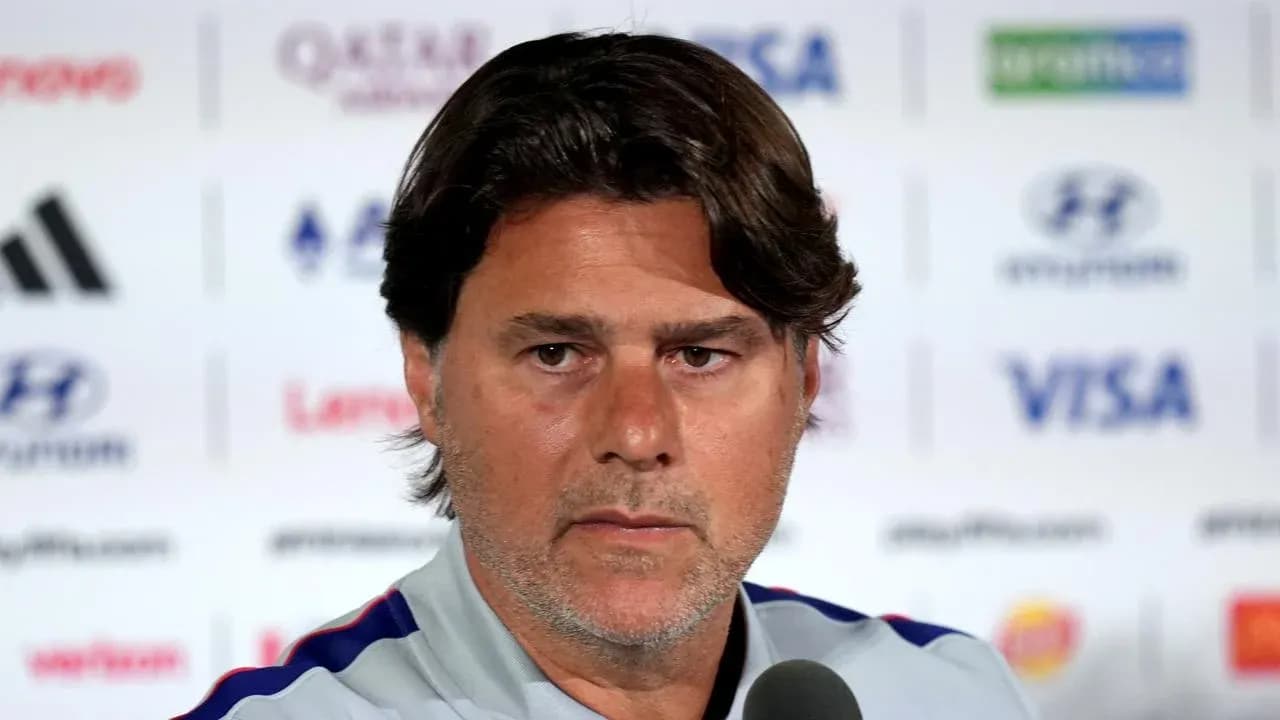
Mauricio Pochettino stalked into his press conference still burning from a 3-2 defeat to Turkiye – and discovered something that annoyed him even more than the loss.
Not one reporter had congratulated him or his players for winning the group.
“The mood is like we [are going] home tonight and Turkey is staying,” the United States Men’s National Team coach snapped. “I need to [remind] you and everyone that we won the group. Sorry guys, we won.”
He wasn’t smiling when he said it.
Group winners, but no party
The questions came thick and fast about momentum, about a late collapse, about whether the USMNT had just stumbled into the knockout rounds. Pochettino bristled at the suggestion that Thursday’s defeat had undermined anything.
From his perspective, the job was already done. The United States had wrapped up top spot before a ball was kicked against Turkiye. The coach had said pre-match he wanted another win, but his team sheet told the real story: nine changes from the XI that beat Australia, a side built from reserves rather than regulars.
This was rotation with a purpose, not surrender. Protect legs, manage minutes, keep stars fresh for when it really counts.
There was a historical carrot dangling in front of them. A victory would have made this US side the first in program history to win all three group games at a World Cup. For many, that sounded like a landmark worth chasing.
Pochettino was having none of it.
“Making history is winning the World Cup,” he said. “It’s not winning three matches only within the World Cup. I don’t really understand. It’s a little bit petty if you will — you’re thinking a little too small. You’re telling me you could make history — what does it mean to win three matches if you lose the next one?”
For him, the obsession with a perfect group stage misses the point. The only record that matters is the one written on the final day.
A warning from Germany, a boost from Pulisic
To reinforce his view, Pochettino pointed across the schedule. Germany, already through, had sent out a strong side just hours earlier – and still lost to a desperate Ecuador team fighting for survival.
The message was clear: there is no safe way to tiptoe through a World Cup group. Rotate and you risk rhythm. Go full strength and you risk fatigue, injury, and still no guarantees.
He insisted the United States had handled the situation well despite the defeat, highlighting one major positive: the return of Christian Pulisic.
The AC Milan forward, the team’s brightest attacking star, had missed the win over Australia with a calf problem after being forced off at half-time in the victory against Paraguay. Getting him back on the pitch before the knockouts, even in a losing effort, counted as a quiet victory inside the camp.
The outside noise focused on a missed chance at perfection. Pochettino’s gaze stayed fixed on the bigger prize.
Arnold’s Iraq thrashed, future unclear
While the US looked ahead, Graham Arnold’s World Cup was already over – and brutally so.
Iraq’s campaign ended with a 5-0 hammering by Senegal, a result that left the former Socceroos boss lamenting a “stupid red card” and a trail of self-inflicted wounds.
Rebin Sulaka’s dismissal in the 13th minute, with Senegal already 1-0 up, killed any hope of a contest.
“The early red card was mentally tough on the players. Against a team like Senegal, mistakes are always punished,” Arnold said.
He then delivered a stark statistic to his squad. Iraq conceded 11 goals at this World Cup; nine of them, he said, came directly from individual errors.
“I told the players after the match that we conceded 11 goals at this World Cup, and nine came from our own individual mistakes. We have to learn from that.
“In the second half, we ran out of energy. I also made changes to give more players the chance to experience representing Iraq at the World Cup, and I take full responsibility for that.”
Group I, with France and Norway alongside Senegal, was always going to be unforgiving. Iraq were the last team to qualify, forced through an intercontinental playoff to reach their first World Cup in 40 years. Simply arriving on this stage represented a major step.
“Everyone in Iraq should be proud of the fact that we made it here and we performed very well in two out of the three games,” Arnold told reporters in Toronto.
Whether he will be the man to lead the next chapter is another question. His contract expires at the end of the tournament, and the looming prospect of facing his old team, the Socceroos, in the group stage of next year’s Asian Cup in Saudi Arabia hangs in the air.
“I’ve just asked them to leave it until after World Cup, then we can have a chat then,” he said.
For now, Iraq’s campaign ends with both progress and pain etched into the scorelines.
Panama fire up, even in elimination
Panama, already out, brought a different kind of edge to their final days.
On Friday, Cecilio Waterman and Jose Luis Rodriguez clashed in training ahead of Saturday’s game against England in New Jersey. Tempers flared. Voices rose. Teammates stepped in.
Coach Thomas Christiansen didn’t mind one bit.
“What happened today in training, this is a normal situation,” said the Danish-born former Spain international. “I would’ve liked to see these situations more often, that means the team is alive. They are willing to do a good effort... to be in the first XI for the game.
“If this happens another time, it’s a good sign that they are alive,” he added.
Panama have never taken a point at a World Cup. Five games, five defeats, including that 6-1 dismantling by England in 2018. Now they face the same opponent again, already eliminated after back-to-back 1-0 losses to Ghana and Croatia in Group L.
“Now we have the last game against England, a good way to finish a World Cup if it goes our way,” said Christiansen, who has been in charge since 2020 but is out of contract after the competition.
“I think we have made changes from the last time they faced Panama eight years ago, but we need to show it tomorrow.
“It will be a tough one but I’m thinking that the team will be able to compete and do a good game.”
A point, even a narrow defeat with pride intact, would mark a tangible step from the chaos of 2018. Panama’s players clearly still care enough to fight each other for a place. Now they must show they can fight England.
France win big amid off-field emotion
France, meanwhile, delivered a 4-1 win over Norway on the pitch while dealing with a deeply personal blow off it.
Coach Didier Deschamps was absent, having returned home to attend his mother’s funeral. His players wanted to show their support in the most visible way possible, planning to wear black armbands in his honour.
The French Football Federation (FFF) revealed that FIFA rejected the request.
There was further confusion around a planned minute’s silence. It had initially been briefed that it would be held for Deschamps’s mother, but the FFF later clarified that it was instead dedicated to the victims of the Venezuelan earthquake.
FIFA have been contacted by the media but are yet to respond.
France still produced a commanding performance without their coach on the touchline, a result that spoke of a squad used to pressure and turmoil. The tribute they really wanted to make, though, was denied before a ball was kicked.
On a day when group winners were booed for losing, underdogs were crushed by their own errors, eliminated sides fought in training, and a giant played through grief, the World Cup again showed its true nature: ruthless, emotional, and utterly unforgiving.
The knockouts will only sharpen that edge.